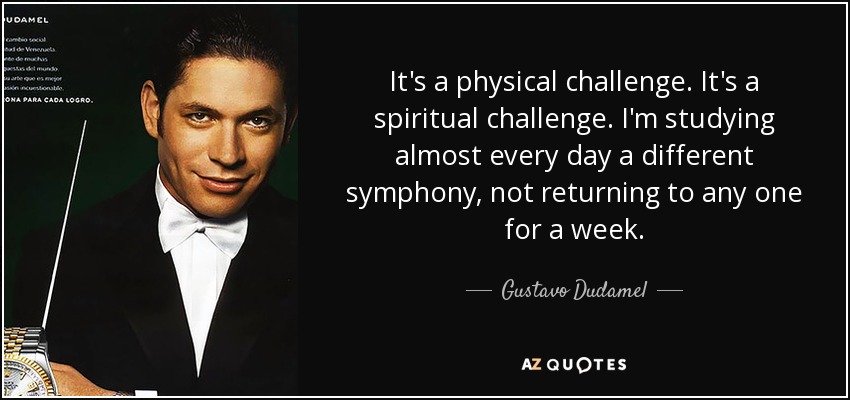
It's a physical challenge. It's a spiritual challenge. I'm studying almost every day a different symphony, not returning to any one for a week.
A friend gave me a CD of the 'Pathetique' Symphony as a Christmas present. I went home, and I put on the CD expecting to listen to Tchaikovsky. But it started 'ta ta ta taaa.' It was too long for me. I didn't understand it at first, but then I fell in love, in love, in love.
I don't see myself necessarily having a burning desire to write a symphony.
Aristotle ... imputed this symphony of the heavens ... this music of the spheres to Pythagorus. ... But Pythagoras alone of mortals is said to have heard this harmony ... If our hearts were as pure, as chaste, as snowy as Pythagoras' was, our ears would resound and be filled with that supremely lovely music of the wheeling stars.
The creation of art is not the fulfillment of a need but the creation of a need. The world never needed Beethoven's Fifth Symphony until he created it. Now we could not live without it.
I was always the kid on scholarship, I was a soloist with my company, I'd been working with the symphony since I was 14.
We in the "developed" world seem to have many auditory strategies that insulate us from the presence of silence, simplicity, and solitude. When I return to Western culture after time in desert, mountain or forest, I discover how we have filled our world with a multiplicity of noises, a symphony of forgetfulness that keeps our won thoughts and realizations, feelings and intuitions out of audible range.
The critics say that Shostakovich's Fourth Symphony has no form. They are wrong; it has the form of Shostakovich's Fourth Symphony.
Mozart, striving for perfection, wrote the same symphony forty-one times. In his case, it worked. He wrote a perfect symphony.
When we look at a painting, or hear a symphony, or read a book, and feel more Named, then, for us, that work is a work of Christian art. But to look at a work of art and then to make a judgment as to whether or not it is art, and whether or not it is Christian, is presumptuous. It is something we cannot know in any conclusive way. We can know only if it speaks within our own hearts, and leads us to living more deeply with Christ in God.
The truth is . . . that the great artists of the world are never puritans, and seldom ever ordinarily respectable. No virtuous man - that is, virtuous in the YMCA sense - has ever painted a picture worth looking at, or written a symphony worth hearing, or a book worth reading, and it is highly improbable that the thing has ever been done by a virtuous woman.
From the glow of enthusiasm I let the melody escape. I pursue it. Breathless I catch up with it. It flies again, it disappears, it plunges into a chaos of diverse emotions. I catch it again, I seize it, I embrace it with delight... I multiply it by modulations, and at last I triumph in the first theme. There is the whole symphony.
A thing of orchestrated hell-a terrible symphony of light and flame.
Lord # God , I praise Your Holy Name. Let every beat of my heart be a note of love in the symphony of my life.
So long as we refuse to include lottery tickets among the symphonies, or medical bulletins among the overtures, we must refrain from treating the emotions as an aesthetic monopoly of music in general or a certain piece of music in particular.
Moving pictures need sound as much as Beethoven symphonies need lyrics.
I would advise my young colleagues, the composers of symphonies, to drop in sometimes at the kindergarten, too. It is there that it is decided whether there will be anybody to understand their works in twenty years time.
I planted some jokes in my wedding. Like, the organizers asked me to select music. So when I approached wife at the ceremony, they played the second movement from Shostakovich's 10th Symphony, which is usually known as the "portrait of Stalin." And then when we embraced, the music that they played was Schubert's "Death and the Maiden." I enjoyed this in a childish way! But marriage was all a nightmare and so on and so on.
There are no accidents in Nature. Every motion of the constantly shifting bodies in the world is timed to the occasion for some definite, fore-ordered end. The flowers blossom in obedience to the same law that marks the course of constellations, and the song of a bird is the echo of a universal symphony. Nature is one, and to me the greatest delight of observation and study is to discover new unities in this all-embracing and eternal harmony.
Empires fall, ids explode, great symphonies are written, and behind all of it is a single instinct that demands satisfaction.
I would think, of all the saxophones, the baritone would be the most logical instrument if anybody was adding a voice to the symphony orchestra.
Our biological rhythms are the symphony of the cosmos.
The point of recapitulation in the first movement of the Ninth [Symphony of Beethoven] is one of the most horrifying moments in music, as the carefully prepared cadence is frustrated, damming up energy which finally explodes in the throttling, murderous rage of a rapist incapable of attaining release.
Why are numbers beautiful? It’s like asking why is Beethoven’s Ninth Symphony beautiful. If you don’t see why, someone can’t tell you. I know numbers are beautiful. If they aren’t beautiful, nothing is.
Although, I am proud of all my Symphonies as they all have something special to say, my particular favourite is the Fifth. As the great Mahler expert Donald Mitchell said that if Mahler had written another Symphony, it would have been my Fifth!
Follow AzQuotes on Facebook, Twitter and Google+. Every day we present the best quotes! Improve yourself, find your inspiration, share with friends
or simply: