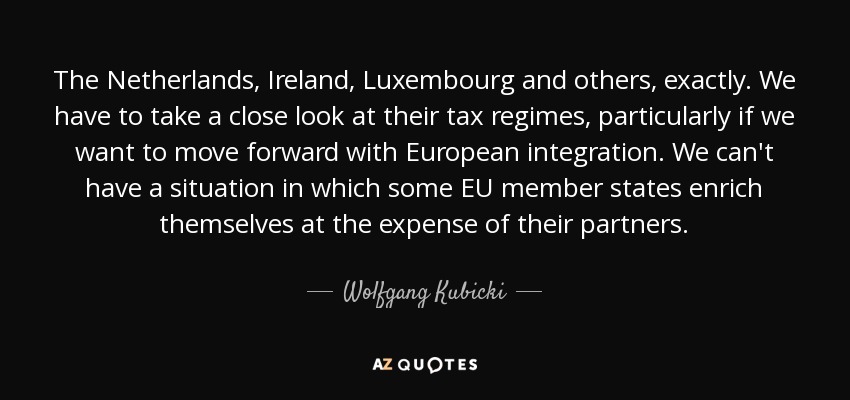
The Netherlands, Ireland, Luxembourg and others, exactly. We have to take a close look at their tax regimes, particularly if we want to move forward with European integration. We can't have a situation in which some EU member states enrich themselves at the expense of their partners.
Working with Republicans in Congress we've already signed 88 pieces of legislation. We get no credit. They always say, well, President Trump really needs this tax bill because he hasn't passed any legislation. Well, so far in 10 months we've passed more during this period of time than any other president in the history of our country and the second - let's call runner up - is Harry Truman, was second.
I don't know a lot of writers, even writers who have been on the bestseller list for a few weeks, or writers who have gotten movie options, who can live on just their writing income. Once you break it down to the years it took to write the book, place it, promote it, and you pay the agent, pay the taxes, the annual income is not enough to live on comfortably. I do not have a starving artist inclination. I'm from the working class. I don't feel creative unless I feel like my house is going to be there and I'm going to be fed. I can't worry about money and write. Maybe some people can.
Canadians expect their government to make sure we're helping the people who need the help and growing the economy, and that's exactly what we're committed to do, not just with our historic investments into infrastructure that are going to create jobs while the others are focusing on cuts, but by lowering payroll taxes, by lowering EI premiums from $1.88 to $1.65, at the same time as we make sure that the people who need help are getting the help that they paid into, because they're not getting it under Stephen Harper. That's what Canadians expect from their government.
One measure for promoting both stability and fairness across financial market segments is a small sales tax on all financial transactions.
Now it is unambiguously clear that trickle-down economics does not work. But what does that mean? That means we have to structure our economic policies to make sure that we have shared prosperity. And you don't do that by giving a tax cut to the big winners and raising taxes on those who have not done very well. Your economic policy has to respond to the way our economic system has been working.
The failure of the first Barack Obama administration to really deliver on a new War on Poverty and a new language to explain these societal challenges in some ways provided the fuel that led to the Occupy Movement a few years later. And, while Occupy was a somewhat transitory phenomenon, many of the activist groups that emerged during this period are still out there, and still working on reshaping the political debate around taxes, around welfare, around government assistance to the poor, around debt relief for students, and so on.
Big cities like New York are thriving, economically, culturally, in terms of real estate values, and by a slew of other measures. Yet, at the same time, much of the country has been utterly hollowed out. In California, where I live, affluent coastal cities such as San Francisco and the Silicon Valley hubs have lower than national average unemployment, higher wages, higher tax bases. Meanwhile, there are inland counties in California where there's still nearly 20 percent unemployment.
To really tackle poverty, politicians, activists, academics will all have to think outside their boxes, will have to start developing much more integrated approaches to these problems. And a large part of this will involve working out ways to push for living wages. Partly this will involve re-empowering the union movement, which has been massively weakened in recent decades. Partly it will involve a willingness to restructure tax codes to penalize companies that don't provide basic benefits and decent wages to employees.
As a country, Americans have to find a way to keep our cities solvent. If large numbers of cities no longer have the necessary tax base, we have to find federal methods to intervene. If we don't, there's a risk of dozens of cities simply being left to their bankrupt fates - and I can't see how that serves anybody's interests in the long run.
I'm not shy about stating my opinion on political issues, so I can state my opinion, which is, on this one, Premier Notley's right. Because cap and trade systems have not been shown to work. And if you want to price carbon, then I would listen to the CEO of Suncor, who suggests a clean, transparent carbon tax makes a bunch more sense than a cap and trade system that just creates jobs for traders. I - I kind of agree with that.
Trump himself stands to benefit dramatically from the tax cuts. One of the things they're cutting is the alternative minimum tax. Last time we have tax returns for him was in 2005, where he paid about $31 million because of the alternative minimum tax. He won't have to pay that, if this tax bill goes through. So, not only is he reordering our constitutional democracy, he is personally enriching himself - which is not new, because, of course, he's done it ever since he swore an oath to become president of the United States.
Look, rich people already have a lot of money. There's literally trillions of dollars in cash held by corporations, their stock valuations at an all-time high. They do not need a tax cut to do anything. They can invest now, if they wanted to. They don't want to, because they can make more money just by mergers and stock buybacks and stuff like that. So, this is really just sort of a travesty.
Liberals in the US don't have great passions about Margaret Thatcher. Conservatives do. For all the worship that Ronald Reagan elicits in conservative circles in the US, I would venture that Thatcher did far more to reshape British society than Reagan did here. When I moved to Britain, the utilities were state-run. By the time I left, most of that was privatized. Thatcher had broken the miners' union, all but crushed the Labour Party, cut back the welfare state, even flirted with a poll tax. In the circles I ran in, Reagan was mocked as a childish dolt. Thatcher was despised.
I can't tell you how many times at the breakfast table my dad would curse out Franklin Roosevelt. I love my father. He was an intelligent man, but he really didn't like regulations of the Roosevelt style, or the taxes. He was an Dwight Eisenhower man. And that's what Eisenhower did, committed to breaking down the program.
I'd like to help struggling homeowners who can't pay their mortgages, I'd like to invest in our crumbling infrastructure, I'd like to reform the tax system so multimillionaires can't pretend their earnings are capital gains and pay at the rate of 15 percent. I'd like to make public higher education free, and pay for it with a small transfer tax on all financial transactions. I'd like to do much more - a new new deal for Americans. But Republicans are blocking me at every point.
I think the Republican tax law is so bad that it almost guarantees a Republican victory, precisely because it's so bad. The seeming irony is that it's so bad that it enables the Democratic Party to think, "A-ha, all we have to do is be the lesser evil.
Donald Trump is the least unpopular thing about today's Republican Party. I mean, the idea that a Mitch McConnell or a Paul Ryan could say, "Let's toss Trump overboard and return to our program of plutocratic politics, health care removal, massive income tax cuts for the affluent, deregulation of finance" - if they cut loose from Donald Trump, it's like, you know, storm in channel, continent cut off. If they cut loose from him, they are much likelier to sink.
When Donald Trump was running for office, he made big claims about how he was going to fight for workers. But since in office, he has consistently moved against the interest of workers in favor of corporate interests - by rolling back important worker protections, advancing nominees to key posts with records of enabling the exploitation of working people, pushing for the dismantling of Obamacare, fighting for a tax bill that overwhelmingly favors the wealthy, etc.
The issue should not be, we're going to tax you more to give you the services you want. The issue is, this is the wealthiest country in the world, and we're going to use that wealth to service human needs and not to service a military industrial corporate surveillance state.
Politicians like to talk about the income tax when they talk about overtaxing the rich, but the income tax is just one part of the total tax system. There are sales taxes, Medicare taxes, social security taxes, unemployment taxes, gasoline taxes, excise taxes - and when you add up all of those taxes [many of which are quite regressive], and then you look at how they affect the rich and the poor, you essentially end up with a system in which the best off 20 percent of Americans pay one percentage point more of their income than the worst off 20 percent of Americans.
When you say the tax system benefits the rich, there are a lot of people who respond, "That can't be true, look at the rate of tax. The people who are rich pay a higher rate than you or I." Well, yeah, but if you don't have to pay taxes on a lot of your income, then your real tax rate is a lot lower. And if you're allowed to pay your taxes thirty years from now instead of today then you're a lot better off. People need to have a sophisticated understanding of how the system works to appreciate that the posted tax rate really has very little to do with the taxes people pay.
I dislike paying taxes as much as anyone, but yes, taxes are the price of civilization. There is no America without taxes. The question isn't, "Do we want to have taxes?" The question is, "How heavy is the burden, and who bears that burden"?
You, as a wage earner have to pay your taxes every year on your income for that year. So if you have a one-time windfall that makes you a lot money you could end up in the top tax bracket. But if you're a corporation you are allowed to reach forward with deferrals for years. Over a 45 to 50 year period, you can balance out the winning years and the losing years in such a way that you pay very little tax, especially considering the time-value of the money.
Americans deserve a new tax code for a new era of American prosperity.
Follow AzQuotes on Facebook, Twitter and Google+. Every day we present the best quotes! Improve yourself, find your inspiration, share with friends
or simply: