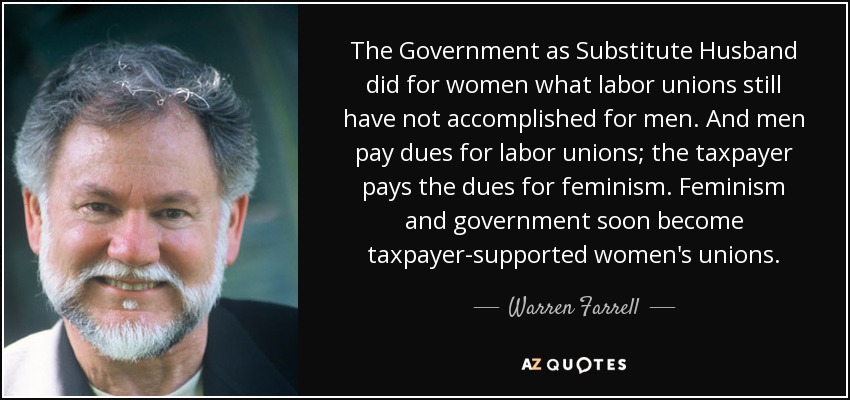
The Government as Substitute Husband did for women what labor unions still have not accomplished for men. And men pay dues for labor unions; the taxpayer pays the dues for feminism. Feminism and government soon become taxpayer-supported women's unions.
The persistent advocates of contraceptive-style sex education have become more and more resourceful in using taxpayer funds to impose their casual-sex attitudes and explicit-sex instruction on other people's children.
The trouble is that privacy is at once essential to, and in tension with, both freedom and security. A cabinet minister who keeps his mistress in satin sheets at the French taxpayer's expense cannot justly object when the press exposes his misuse of public funds. Our freedom to scrutinise the conduct of public figures trumps that minister's claim to privacy. The question is: where and how do we draw the line between a genuine public interest and that which is merely what interests the public?
Unfortunately, throughout the housing crisis we've seen innocent homeowners who have been victims of shady mortgage lenders and unscrupulous individuals who have used a down market to line their own pockets at the expense of others. This bill is designed to send a message by revising our laws to ensure criminals are brought to justice and that law enforcement has the tools to uncover these fraudulent schemes and go after the bad actors. Criminals should be put on notice that ripping off homeowners and taxpayers won't be tolerated.
Medicare is paid for by the American taxpayer. Medicare belongs to you. Medicare is for seniors, who many of them are on fixed income, to lift them out of poverty.
Many politicians and pundits claim that the credit crunch and high mortgage foreclosure rate is an example of market failure and want government to step in to bail out creditors and borrowers at the expense of taxpayers who prudently managed their affairs. These financial problems are not market failures but government failure. ... The credit crunch and foreclosure problems are failures of government policy.
President Obama has shown he has the vision to support average consumers and taxpayers.
We can't constantly explain to our voters that taxpayers have to be on the hook for certain risks, rather than those who make a lot of money taking those risks.
There is a fundamental difference, however, between asking to be permitted to keep a vegetative relative on costly machinery, and asking the taxpayers or society as a whole to pay for such machinery.
By the standards of honest, if unorthodox, accounting, government workers don't pay taxes, but are paid out of taxes. In other words, they pay taxes out of money confiscated from taxpayers, who, in turn, pay taxes twice: on their own income and on the income of members of the bureaucracy. At the very least, this should disqualify state workers from voting.
It is absolutely outrageous that a spin doctor for Labor's NBN Co is being paid $450,000 per annum by Australian taxpayers to promote a company that generates no revenue, has no customers and provides no services to anybody
The Treasury plan is a disgrace: a bailout of reckless bankers, lenders and investors that provides little direct debt relief to borrowers and financially stressed households and that will come at a very high cost to the US taxpayer. And the plan does nothing to resolve the severe stress in money markets and interbank markets that are now close to a systemic meltdown.
Remember, politicians get votes by promising everything to everyone, always at the expense of some other invisible taxpayers.
Somebodys paying the corporations that destroyed Iraq and the corporations that are rebuilding it. Theyre getting paid by the American taxpayer in both cases. So we pay them to destroy the country, and then we pay them to rebuild it. Those are gifts from U.S. taxpayer to U.S. corporations.
The pre-war empire had been sufficiently informal and sufficiently cheap for Parliament to claim authority over it without having to concern itself too much about what this authority entailed. The post-war empire necessitated a much greater investment in administrative machinery and military force. This build-up of control had to be paid for, either by British taxpayers or by their colonists.
People who are government servants, public servants, should not be paid more than the taxpayers who are paying for it.
The important thing is that the principles that Senator Obama outlined originally are now embraced and taxpayers will be protected.
Was it a good idea to spend taxpayer dollars on electric cars in Finland, or on windmills in China? Was it a good idea to borrow all this money from countries like China and spend it on all these various different interest groups?
When this crisis began, crucial decisions about what would happen to some of the world's biggest companies - companies employing tens of thousands of people and holding trillions of dollars in assets - took place in hurried discussions in the middle of the night. We should not be forced to choose between allowing a company to fall into a rapid and chaotic dissolution or forcing taxpayers to foot the bill.
In business, poor performance leads to bankruptcy or, at a minimum, a restructuring of the company. In American education, failure entitles the bankrupt system to even more taxpayer dollars.
[T]ax cuts are not just something that all taxpayers deserve, but also the best way to curb government spending. It is the best kind of tax reform. If the money never reaches the table, Congress can't gobble it up.
For years President Obama has been saying that no one would lose their healthcare plan. Now the White House has admitted that in fact many people will lose their plans. But there is a way to keep the great coverage you have. Just become a member of Congress. Then the taxpayers pay for the whole thing.
There are some people who seem to think that the way you reduce the cost of living in this country is for the state to spend more and more taxpayers' money. It is as if somehow you measure the compassion of the government by the amount of other people's money it can spend.
Subsidies for the oil, gas and coal industries are projected to cost taxpayers more than $135 billion in the coming decade. At a time when scientists tell us we need to reduce carbon pollution to prevent catastrophic climate change, it is absurd to provide massive subsidies that pad fossil-fuel companies' already enormous profits.
Either the Baby Boomers are not going to have the retirement life that they expect or taxpayers are going to be hit with a tremendously huge bill. Or both.
Follow AzQuotes on Facebook, Twitter and Google+. Every day we present the best quotes! Improve yourself, find your inspiration, share with friends
or simply: