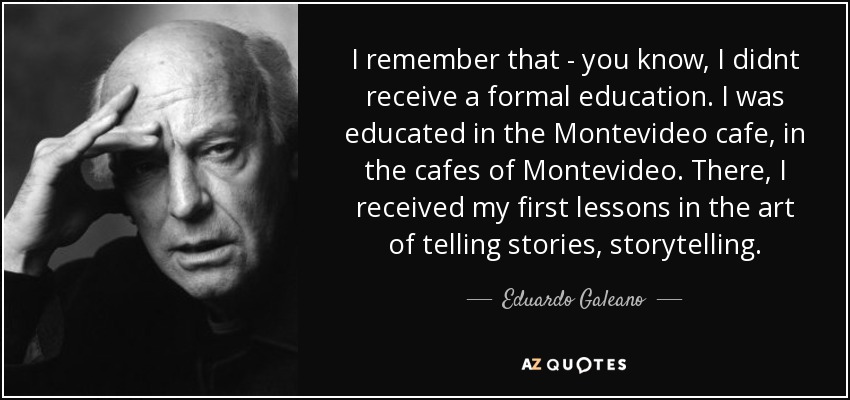
I remember that - you know, I didnt receive a formal education. I was educated in the Montevideo cafe, in the cafes of Montevideo. There, I received my first lessons in the art of telling stories, storytelling.
As you get older and you hopefully battle your own demons, you find other reasons why you want to be an actor. The people that I truly admire do this because they love telling stories and they love the make-believe of the moment and not so much the gratification afterwards.
I really said, 'Okay, this is just the right job for me. This is really what I need to be doing: telling stories through music in lots of different styles of music.'
I aspired to be a writer and then I just started getting acting work. I really didn't have a direct goal, I just knew I wanted to be in this industry telling stories and doing this for a job. I thought my path was going to be as a writer, but I'm pretty happy doing it as an actor.
Nothing's really changed for me over the years. I like telling stories about people with problems. I can't really put it much simpler than that. Relationships are interesting to me. Not just between men and women but fathers and sons, brothers and sisters and friends.
I think television has become such an interesting place for characters and for incredible storytelling. Half of what I watch are television shows that I've become obsessed with. I just think that it's opened up so much, to be such an interesting and creative medium, and so many wonderful directors and actors are moving to television because it is a great medium for telling stories and for creating a character over a long period of time.
I'm not against people just being funny or telling stories. I don't need to delve into the soft, dark core all the time. If it happens, it happens.
I love acting. I love play-acting. I love pretending. I love telling stories so whether they be comedic or serious or whatever, it doesn't really matter to me. I enjoy telling a good story. I have it all in me.
To make movies you just have to want it enough. You have to have the passion for telling stories. You have to get by the love-of-movies aspect. You can't just be a movie fan.
Directing is one of my favourite things to do because I love telling stories and I love working with the individual artists and it's something that I really missed.
I was always storytelling, since I was a child. I remember myself at 10 years old telling stories to my sisters and brother. This is something I did through my adolescence and even through my twenties.
If I had not been successful as a director, then I'm sure I would still be telling stories. I would have continued on 16mm or found a different medium through which to tell them. Maybe they would have been less glamorous than films, but I would continue to tell stories.
I might do a film someday for the collection. I love designing sets and creating environments, in film school and for my own presentations. I love telling stories.
Acting is so much fun. It is a different ball game and I want to concentrate on that at the moment. I'm really passionate about what I do. I love entertainment and telling stories to people and I am very lucky that I am doing what I want to do.
I shot many scenes of Hamburg, albums full of postcard motifs, and I discarded almost all of them. I ride my bike through Hamburg every day. I go shopping here, I go to the doctor - and yet I no longer have the eye for telling stories about this damn city, even though I love it.
I'm always interested in telling stories that have a message because I really do believe that film is so powerful.
As an artist, I am interested in telling stories that haven't been told before, stories that are going to affect people, and also stories that shine light on areas of history that haven't had light shined on them before.
Language is material to shape and mold, not only a transparent or invisible medium for communication, business contracts, or telling stories.
I'm a strong believer in telling stories through a limited but very tight third person point of view. I have used other techniques during my career, like the first person or the omniscient view point, but I actually hate the omniscient viewpoint. None of us have an omniscient viewpoint; we are alone in the universe. We hear what we can hear... we are very limited. If a plane crashes behind you I would see it but you wouldn't. That's the way we perceive the world and I want to put my readers in the head of my characters.
For me, as a documentary filmmaker, I'm interested in telling stories of real people whose experiences tell us something about ourselves or our history, or who we are and our potential.
When you direct your first film, you always start by telling stories that you are familiar with
I really love sort of classical cinema where people were telling stories with very little dialogue, and people were using the camera in a really interesting way.
Data, I think, is one of the most powerful mechanisms for telling stories. I take a huge pile of data and I try to get it to tell stories.
I began telling stories as a volunteer in my daughters' school. But I grew up hearing stories from Cuban and Southern storytellers, and I learned a great deal by just being quiet and listening.
There is no off position on my visual switch, and I don't want one. I love, and always have, telling stories with my camera.
Follow AzQuotes on Facebook, Twitter and Google+. Every day we present the best quotes! Improve yourself, find your inspiration, share with friends
or simply: