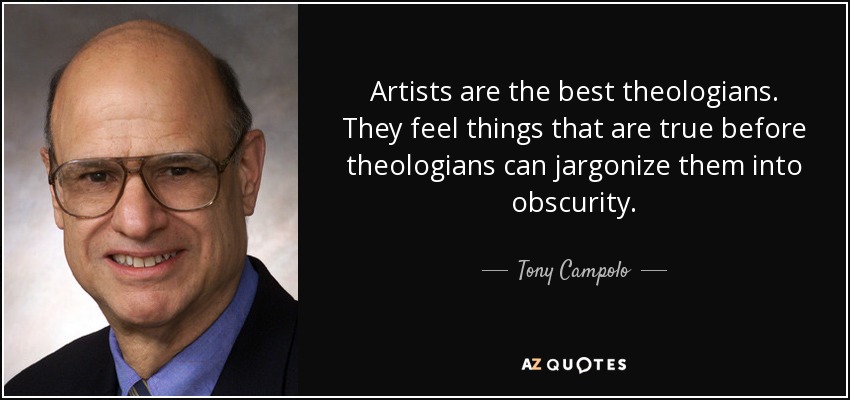
Artists are the best theologians. They feel things that are true before theologians can jargonize them into obscurity.
Theologians have felt no hesitation in founding a system of speculative thought on the teachings of Jesus; and yet Jesus was never an inhabitant of the realm of speculative thought.
In the end theologians are jealous of science, for they are aware that it has greater authority than do their own ways of finding "truth": dogma, authority, and revelation. Science does find truth, faith does not.
I had NO interest in being a theologian, especially not a Christian, as I had been raised by progressive atheists. We bowed down every morning to the golden calf of the New York Times, Noam Chomsky, Hannah Arendt. I tried to get my parents to respect and nourish me, let alone delight in me, so even though I secretly loved and believed in the Divine Something - Goodness, Good Orderly Direction, Gift of Desperation, the Cosmic Muffin - I wasn't ready yet to commit myself to the study of a higher power.
I don't like realism. We already know the real facts about li[fe], most of the basic facts. I'm not interested in repeating what we already know. We know about sex, about violence, about murder, about war. All these things, by the time we're 18, we're up to here. From there on we need interpreters. We need poets. We need philosophers. We need theologians, who take the same basic facts and work with them and help us make do with those facts. Facts alone are not enough. It's interpretation.
Christians believe that God created man, and humanists believe that man invented God. But whichever way you look at it, we're brothers and sisters. Either we're brothers and sisters because we're children of God, or because we've banded together to invent God. So the ethics of the humanist and the ethics of some Christians are very similar. And we don't want to create divisions between humanists and Liberation Theologians, any more than we want between the New Worker and the Trots. It's not helpful.
God cannot suffer - at least not as we do. It has some roots in Greek philosophy: if God is a perfect being, suffering would reduce that perfection, so God cannot suffer. More thoughtful theologians take the phrase in the sense of one of the confessions of faith that talks of God as being "without parts or passions" - he is not physical as we are, and not subject to "passions" in the sense of uncontrollable emotions that can take charge of us at times. God is not "emotional," if that word is used as some kind of weakness.
My goal as a theologian is to move beyond the acquisition of knowledge to its application in real life: in a word, I want to get wisdom.
Theology is never any help; it is searching in a dark cellar at midnight for a black cat that isn't there. Theologians can persuade themselves of anything.
I am for liberty of conscience in its noblest, broadest, and highest sense. But I cannot give liberty of conscience to the pope and his followers, the papists, so long as they tell me, through all their councils, theologians, and canon laws that their conscience orders them to burn my wife, strangle my children, and cut my throat when they find their opportunity.
I think gardening is nearer to godliness than theology. True gardeners are both iconographers and theologians insofar as these activities are the fruit of prayer 'without ceasing.' Likewise, true gardeners never cease to garden, not even in their sleep, because gardening is not just something they do. It is how they live.
Laughter has been implanted in our soul, that the soul may sometime be refreshed.
For the Lord hath in no place forbidden mirth.
We are nowhere forbidden to laugh, or be satisfied with food...or to be delighted with music or to drink wine.
Humor is the foundation of reconciliation.
It is possible to live for the next life and still be merry in this.
A good joke is the closest thing we have to divine revelation.
It is much easier to write a good Times leading article than a good joke in Punch.
What is so funny about us is precisely that we take ourselves too seriously. Laughter is the same and healthy response to the innocent foibles of men; and even to some which are not innocent.
A church is in a bad way when it banishes laughter from the sanctuary and leaves it to the cabaret, the nightclub and the toastmasters.
The only time laughter is wicked is when it is turned against Him Who gave it.
Humor is proof that everything is going to be all right with God nevertheless.
Wherever she was, holy laughter was present to heal and redeem.
Humor, together with irony,forms a safeguard against idolatry.
The experienced pastor will recognize to which situation humor belongs and to which belongs sobriety.
Follow AzQuotes on Facebook, Twitter and Google+. Every day we present the best quotes! Improve yourself, find your inspiration, share with friends
or simply: