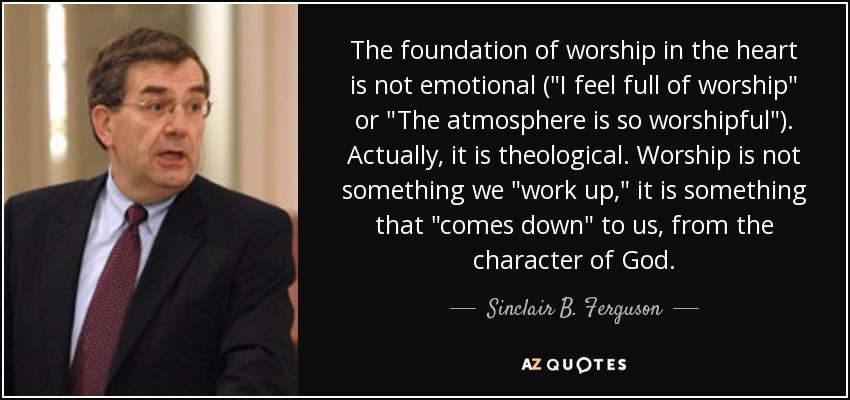
The foundation of worship in the heart is not emotional ("I feel full of worship" or "The atmosphere is so worshipful"). Actually, it is theological. Worship is not something we "work up," it is something that "comes down" to us, from the character of God.
Worship without wonder is lifeless and boring. Many have lost their sense of awe and amazement when it comes to God. Having begun with the arrogant presumption of knowing about God all that one can, they reduce Him to manageable terms and confine Him to a tidy theological box, the dimensions of which conform to their predilections of what a god ought to be and do.
[Albert] Schweitzer thus carved out his own path through the first half of this century, a lonely and learned giant amidst the hordes of noisy and shallow theological pygmies.
Given that sexual orientation is innate and that we are all, in theological terms, children of God, to deny access to some sacraments based on sexuality is as wrong as denying access to some sacraments based on race or gender.
Thus, a vision of the whole gradually grew for me that was nourished by the various experiences and realizations I had encountered along my theological path. I rejoiced to be able to say something of my own, something new and yet completely within the faith of the Church. The feeling of aquiring a theological vision that was ever more clearly my own was the most wonderful experience of those years.
Under the Providence of God, our means of education are the grand machinery by which the 'raw material' of human nature can be worked up into inventors and discoverers, into skilled artisans and scientific farmers, into scholars and jurists, into the founders of benevolent institutions, and the great expounders of ethical and theological science.
In too many churches today, people don't see manifestations of God's power in answer to fervent praying. Instead, they hear arguments about theological issues that few people care about.
I do not believe a person can take two issues from Scripture, those being abortion and gay marriage, and adhere to them as sins, then neglect much of the rest and call himself a fundamentalist or even a conservative. The person who believes the sum of his morality involves gay marriage and abortion alone, and neglects health care and world trade and the environment and loving his neighbor and feeding the poor is, by definition, a theological liberal, because he takes what he wants from Scripture and ignores the rest.
But now it's kind of a given that a 15-year-old would have a record deal and sell a quarter of a million records. No one's expecting her to answer any deep theological questions. And I'll tell you, I was asked some deep theological questions from the git-go.
Extremists often derive their inspiration from literal interpretations of texts that should rightly be read not as Associated Press reports from the ancient world, but as theological and literary enterprises requiring independent intellectual assessment.
God has hardwired me to thoroughly enjoy and be sharpened by good and friendly theological discussion about the gospel.
Knotty theological questions are the least worrying of problems to me. Why? Because they will be resolved in the hereafter, and meanwhile they can be safely shelved.
I want first of all - in fact, as an end to these other desires - to be at peace with myself. I want a singleness of eye, a purity of intention, a central core to my life that will enable me to carry out these obligations and activities as well as I can. I want, in fact - to borrow from the language of the saints - to live 'in grace' as much of the time as possible. I am not using this term in a strictly theological sense. By grace I mean an inner harmony, essentially spiritual, which can be translated into outward harmony.
If someone were to ask whether communications skills or meekness is most important to a marriage, I'd answer meekness, hands down. You can be a superb communicator but still never have the humility to ask, 'Is it I?' Communication skills are no substitute for Christlike attributes. As Dr. Douglas Brinley has observed, 'Without theological perspectives, secular exercises designed to improve our relationship and our communication skills (the common tools of counselors and marriage books) will never work any permanent change in one's heart: they simply develop more clever and skilled fighters!
The Christ within who is our hope of glory is not a matter of theological debate or philosophical speculation. He is not a hobby, a part-time project, a good theme for a book, or a last resort when all human effort fails. He is our life, the most real fact about us. He is the power and wisdom of God dwelling within us.
Theological formation is the gradual and often painful discovery of God's incomprehensibility. You can be competent in many things, but you cannot be competent in God.
In terms of the historical record, I should also point out that there is no account in any ancient source whatsoever about King Herod slaughtering children in or around Bethlehem, or anyplace else. No other author, biblical or otherwise, mentions this event. Is it, like John's account of Jesus' death, a detail made up by Matthew in order to make some kind of theological point?
and while faith based on theological reasoning is today universally engaged in a bitter struggle with doubt and resistance from the prevailing brand of rationalism, it does seem that the naked fundamental experience itself, that primal seizure of mystic insight, stripped of religious concepts, perhaps no longer to be regarded as a religious experience at all, has undergone an immense expansion and now forms the soul of that complex irrationalism that haunts our era like a night bird lost in the dawn.
This much is certain, that we have no theological right to set any sort of limits to the loving-kindness of God which has appeared in Jesus Christ. Our theological duty is to see and understand it as being still greater than we had seen before.
We might be wise to follow the insight of the enraptured heart rather than the more cautious reasoning of the theological mind.
You might tell me that you have been engaging in some deep questioning and theological rethinking.1 You can no longer live with the faith you inherited from your parents or constructed earlier in your life. As you sort through your dogma and doctrine, you’ve found yourself praying less, less thrilled about worship, scripture, or church attendance. You’ve been so focused on sorting and purging your theological theories that you’ve lost track of the spiritual practices that sustain an actual relationship with God. You may even wonder if such a thing is possible for someone like you.
I know the theological answers, but do my blood and my pulse?
See that's where it falls apart for me!" Anne cried. "What sticks in my throat is that God gets the credit but never the blame. I just can't swallow that kind of theological candy. Either God's in charge or he's not.
I wouldn't burden any decent system of faith by participating in it... I'm not agnostic. Just nonpartisan. Theological Switzerland, that's me.
Are they really gods?" "I never worry about theological questions," said Nightingale. "They exist, they have power and they can breach the Queen's peace - that makes them a police matter.
Follow AzQuotes on Facebook, Twitter and Google+. Every day we present the best quotes! Improve yourself, find your inspiration, share with friends
or simply: