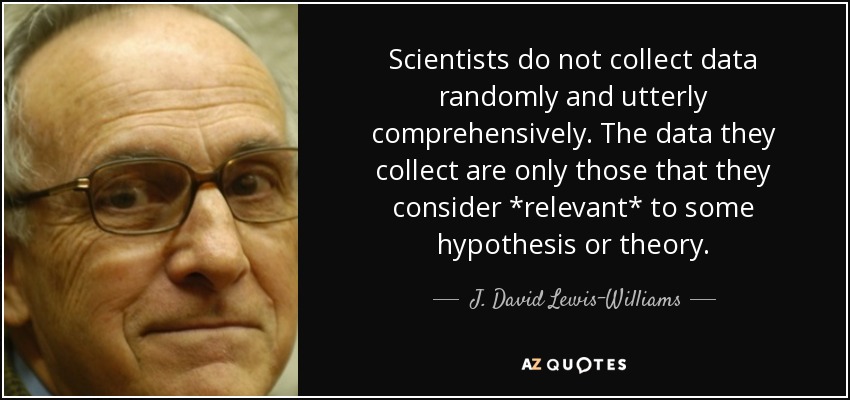
Scientists do not collect data randomly and utterly comprehensively. The data they collect are only those that they consider *relevant* to some hypothesis or theory.
I know of no other country where love of money has such a grip on men's hearts or where stronger scorn is expressed for the theory of permanent equality of property
I cannot think of permanent enmity between man and man, and believing as I do in the theory of reincarnation, I live in the hope that if not in this birth, in some other birth I shall be able to hug all of humanity in friendly embrace.
To me this is the most beautiful, the most satisfactory from a scientific standpoint, the most logical theory of life. For thirty years I have leaned toward the theory of Reincarnation. It seems a most reasonable philosophy and explains many things.
I adopted the theory of reincarnation when I was 26. Genius is experience. Some think to seem that it is a gift or talent, but it is the fruit of long experience in many lives
I adopted the theory of Reincarnation when I was twenty six. Religion offered nothing to the point. Even work could not give me complete satisfaction. Work is futile if we cannot utilise the experience we collect in one life in the next. When I discovered Reincarnation... time was no longer limited. I was no longer a slave to the hands of the clock... I would like to communicate to others the calmness that the long view of life gives to us.
What, after all, is the public under present conditions? What are the reasons for its eclipse? What hinders it from finding and identifying itself? By what means shall its inchoate and amorphous estate be organized into effective political action relevant to present social needs and opportunities? What has happened to the public in the century and a half since the theory of political democracy was urged with such assurance and hope?
What the public does is not to express its opinions but to align itself for or against a proposal. If that theory is accepted, we must abandon the notion that democratic government can be the direct expression of the will of the people. We must abandon the notion that the people govern. Instead, we must adopt the theory that, by their occasional mobilizations as a majority, people support or oppose the individuals who actually govern. We must say that the popular will does not direct continuously but that it intervenes occasionally.
Democracy, thus French revolution, was not invented by philosophic theory nor by the bourgeois leadership. It was discovered by the masses in their method of action.
Among the current discussions, the impact of new and sophisticated methods in the study of the past occupies an important place. The new 'scientific' or 'cliometric' history-born of the marriage contracted between historical problems and advanced statistical analysis, with economic theory as bridesmaid and the computer as best man-has made tremendous advances in the last generation.
Everyone knows, or has strongly suspected, that capital theory is difficult.
Unlike physics, for example, such parts of the bare bones of economic theory as are expressible in mathematical form are extremely easy compared with the economic interpretation of the complex and incompletely known facts of experience, and lead one a very little way towards establishing useful results.
There is a history of mathematical models of oligopolistic competition dating from Cournot to the theory of games. There is also a literature generated by institutional economists, lawyers, and administrators interested in formulating and implementing public policy. It has been the tendency of these groups to work almost as though the other did not exist.
The attempt to isolate economics from other disciplines-notably politics, history, philosophy, finance, constitutional theory and sociology-has fatally disabled its power to explain what is happening in the world.
But it is not at all certain that this superiority of the many over the sound few is possible in the case of every people and every large number. There are some whom it would be impossible: otherwise the theory would apply to wild animals- and yet some men are hardly any better than wild animals.
Economists have the correct insight that economics is a theory of choice, the key to the story is the variety of options and centralised political control limits the options. The best recipe is adaptive efficiency coping with novel uncertainty in a non-ergodic world, the maintenance of institutions which enable trial & error experiment to occur, and an effective means of eliminating unsuccessful solutions
The first issue to be settled is whether socialism has a right to exist. Are its allegations concerning the present system true? Is industry proceeding on a principle of fraud? I wish to test the power of recent economic theory to give an exact answer to this question.
Governments do not necessarily act in the national interest, especially when making detailed microeconomic interventions. Instead, they are influenced by interest group pressures. The kinds of interventions that new trade theory suggests can raise national income will typically raise the welfare of small, fortunate groups by large amounts, while imposing costs on larger, more diffuse groups.
Liberalism is, in fact, the ideology of the capitalist revolution that prodigiously raised the living standards of the mass of people; a doctrine gradually elaborated over several centuries, which offered a new concept of social order, encompassing freedom in the only form suited to the modern world. Step by step, in practice and theory, the various sectors of human activity were withdrawn from the jurisdiction of coercive authority and given over to the voluntary action of self-regulating society.
The number of hypotheses and theories about climate change are numerous. Quite naturally they have caught the public attention, as any proof of past climactic change points to the possibility of future climate change, which inevitably will have significant implications for global economics.
We've got to ride the global-warming issue. Even if the theory of global warming is wrong, we will be doing the right thing in terms of economic policy and environmental policy.
It is obvious that the most despotic forms of social organization would be suitable for inert men who are satisfied with the situation fate has placed them in, and that the most abstract form of democratic theory would be practicable among sages guided only by their reason. The only problem is to what degree it is possible to excite or to contain the passions without endangering public happiness.
I am afraid that I do not hold with the theory of 'global warming' - there will always be climate change....Big thing here is - do we know what we are doing that is bringing about climate change? At present the answer to this is NO.
We thus find ourselves in the situation that the entire theory of man-made global warming-with its repercussions in science, and its important consequences for politics and the global economy-is based on ice core studies that provided a false picture of the atmospheric CO2 levels.
The tendency of those committed to the theory of catastrophic man-made global warming to unquestioningly adopt the assumptions, at every stage, that maximise the expectation of calamity should alert us that groupthink is driving the movement.
Follow AzQuotes on Facebook, Twitter and Google+. Every day we present the best quotes! Improve yourself, find your inspiration, share with friends
or simply: