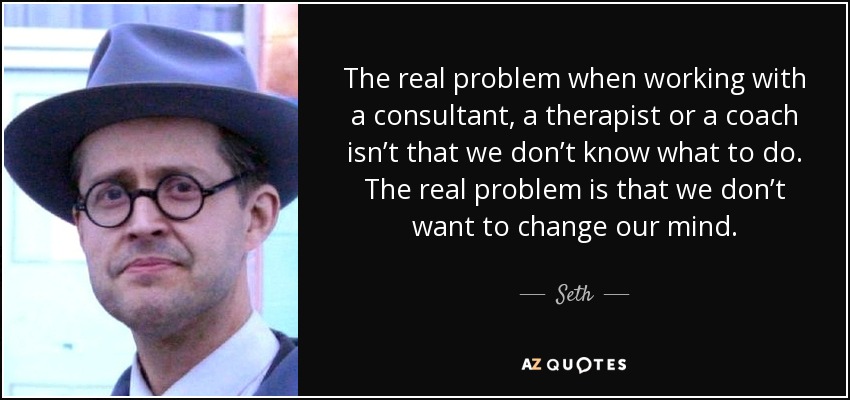
The real problem when working with a consultant, a therapist or a coach isn’t that we don’t know what to do. The real problem is that we don’t want to change our mind.
We all have direct experience with things that do or don't make us happy, we all have friends, therapists, cabdrivers, and talk-show hosts who tell us about things that will or won't make us happy, and yet, despite all this practice and all this coaching, our search for happiness often culminates in a stinky mess. We expect the next car, the next house, or the next promotion to make us happy even though the last ones didn't and even though others keep telling us that the next ones won't.
The greatest scandal of the century in American psychiatry ... is the growing mania among thousands of inept therapists, family counselors, and social workers for arousing false memories of childhoood sexual abuse.
Psychotherapy is a cyclical process from isolation into relationship. It is cyclical because the patient, in terror of existential isolation, relates deeply and meaningfully to the therapist and then, strengthened by this encounter, is led back again to a confrontation with existential isolation.
Therapists need to have a long experience in personal therapy to see what it's like to be on the other side of the couch and see what they find helpful or not helpful. And if possible, get into therapy at different stages of their life with different kinds of therapists just to sample a bit.
One doesn't do existential therapy as a freestanding separate theory; rather it informs your approach to such issues as death, which many therapists tend to shy away from.
You know, I think everybody I've seen has come from some other therapy, and almost invariably it's very much the same thing: the therapist is too disinterested, a little too aloof, a little too inactive. They're not really interested in the person, he doesn't relate to the person. All these things I've written so much about. That's why I've made such a practice really, over and over to hammer home the point of self-revelation and being more of yourself and showing yourself. Every book I write I want to get that in there.
One reason patients are reluctant to work in a therapy group is they fear that things will go too far, that the powerful therapist or the collective group might coerce them to lose control--to say or think or feel things that will be catastrophic. The therapist can make the group feel safer by allowing each patient to set his or her limits and by emphasizing the patient's control over every interaction.
If I had to pick out a therapist in a movie that I'd like to go see as a personal therapist, it would be Robin Williams in Goodwill Hunting.
All the therapists would tell me was that I was the only healthy person they knew.
I went to a Gestalt therapist and said that I want to be able to at least tell my muscles that aren't involved that they don't have to go into spasms too.
Therapists need to give a depressed patient support and direction.
Talking to a therapist, I thought, was like taking your clothes off and then taking your skin off, and then having the other person say, "Would you mind opening up your rib cage so that we can start?
Growing up, I had a singing teacher who was an amazing champion of mine who helped build up my confidence, and I also count my therapist as one of the best teachers that I've ever had.
I think secrets often come out. I spoke to a friend who is a therapist and I asked her if there were people who came to her and admitted to doing horrible things and she said, 'More than you know.'.
children may need challenges and high-risk conditions in order to develop the self-generated immunity to trauma that characterizes survivors. To be tested is good. The challenged life may be the best therapist.
Sometimes you're a psychiatrist and sometimes you're a group therapist. The dynamics in between people and the misgivings sometimes that artists have when they get into the studio because they're under a different level of scrutiny. A lot of them can be insecure about it. My job is not simply to make musical determinations but sometimes to just keep people from flipping out during the process.
I've spent years trying to "get in touch with my inner child," but now my new therapist tells me it's mostly been inappropriate touching.
More than any other personality trait, my mother seemed to be ruled by anger and sadness. She seemed to hate being a mother. Watching her unhappiness as I grew up made me conclude that the answer was to try and be as unemotional as I could, which many therapists have taught me is a bad idea. It also made me want to avoid marriage and having children.
I'm sure I've dated my share of loonies in the past. Sometimes I realized it early on and sometimes not that fast. Love can be blinding, even for therapists. Plus, crazy can be fun sometimes. Don't you think?! Maybe that's just me!
The clergy profession is fundamentally self-defeating. Its stated purpose is to nurture spiritual maturity in the church - a valuable goal. In actuality, however; it accomplishes the opposite by nurturing a permanent dependence of the laity on the clergy. Clergy become to their congregations like parents whose children never grow up, like therapists whose clients never become healed, like teachers whose students never graduate.
Only idiots and infants need things. The language of needs is the native tongue of socialists, therapists, and paternalists of all sorts and is addressed to needy dependents. The language of wants is spoken by self-respecting adults and is addressed to other self-respecting adults.
In therapy , the therapist acts as a container for what we daren't let out, because it is so scary, or what lets itself out every so often, and lays waste to our lives.
Facilitative attitudes (and skills) can help a therapist gain entry into the group Freedom from a desire to control the outcome, and respect for the capacity of the group, and skills in releasing individual expression Openness to all attitudes no matter how extreme or unrealistic they may seem Acceptance of the problems experienced by the group where they are clearly defined as issues Allowance of the freedom of choices in direction, either for the group or individuals particularly in the near future
Therapy isn't curing somebody of something; it is a means of helping a person explore himself, his life, his consciousness. My purpose as a therapist is to find out what it means to be human. Every human being must have a point at which he stands against the culture, where he says, "This is me and the world be damned!" Leaders have always been the ones to stand against the society - Socrates, Christ, Freud, all the way down the line.
Follow AzQuotes on Facebook, Twitter and Google+. Every day we present the best quotes! Improve yourself, find your inspiration, share with friends
or simply: