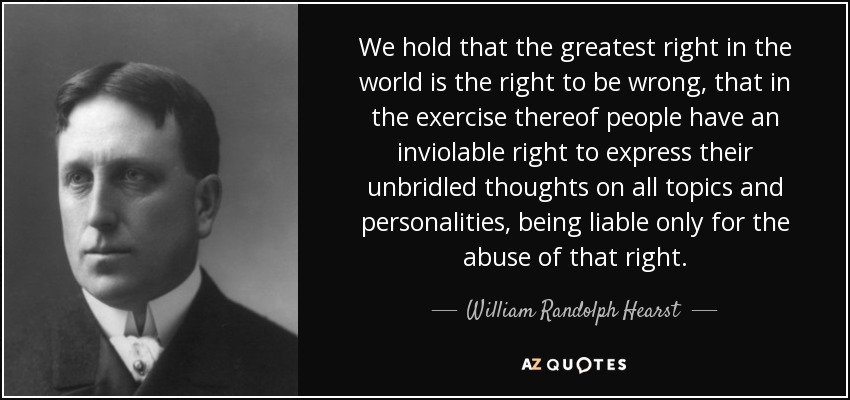
We hold that the greatest right in the world is the right to be wrong, that in the exercise thereof people have an inviolable right to express their unbridled thoughts on all topics and personalities, being liable only for the abuse of that right.
I think that argument is completely morally bankrupt, and I think people know that when they make it. There's a very big difference between having a sincere, passionate interest in a topic and being a paid shill. Particularly for PR firms, it's something they should really very strongly avoid: ever touching an article.
THERE is no method of reasoning more common, and yet none more blameable, than, in philosophical disputes, to endeavour the refutation of any hypothesis, by a pretence of its dangerous consequences to religion and morality. When any opinion leads to absurdities, it is certainly false; but it is not certain that an opinion is false, because it is of dangerous consequence. Such topics, therefore, ought entirely to be forborne; as serving nothing to the discovery of truth, but only to make the person of an antagonist odious.
I know my comfort zone and I know what my strong points are and my first love was always music. I'm a huge cinema fan. I was taking my time; I got offered a lot of scripts and things along the way but until Burlesque showed up at my doorstep, it really spoke to me. I have a collection of burlesque books at home that I've had for years. I've always been intrigued and fascinated with the topic, the beauty and the art of it and the comedic value of it. I think it's just a beautiful, empowering thing for women.
Most public persons do not market themselves as cheating lowlives - certainly not politicians (okay, maybe a few rock stars.) But most people try to present a somewhat appealing persona, which is why sex is still a hot topic.
We scientists can argue forever about important topics like slightly different flavors of vanilla ice cream. Consider the silliness of this debate: one group of scientists found a 90% decline of big fish and criticized fishery management. Some other scientists found an 80% decline and started a big argument with the 90% people. Who cares if it's 80% or 90%? The real question is whether it's OK to let fishermen take most of the big fish out of our oceans.
Healing is too big a topic for any one person to know it all.
What I love about what I do is expanding people's minds on the topics of gender expression, gay rights, and most of all, entertaining them while I do it.
It is a mistake to think of these men as visionary dreamers, playing around at Philadelphia with abstract conceptions of political theory, pulling a whole scheme of government out of the air like a rabbit out of a hat. True, many of them had read and studied enough about the science of politics to put the average statesman of today to shame. But political science was to them an extremely practical topic of discussion, dealing with the extremely practical business of running a government--not, as today, a branch of higher learning reserved for the use of graduate students.
Do or do not. There is no try," says Yoda, the bewitching philosopher warrior created by George Lucas in Star Wars. Yoda is quoted at least as often as the founding fathers on this topic.
According to the science of cybernetics, which deals with the topic of control in every kind of system (mechanical, electronic, biological, human, economic, and so on), there is a natural law that governs the capacity of a control system to work. It says that the control must be capable of generating as much "variety" as the situation to be controlled.
Psychohistory, like psychoanalysis, is a science in which the researcher's feelings are as much or even more a part of his research equipment than his eyes or his hands. Weighing of complex motives can only be accomplished by identification with human actors, the usual suppression of all feeling preached and followed by most "science" simply cripples a psychohistorian as badly as it would cripple a biologist to be forbidden the use of a microscope. The emotional development of a psychohistorian is therefore as much a topic for discussion as his or her intellectual development.
Saul Gorn, an authority on machine oi automated language who has expanded his interests from the use of the computer foi information storage and retrieval to the broader topic of the "'information pollution" and an examination of the forces which contribute to it.
Today the term "global" can no longer constitute a serious topic for an in-depth intellectual discussion because it simply means "Camerica".
To judge sins is the business of one who is sinless, but who is sinless except God? Who ever thinks about the multitude of his own sins in his heart never wants to make the sins of others a topic of conversation. To judge a man who has gone astray is a sign of pride, and God resists the proud. On the other hand, one who every hour prepares himself to give answer for his own sins will not quickly lift up his head to examine the mistakes of others.
The freedom to think out loud on certain topics, without fear of being hounded into hiding or killed, has already been lost.
Our teaching of mathematics revolves around a fundamental conflict. Rightly or wrongly, students are required to master a series of mathematical concepts and techniques, and anything that might divert them from doing so is deemed unnecessary. Putting mathematics into its cultural context, explaining what is has done for humanity, telling the story of its historical development, or pointing out the wealth of unsolved problems or even the existence of topics that do not make it into school textbooks leaves less time to prepare for the exam. So most of these things aren't discussed.
Admitting the force of these contentions, nevertheless, the custom of meeting together in public assembly for the consideration of the most serious, the most exalted topics of human interest is too vitally precious to be lost.
Writing can be wonderful therapy, and cheap at the price. At the very least, you eventually get bored by thinking about anxious topics and move on.
I thought that, with so much current attention focused on the topic of North Korea, I might share what I think are three books which cast a rare light on the elusive realm of North Korea.
Sexuality is a topic that has huge shifts in -society. Attitudes toward different sexualities change, but the actual sexuality of a human being is something that's consistent, and it's consistently interesting, and so people write about it.
I'd say the biggest relationship is the repetition of certain themes. I don't want to say "topics," but certain points of interest.
You know you're ready to write a book when you have a feeling that you should do it, no matter what anybody says. It's like falling in love or starting a company. When you're still wondering if you should get married or you're still wondering whether you should start a company that might be not the right person or the right idea. And writing is the same way. When you've locked on to the topic, you'll just write it.
Something about the topic of consciousness makes people, like the White Queen in Through The Looking Glass, believe six impossible things before breakfast.
You know, you've got serious pieces, you've got light pieces, you've got cooking segments, you've got health-related topics, so it's not as if they've had a unique personality from the get-go.
Follow AzQuotes on Facebook, Twitter and Google+. Every day we present the best quotes! Improve yourself, find your inspiration, share with friends
or simply: