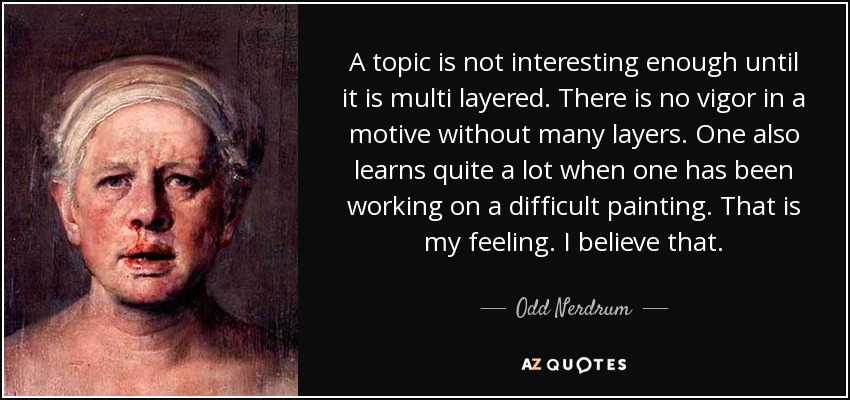
A topic is not interesting enough until it is multi layered. There is no vigor in a motive without many layers. One also learns quite a lot when one has been working on a difficult painting. That is my feeling. I believe that.
Because my graduate academic training at law school was not one that included most of the intellectual traditions I find useful for understanding the conditions and problems that most concern me - anti-colonial theories, Foucault, critical disability studies, prison studies and the like are rarely seen in standard US Law School curricula, where students are still fighting on many campuses to get a single class on race or poverty offered - I developed most of my thinking about these topics through activist reading groups and collaborative writing projects with other activist scholars.
We scientists can argue forever about important topics like slightly different flavors of vanilla ice cream. Consider the silliness of this debate: one group of scientists found a 90% decline of big fish and criticized fishery management. Some other scientists found an 80% decline and started a big argument with the 90% people. Who cares if it's 80% or 90%? The real question is whether it's OK to let fishermen take most of the big fish out of our oceans.
Healing is too big a topic for any one person to know it all.
What I love about what I do is expanding people's minds on the topics of gender expression, gay rights, and most of all, entertaining them while I do it.
To judge sins is the business of one who is sinless, but who is sinless except God? Who ever thinks about the multitude of his own sins in his heart never wants to make the sins of others a topic of conversation. To judge a man who has gone astray is a sign of pride, and God resists the proud. On the other hand, one who every hour prepares himself to give answer for his own sins will not quickly lift up his head to examine the mistakes of others.
The freedom to think out loud on certain topics, without fear of being hounded into hiding or killed, has already been lost.
Our teaching of mathematics revolves around a fundamental conflict. Rightly or wrongly, students are required to master a series of mathematical concepts and techniques, and anything that might divert them from doing so is deemed unnecessary. Putting mathematics into its cultural context, explaining what is has done for humanity, telling the story of its historical development, or pointing out the wealth of unsolved problems or even the existence of topics that do not make it into school textbooks leaves less time to prepare for the exam. So most of these things aren't discussed.
Admitting the force of these contentions, nevertheless, the custom of meeting together in public assembly for the consideration of the most serious, the most exalted topics of human interest is too vitally precious to be lost.
The human overpopulation issue is the topic I see as the most vital to solve if our children and grandchildren are to have a good quality of life.
Writing can be wonderful therapy, and cheap at the price. At the very least, you eventually get bored by thinking about anxious topics and move on.
I thought that, with so much current attention focused on the topic of North Korea, I might share what I think are three books which cast a rare light on the elusive realm of North Korea.
One thing I like about writing is that it provides such a wonderful opportunity for confidential chats with readers. In the privacy of writing, and reading, we can discuss topics that are a little touchy, a bit embarrassing, and feel less alone in the process. Feeling consumed by memories from high school. Feeling wimpy. Feeling time-obsessed. Yearning for our fathers. Wishing we were taller, or shorter, or less average. To name just a few.
Sexuality is a topic that has huge shifts in -society. Attitudes toward different sexualities change, but the actual sexuality of a human being is something that's consistent, and it's consistently interesting, and so people write about it.
I'd say the biggest relationship is the repetition of certain themes. I don't want to say "topics," but certain points of interest.
You know you're ready to write a book when you have a feeling that you should do it, no matter what anybody says. It's like falling in love or starting a company. When you're still wondering if you should get married or you're still wondering whether you should start a company that might be not the right person or the right idea. And writing is the same way. When you've locked on to the topic, you'll just write it.
Why write if this too easy activity of pushing a pen across paper is not given a certain bullfighting risk and we do not approach dangerous, agile and two-horned topics?
The story is everything, so it always begins with a story. Research is a kind of scaffolding built underneath the story as I go along. My enjoyment level varies, but in general, I'm writing about topics I find interesting, so I can't gripe too much.
I think that this vein is close to being mined out already, but I'll say that my knowledge of and talent for linguistics are quite limited and I'm not aware of being a hell of a lot more interested in that topic than I am in others.
History is important. More than any other topic, it is about us. Whether one deems our present society wondrous or awful or both, history reveals how we got to this point.
It is only when someone cannot defend his opinion, and is not interested in believing the truth, that he will attempt to stifle discussion with good manners. Those who take religion, politics and sex seriously do not adhere to the general prohibition on discussing these topics. And they do not take offence when they are shown to be wrong. If you start to feel during a discussion, that you are not so much incorrect as insensitive, then you are probably dealing with a respectable bigot.
All of our panelists are deeply engaged in the topics at hand, so that leaves me free to convene a little dinner party, sans alcohol, and invite the rest of America to listen in.
For many years I have devoted articles and essays to newspapers, from the inside. So criticism of the newspapers was a topic that I practiced for a long time.
A number of individuals tried to make my homosexuality a topic of debate. I admittedly found that rather upsetting.
Philosophy is problem-solving. There's a philosophical problem, and then you try to solve it by approaching it from different angles and seeing what way works. That's what comedy is: you have a topic and you try to just hit it as many different ways as you can.
Follow AzQuotes on Facebook, Twitter and Google+. Every day we present the best quotes! Improve yourself, find your inspiration, share with friends
or simply: