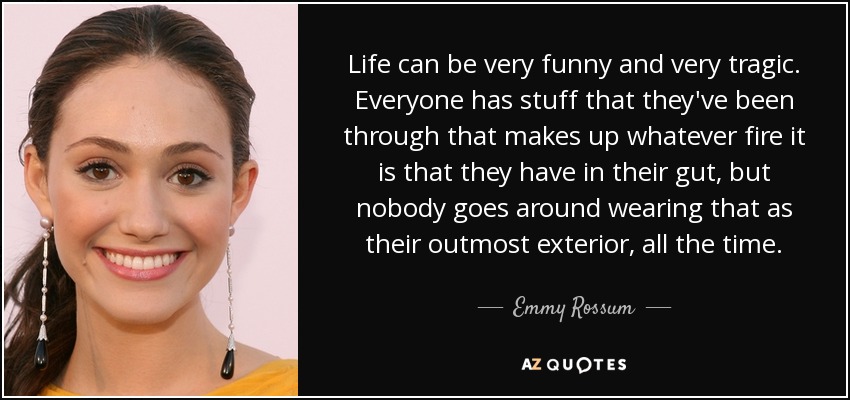
Life can be very funny and very tragic. Everyone has stuff that they've been through that makes up whatever fire it is that they have in their gut, but nobody goes around wearing that as their outmost exterior, all the time.
I'm interested in everything about what it means to be a human being, so every role is an excuse to delve into a different way of life, a different socio-economic background, and a different tragic or comedic circumstance.
In some mysterious way, once one has gained an insight into human nature, that insight grows from day to day, and he to whom it has given to experience vicariously even one single form of earthly suffering acquires, by reason of this tragic lesson, an understanding of all its forms, even those most foreign to him, and apparently abnormal.
Early on in my life I comprehended that death is the most tragic event in our life. Events of early Monday July 14, 1958 [Coup in Iraq] had convinced me that hate is the most destructive force in our life.
Are there many situations more sublimely tragic than the struggle of the soul with the demand to renounce a work which has been all the significance of its life--a significance which is to vanish as the waters which come and go where no man has need of them?
It is a tragic hour, that hour when we are finally driven to reckon with ourselves, when every avenue of mental distraction has been cut off and our own life and all its ineffaceable failures closes about us like the walls of that old torture chamber of the Inquisition.
The ideal may seem remote of execution, but the democratic ideal of education is a farcical yet tragic delusion except as the ideal more and more dominates our public system of education.
If you string together a set of speeches expressive of character, and well finished in point and diction and thought, you will not produce the essential tragic effect nearly so well as with a play which, however deficient in these respects, yet has a plot and artistically constructed incidents.
The Socratic demonstration of the ultimate unity of tragic and comic drama is forever lost. But the proof is in the art of Chekhov.
I never cared about whatever tragic event happened in China. It's faraway decoration, even if in blood and plague.
Is it not tragic, for example, that while in the last World War almost everyone believed it was the war to end all wars and wanted to make it so, now in this Second World War almost no writer that I have read dares even suggest that this is the war to end all wars, or act on that belief? We have lost the courage to hope.
What after all, has maintained the human race on this old globe despite all the calamities of nature and all the tragic failings of mankind, if not faith in new possibilities, and courage to advocate them. Doubtless many times these new possibilities were declared by a man who, quite unconscious of courage, bore the "sense of being an exile, a condemned criminal, a fugitive from mankind." Did every one so feel who, in order to travel on his own proper path had been obliged to leave the traditional highway?
A society, in the process of moving forward, often appears to be tearing itself apart. Certainly, an age of rapid change, such as ours, produces many paradoxes. But perhaps the most tragic paradox of our time is to be found in the failure of nation-states to recognize the imperatives of internationalism.
Thus, if there exists a law which sanctions slavery or monopoly, oppression or robbery, in any form whatever, it must not even be mentioned. For how can it be mentioned without damaging the respect which it inspires? Still further, morality and political economy must be taught from the point of view of this law; from the supposition that it must be a just law merely because it is a law. Another effect of this tragic perversion of the law is that it gives an exaggerated importance to political passions and conflicts, and to politics in general.
Nietzsche inveighs against every sort of historical optimism; but he energetically repudiates the ordinary pessimism, which is the result of degenerate or enfeebled instincts of decadence. He preaches with youthful enthusiasm the triumph of a tragic culture, introduced by an intrepid rising generation, in which the spirit of ancient Greece might be born again. He rejects the pessimism of Schopenhauer, for he already abhors all renunciation; but he seeks a pessimism of healthiness, one derived from strength, from exuberant power, and he believes he has found it in the Greeks.
I think that the tendency for most people is to fall back on a comic interpretation of things because things are so sad, so terrible. If you didn't laugh you'd kill yourself. But the truth of the matter is that existence in general is very very tragic, very very sad, very brutal and very unhappy.
After all, no one is ever taken in by the happy ending, but we are often divinely fuddled by the tragic curtain.
When you attend a funeral, It is sad to think that sooner o' Later those you love will do the same for you. And you may have thought it tragic, Not to mention other adjec- Tives, to think of all the weeping they will do. (But don't you worry.
Many consider that Shostakovich is the greatest 20th-century composer. In his 15 symphonies, 15 quartets, and in other works he demonstrated mastery of the largest and most challenging forms with music of great emotional power and technical invention...All his works are marked by emotional extremes - tragic intensity, grotesque and bizarre wit, humour, parody, and savage sarcasm.
It's a fairytale so tragic there's no prince to break the spell. I don't believe in magic, but for you I will
As a child, I saw this beautiful film, Dracula's Daughter, and it was with Gloria Holden and was a sequel to the original Dracula. It was all about this beautiful daughter of Dracula who was an artist in London, and she felt drinking blood was a curse. It had beautiful, sensitive scenes in it, and that film mesmerized me. It established to me what vampires werethese elegant, tragic, sensitive people. I was really just going with that feeling when writing Interview With the Vampire. I didn't do a lot of research.
A law which excludes all dialectic and all reconciliation; which establishes, consequently, both the flawless unity of knowledge and the uncompromising division of tragic existence; it rules over a world without twilight, which knows no effusion, nor the attenuated cares of lyricism; everything must be either waking or dream, truth or darkness, the light of being or the nothingness of shadow.
But that is the way of the place: down our many twisting corridors, one encounters story after story, some heroic, some villainous, some true, some false, some funny, some tragic, and all of them combining to form the mystical, undefinable entity we call the school. Not exactly the building, not exactly the faculty or the students or the alumni - more than all those things but also less, a paradox, an order, a mystery, a monster, an utter joy.
So long as men die, life will reassert its tragic interest from time to time with fresh energy, and to this interest Christianity alone can respond. If the scientific people could rid us of death, they might indeed hope to win over the heart and conscience of the world, permanently, to some form of non-theistic speculation. As it is, the tide ebbs, as I believe, only that it may flow again.
I think that life is a friggin' magic carpet ride - it's amazing. Everything about life is mysterious and beautiful and touching and tragic and lovely and mystical.
Follow AzQuotes on Facebook, Twitter and Google+. Every day we present the best quotes! Improve yourself, find your inspiration, share with friends
or simply: