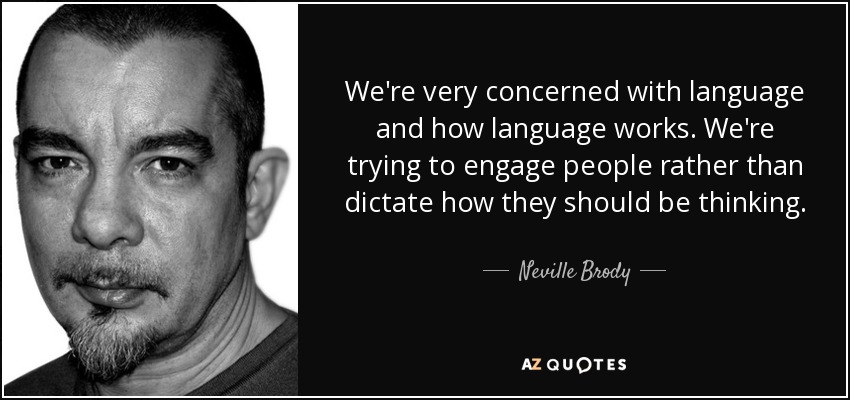
We're very concerned with language and how language works. We're trying to engage people rather than dictate how they should be thinking.
Its focus wasn't on the written word but how the word was written.
The Ardent Hymn that Unites Peoples.
Someday I'll design a typeface without a K in it, and then let's see the bastards misspell my name.
Printing demands a humility of mind, for the lack of which many of the fine arts are even now floundering in self-conscious and maudlin experiments.
Standardization, instead of individualization. Cheap books, instead of private press editions. Active literature, instead of passive leather bindings.
...if all people doing desktop publishing were doctors we would all be dead!
The first thing one learns about typography & type design is that these rules are made to be broken.
I love bookshelves, and stacks of books, spines, typography, and the feel of pages between my fingertips. I love bookmarks, and old bindings, and stars in margins next to beautiful passages. I love exuberant underlinings that recall to me a swoon of language-love from a long-ago reading, something I hoped to remember. I love book plates, and inscriptions in gifts from loved ones, I love author signatures, and I love books sitting around reminding me of them, being present in my life, being. I love books.
Keep it simple: In general, interfaces should use simple geometric forms, minimal contours, and a restricted color palette comprised primarily of less-saturated or neutral colors balanced with a few high contrast accent colors that emphasize important information. Typography should not vary widely in an interface.
This project started nearly twenty years ago as an assignment in my typography class at art school. Students were encouraged to see letters beyond their dull, practical functionality. We played with their unique shapes and tinkered with their infinite possibilities. The challenge was hard, so the reward of “cracking” a word felt great. This became a lifelong project for me.
The flood of print has turned reading into a process of gulping rather than savoring.
I'm very much a word person, so that's why typography for me is the obvious extension. It just makes my words visible.
The book, that stubbornly unelectric artifact of pure typography, possesses resources conducive to the flourishing of the soul. A thoughtful reading of the printed text orients one to a world of order, meaning, and the possibility of knowing truth.
Type production has gone mad, with its senseless outpouring of new types... only in degenerate times can personality (opposed to the nameless masses) become the aim of human development.
I fought linotype and montype for some time because it would not justify as well as handset could be made to do; but at last, as always happens, the machine outdid the hand, and got all the best types on it.
I discovered that I never really used Helvetica but I like to look at it. I like the VW beetle, too, although I've never driven one.
Set a page in Fournier against another in Caslon and another in Plantin and it is as if you heard three different people delivering the same discourse - each with impeccable pronunciation and clarity, yet each through the medium of a different personality.
Typography fostered the modern idea of individuality, but it destroyed the medieval sense of community and integration.
The contributions that one makes in typography, design, and art in general cannot be, and must not be measured on how much money is involved. That would lead to total chaos. The word itself (contribution) is to give to a common purpose.
They should make new ways to better design buildings and books. The computer was the end of Swiss typography!
By the year 2000 every secretary will have a favorite typeface.
Typography is not only a technology but is in itself a natural resource or staple, like cotton or timber or radio; and, like any staple, it shapes not only private sense ratios but also patterns of communal interdependence.
Malevich, Lissitsky, Kandinsky, Tatlin, Pevsner, Rodchenko... all believed in the social role of art... Their works were like hinged doors, connecting activity with activity. Art with engineering; music with painting; poetry with design; fine art with propaganda; photographs with typography; diagrams with action; the studio with the street.
Anyone who uses Helvetica knows nothing about typefaces.
Follow AzQuotes on Facebook, Twitter and Google+. Every day we present the best quotes! Improve yourself, find your inspiration, share with friends
or simply: