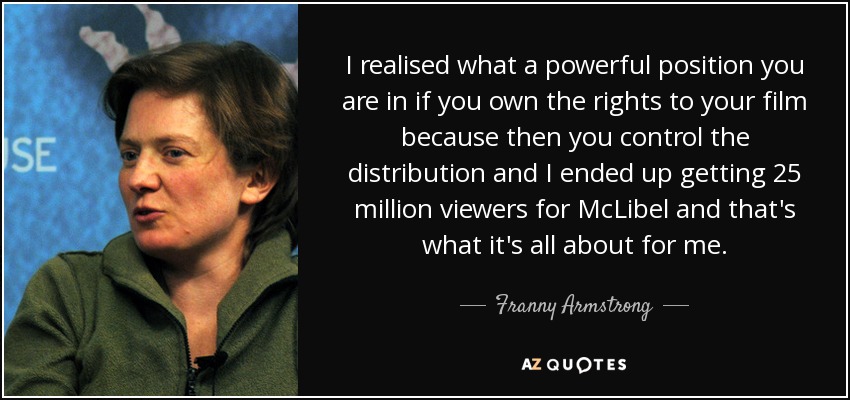
I realised what a powerful position you are in if you own the rights to your film because then you control the distribution and I ended up getting 25 million viewers for McLibel and that's what it's all about for me.
I have always thought that the role of the film-maker is to present the argument persuasively, emotionally and coherently and then it is over to the viewer, they are either convinced or not convinced, moved or not moved and they decide whether they will take action or not.
I've learned that the effort sportsmen and women put in is incredible. Their commitment to their sport is phenomenal. Sometimes as a viewer, as a sports fan, you only see the end result.
Drawing from art history and mythology allows me to connect with viewers in a familiar, yet loose visual framework. Blending disparate histories and themes can give the overall presentation a recognizable, yet unique flavor.
We don't have formal training, that makes what we're experiencing a little bit more accessible to the viewers. If we actually knew what we were doing ahead of time, it would just be like talking at you, instead of experiencing the situation with you.
I've taken my cue from people here and from viewers, especially survivors-who said, 'When it's time to literally flip your wig, you'll know.'
Protect your good image from the eyes of negative viewers, who may look at your good appearance with an ugly fiendish eye, and ruin your positive qualities with their chemical infested tongues.
When a show fails to destroy the competition-and it can fail while attracting 20 million viewers-it is itself destroyed.
The networks are different so they have a different approach. Obviously, with The Shield - that was on FX so they had a little bit more leeway as far as the dialogue was concerned and even the content and what they showed the viewers, which is a great thing. But we will push it to the limit as far as FOX will let us go; that's for damn sure.
Well, it's basically the viewers who determine it. We - well, basically the producers and myself chose the people we felt had the best reaction, you know, through the press, the Internet, the people we thought deserved a second chance. And they've chosen a winner, I believe.
People like my films. They understand me through my films; it's like a connection that has been established between all my work and myself and the audience and the viewer.
I talk about things from the perspective of the consumer - mostly because that's what I am. A guy going out and buying things and sharing that experience with the viewer. Nothing should change that, but if it ever does, I'll absolutely make it known.
I totally agree. I hate knowing too much when I'm going to the cinema and watching as a viewer. I don't want to know that the actor has just gone through a divorce. I don't want to know that the person is an alcoholic. It just gets in the way of my pleasure of watching the character on the screen.
I've seen many films and read lots of thrillers - and I'm always disappointed that I can guess the story before the other viewers.
I decided that one day I had to make a film where the viewer couldn't possibly guess the end.
You have to strike hard from the beginning and create a depressurizing zone between the viewer's own life and the one onscreen. The creators of James Bond got it right: the attention-grabbing scene of each Bond movie is the very first one, before the opening credits.
I don't mind ratings boards. As a viewer, you have the right not to see a film.
I became interested in film as a viewer when I was a teenager. I would spend entire afternoons in an arthouse theater in downtown Santiago. I didn't really expect to be a filmmaker back then. But it was clearly an interest.
About my work, my first film, Écoute le Temps (Fissures), was positioned by distributors as a thriller because they thought that it would sell more easily. But it was surely a mistake, as that kind of viewer did not take the bait, and it drew away its potential core audience, those whom I met in festivals and in various Q&As who seem to appreciate that particular kind of cross-over arthouse film.
I have always been interested in crafting films that use long, static urban landscape shots as a way of manipulating the emotions of the viewer and forcing them to slow down, which I think simultaneously makes them more vulnerable as spectators, and also puts them in a position of being more than just spectators.
ather than Eisenstein's fast and hard cutting, I like to hold the shot very still and for longer than we're accustomed to. For me personally as a viewer, this technique invariably causes me to have waves of emotions that I think arise from a profound form of mindful awareness and the feelings that go along with that. I am frequently brought to tears by this kind of existential cinematic technique.
Photographs need to demand the viewer's attention, often implicitly, posing questions as to the nature of what is being depicted. Photographs are not there to show us the world, but to show us a version of what may be happening.
Definitely. Cate Blanchett or Meryl Streep, Julianne Moore - women that have no boundaries, no borders. They can do anything, They can be any character and you accept it and go with it as a viewer, and as an audience member. That's the kind of career that I'm looking for.
At the heart of any successful film is a powerful story. And a story should be just that: a narrative with a beginning, middle, and end, powerful protagonists that audiences can identify with, and a dramatic arc that is able to capture and hold viewers' intellectual and emotional attention.
I'm always careful about the thing I'm writing to make sure a viewer can imagine it happening to themselves.
Follow AzQuotes on Facebook, Twitter and Google+. Every day we present the best quotes! Improve yourself, find your inspiration, share with friends
or simply: