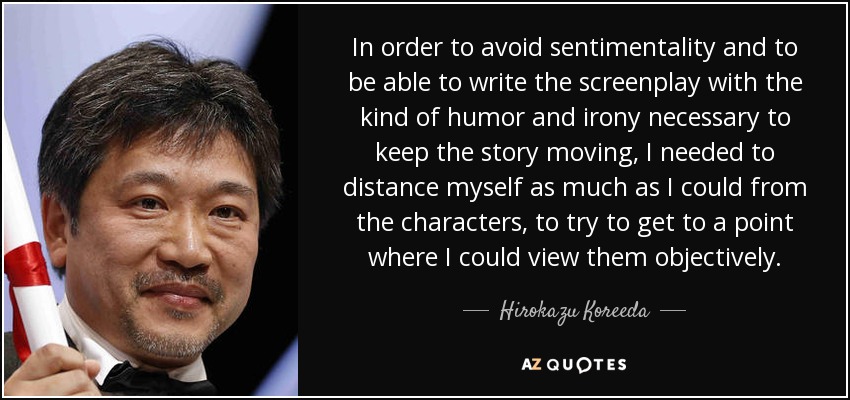
In order to avoid sentimentality and to be able to write the screenplay with the kind of humor and irony necessary to keep the story moving, I needed to distance myself as much as I could from the characters, to try to get to a point where I could view them objectively.
The inspiration comes from everywhere, from what I grew up with. There's so much silliness and nonsense in the world that we regard as normal working procedure. The satirical point of the view may be to counterpoint that. The way we look at classics has been hijacked by the intelligentsia - Shakespeare is highbrow and seen as something clever people do, which isn't right at all. I basically pull inspiration from everywhere.
I suppose the short chapters and differing narrative points of view are quite "cinematic" devices, which came very naturally to me.
What's fun is watching actors of that calibre bring them to life. It's incredible. Christian Bale spent a day with the character he plays and after my year of being with him I couldn't have generated the same view of him. They have a different way of looking at people, it's fascinating to watch.
Now, as a reader, you shouldn't feel the decisions the writer makes about this DNA, or it would be boring beyond belief. But, as a writer, you're struggling to make these decisions. What should the title be? What's the first line? The point of view? And the struggle with the decisions is because you're trying to figure out WHAT IS THE NOVEL, WHAT IS THE NOVEL?
As a school board member, I might have particular views about the ways we might increase the economics curriculum in a local high school, but I'm not sure I should mandate that for the entire country.
The DNA of the novel - which, if I begin to write nonfiction, I will write about this - is that: the title of the novel is the whole novel. The first line of the novel is the whole novel. The point of view is the whole novel. Every subplot is the whole novel. The verb tense is the whole novel.
I am only able to be honest. And sometimes my view of the world is pretty dark. But still funny.
I used to teach writing in a federal prison, and for my students' benefit, I would liken the narrative use of this highly personal point of view to a boxer's getting in close to his opponent.
I think that the audience should not be able to tell if it is real or not real - it should be an enhanced version of reality, or an artistic view of reality, that captures not only what is physically there, but what is not visible - the mood.
Remain a witness to your emotions as if from a great distance an eagles eye view
Poetry at large in America is naturally a reflection of the American system and culture. That's my possibly narrow view of it, or reductive view. But I think for as many portals for critical consciousness in the poetry world and in the American spirit that exist, there's also an over-arching, dominant mirroring, in poetry, of the corporate structure, the capitalist enterprise.
There's always something extremely personal in the songs, but I may change the point of view from what I actually experienced.
I tend to view the superstitions or fragments of myth as triggers for lyric inquiry. I also find I think of this kind of language as ars poetica - if we can find the right combination of words, we can make something improbably or extraordinary happen.
Humor is not funny. Humor is something else. Funny is a joke, sometimes silly. Comedy is deep and connected to tragedy; comedy could be deeper than tragedy, in my view.
When I listen to candidates spend all their time attacking Barack Obama, I'm glad they're not driving this bus because they'd be looking through the rear-view mirror. I look through the windshield at the road ahead.
I feel connected with people because of their sense of humor, worldview, and what they think and feel about certain existential issues (things not affected, in my view, by if someone rides a horse or drives a car or talks only IRL or only by typing), not how old they are, what they use to convey what they think and feel about certain existential issues, or if we have both watched the same TV shows or looked at the same websites.
You can`t differentiate between an Islamic terrorist and a Christian terrorist. Or a politically motivated terrorist who`s anti-abortion or someone who may have differing views.
I don't view myself as any kind of celebrity, but we as people are called to do those things and I am just lucky I have a microphone and can reach more people sometimes.
The job of a president is to identify, distinguish between the two. Make sure the people know that we view it as a threat that we're - because people are scared and they're legitimately so. Take action accordingly. And then you're going to lessen people's fears on the day-to-day activities. We can't be paralyzed in place. And that's where we are today.
If someone is brought in for an interview, for example, and is asked about their views on things, but has posted things that are completely contrary to the interview, frankly I have much more faith in what they posted than what they say during the course of an interview.
I think I realized that Dave Barry was funnier than I'll ever be, and he made no attempt to make any actual points. He had a general libertarian point of view, but in general, he just liked to make jokes.
I think the whole progress over the last two or three millennia has been entirely dependent on ideas and techniques and commodities and people moving from one part of the world to another. It seems difficult to take an anti-globalization view if one takes globalization properly in its full sense.
We need to ask the moral questions: Do I have a right to be rich? And do I have a right to be content living in a world with so much poverty and inequality? These questions motivate us to view the issue of inequality as central to human living.
I admire Joyce Maynard a lot, specifically her memoir "At Home in the World." Her writing is beautiful and fascinating and seemed to give me validation to the idea that I could write validly in earnest about my life with (my) very feminine point of view, and also that I could unapologetically explore the bad traits of my character (which I find to be more interesting to explore than the good traits), as well as explore other concepts that interest me like private vs public personas, age gap relationships, etc.
Follow AzQuotes on Facebook, Twitter and Google+. Every day we present the best quotes! Improve yourself, find your inspiration, share with friends
or simply: