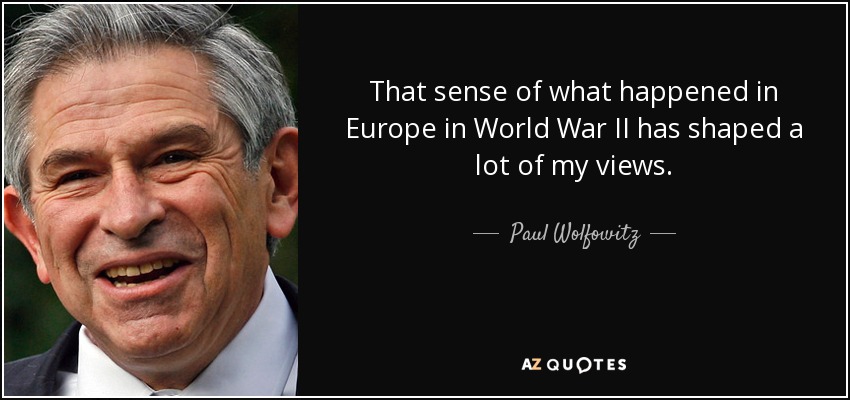
That sense of what happened in Europe in World War II has shaped a lot of my views.
In the Crusades, getting the Holy Land back was the goal, and any means could be used to achieve it. World War II was a crusade. The firebombing of Tokyo by Doolittle and the carpet bombing in Germany, especially by the British, showed that.
Libya as a country is a relatively new concept. The period of Libya as a modern nation really starts after World War II.
There arent many great passages written about food, but I love one by George Millar, who worked for the SOE in the second world war and wrote a book called Horned Pigeon. He had been on the run and hadnt eaten for a week, and his description of the cheese fondue he smells in the peasant kitchen of a house in eastern France is unbelievable.
If you want to know when a war might be coming, you just watch the U.S. and see when it starts cutting down on its defenses. It's the surest barometer in the world.
All humor is based on hostility - that's why World War Two was funny.
One of the main reasons I wanted to work on 'World War Z' was because I'm a huge fan of the book, and I love the idea of taking a non-linear story and creating a three-act structure out of it.
In the period after the Second World War, there were still leaders in Europe who represented weak countries, but possessed a sense of global foreign policy. Nowadays, on the other hand, there are politicians who represent pretty powerful countries, but whose citizens are not prepared to sacrifice themselves for the state.
America felt victorious and generous after World War II. They had also learned from the mistakes after World War I when they imposed punishment on Germany. What became of Germany? A Nazi dictatorship which threatened the world. Today's Germany doesn't feel as prosperous and generous as America then. But actually, Germany still is very prosperous.
In 2003, at the time I made my "Old Europe" comment, the center of gravity in NATO and Europe had long since shifted to the East. With the former Warsaw Pact countries joining NATO, the alliance has a different mix today. Some people were sensitive about my comment because they thought it was a pejorative way of highlighting demographic realities. Apparently they felt it pointed a white light at a weakness in Europe - an aging population. Europe has come some distance since World War II in becoming Europe.
World War II put feminism on hold for a long time; the men went away to fight, a lot of women in those years got jobs both in teaching and in factories - at all social levels - which they enjoyed very much. A lot of them were quite happy during the war.
I think at the time, my radicalization was not through growing up Chinese, but through the role that the black people were playing at the beginning of World War II, when they had started the "Double V for Victory" movement - for democracy at home as well as abroad.
The attack on Dresden, which was overflowing with refugees, on February 13th 1945 caused around 250,000 dead.
I was born in the middle of the Second World War when the United States dropped their atomic bombs in Hiroshima and Nagasaki, when millions of people were dying in concentration camps, when half the planet were colonies that belonged to empires. The word feminism didn't exist. And in my lifetime I have seen all these things improved, changed. We are more connected, more informed. We can fight against stuff together in ways we couldn't before.
World War II was really unusual, because America was in the Great Depression before. So the war did help the US economy to get securely out of this decline. This time, the war [in Iraq] is bad for the economy in both the short and long run. We could have spent trillions in research or education instead. This would have led to future productivity increases.
It is a myth that higher taxes lead to less demand and slower growth. In the first three decades after World War II, US top tax rates on the wealthy were never below 70 percent.
When I was a kid, I was taken to something called Telenews in Cleveland by my best friend's father. My own father was gone by the time I was 5, I think, but this man would take us to Telenews at the end of World War II, and we'd watch all these newsreels. I'd seen real stuff. That kind of stuck in my mind.
I was hoping to build a country and add to its literature. That's why I served in World War II, and that's why I wrote books.
My country is in ruins. So I'm a fish in a poisoned fishbowl. I'm mostly just heartsick about this. There should have been hope. This should have been a great country. But we are despised all over the world now. I was hoping to build a country and add to its literature. That's why I served in World War II, and that's why I wrote books.
After world war all we got was a lot of conformity, and conservatism and when I was in college at the university of Illinois the skirt lengths dropped instead of going up as they had during the roaring twenties and I knew that was a very bad sign, and it is symbolic and reflective of a very repressive time, and some of that was laid the feet of the cold war.
First, separate ground, sea and air warfare is gone forever. This lesson we learned in World War II. I lived that lesson in Europe. Others lived it in the Pacific. Millions of American veterans learned it well.
Each of us is free to move our consciousness through that infinite pattern of possibilities as we please. If we're filled with fears, or if we trust the fears of others, we'll choose a path in which our city falls into the sea, or a path in which a third world war vaporizes us, or whatever other disaster is most thrilling or horrifying or fascinating for us.
Between the postwar fifties - domesticity, people happy to be alive after the Second World War, wanting to build a home, make a family, make a nest. Women were pushed back into the home after having been active in the Second World War. It was a big Doris Day moment for women, which didn't suit all women.
My father fought in World War I and single-handedly destroyed the Germans' line of communication. He ate their pigeon.
Leonid Breznev was an old man and despite his own military experience in World War II, he on the other hand was not very close to the military.
Follow AzQuotes on Facebook, Twitter and Google+. Every day we present the best quotes! Improve yourself, find your inspiration, share with friends
or simply: