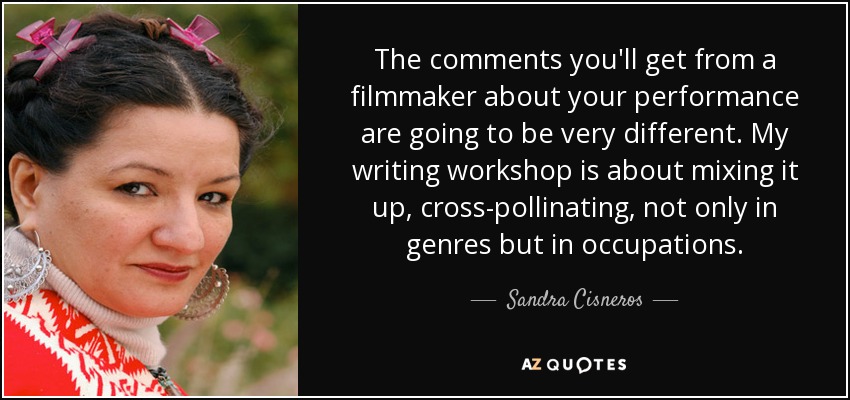
The comments you'll get from a filmmaker about your performance are going to be very different. My writing workshop is about mixing it up, cross-pollinating, not only in genres but in occupations.
One code prevails in the family; another, on the street; a third, in the workshop or store; a fourth, in the religious association. As a person passes from one of the environments to another, he is subjected to antagonistic pulls, and is in danger of being split into a being having different standards of judgment and emotion for different occasions. This danger imposes upon the school a steadying and integrating office.
Every good story needs a complication. We learn this fiction-writing fundamental in courses and workshops, by reading a lot or, most painfully, through our own abandoned story drafts. After writing twenty pages about a harmonious family picnic, say, or a well-received rock concert, we discover that a story without a complication flounders, no matter how lovely the prose. A story needs a point of departure, a place from which the character can discover something, transform himself, realize a truth, reject a truth, right a wrong, make a mistake, come to terms.
I once gave a workshop and I asked the women poets there, If you went back to that little town you've come from - these were from small towns - would you say, I'm a poet? And one of them said, If I said I was a poet in that town, they'd think I didn't wash my windows. And that stayed with me for so long, the sense of the collective responsibility of someone as against the individual thing it takes to be a poet.
It actually has transcended my career at the Geographic, so that when my career there ended, I had momentum as a teacher, and a belief in photographic education at the workshop level.
My Dad took a workshop from a photographer who worked at the Toledo Blade, a newspaper I delivered. I knew this photographer's work. My Dad took a night class from him at the University of Toledo. Without that class, I wouldn't have become a photographer, because my Dad came home and taught me what he learned in class.
People say to me, "Who's your favorite kind of photographer?" Or "Who would be your favorite photographer to have in a workshop?" And I always say, "My Dad."
The thing with my workshops is, photography is a thoughtful process. In an atmosphere of fast photography, and generally thoughtless, quick, automatic photography, I think that there is an interest in the slowed down, thoughtful approach.
That's who comes to my workshops. I jokingly tell my students that the class could be called "Your photographs: Better."
There are things that I teach, about building photographs, and that's why people come to my workshops. When people come to the workshops, they're consumed with seeking the subject, and I teach seeking the setting.
My home office and workshop are on an overlook on the only deep river gorge on the entire length of the Mississippi River.
I have a large standalone workshop on the back of my property where I prototype and build stuff. It's bright, roomy, and has a giant door so it's easy to bring projects in or out.
There are things I don't like, like sitting at the head of the class. It makes me uncomfortable. I'll do it in a seminar if I have to, but with a workshop, I try to put myself in the circle somewhere. Because that hopefully frees up some people by making somebody else sit at the nominal head of the table.
You don't teach information in a writing workshop.
I recall that my workshop leaders were tactful in their ways of acquainting me with my shortcomings as a writer. So much so that I hardly realized they were doing it. I want always to keep that sort of thing in mind when I'm teaching. The way you get better in everything in this life is to make mistakes. Otherwise you're probably doing it right by accident. But you have to do everything wrong before you can really start with some authority to do it right.
In the world of poetry there are would-be poets, workshop poets, promising poets, lovesick poets, university poets, and a few real poets.
I got out of college and I went to get my master's in creative writing at San Francisco State. I was working as an actor at the Actor's Workshop, being abused as a intern.
Well, you know, I played Mufasa in the workshop of The Lion King.
I've taken every writing class I've had available. I took classes in high school, and I took English and writing classes in community college, but I dropped out of college. I also attended a local writing workshop two years ago.
There's like a special group of people that come from different parts of the planet to study with me. It's nice. I just gave a workshop in Boston at the New England Conservatory, which was really nice.
A child came up to me and asked 'am I dreaming?' I had a similar experience coming to the Art Gallery of South Australia when I was a child. My mum had done a workshop here and it stayed with me. It's an important formative time.
With my union project in my hand, from town to town, from one end of France to the other, to talk to the workers who do not know how to read and to those who do not have the time to read....I will go find them in their workshops; in their garrets and even, if needed, in their taverns, and there, face to face with their poverty, I will compel them, in spite of themselves, to escape from this frightful poverty which is degrading and killing them.
Art itself cannot be taught, but craftsmanship can. Architects, painters, sculptors are all craftsmen in the original sense of the word. Thus it is a fundamental requirement of all artistic creativity that every student undergo a thorough training in the workshops of all branches of the crafts.
While I was in school, trying to figure out how to write an essay that could both satisfy my nonfiction workshops and still pass as something hybrid-y enough for my poetry workshops, I was looking for models, for forebears.
In the last workshop I taught, a woman flew in from Thailand. She's a medical doctor in Bangkok. I asked her in her one-on-one session where she wanted photography to be in her life.Did she want a second career? Was it about earning money? Or was it art? And she said "None of those. I want photography to be serious in my life." It would be like someone wanting music, like piano playing, to be a richer, deeper, and maybe even harder experience.
Follow AzQuotes on Facebook, Twitter and Google+. Every day we present the best quotes! Improve yourself, find your inspiration, share with friends
or simply: