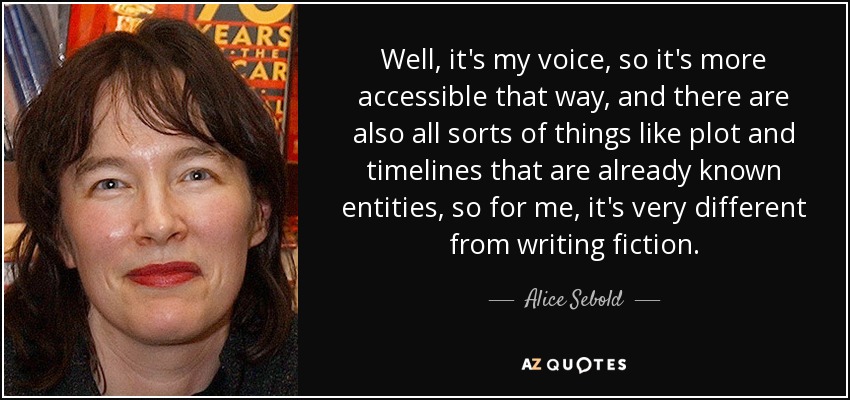
Well, it's my voice, so it's more accessible that way, and there are also all sorts of things like plot and timelines that are already known entities, so for me, it's very different from writing fiction.
I was uncomfortable writing fiction. My love was the personal essay rather than the novel.
When you're writing fiction it's a heightened voice. You're trying to cast a spell, which isn't the same thing as trying to cast someone into it. You are creating a reality but it's a different sort of performance.
Speech recognition is utterly crap for writing fiction. If you try reading a novel aloud you'll soon figure out why - written prose style is utterly unlike the spoken word.
Writing fiction is an inherently political activity because people-even imaginary ones-do not live in vacuums... From Twilight to Romeo and Juliet to The Little Mermaid, no work of the imagination is truly apolitical, because the world and our hopes for it are always part of our stories.
Writing fiction, like reading fiction, is a practice in empathy.
Rules such as "Write what you know," and "Show, don't tell," while doubtlessly grounded in good sense, can be ignored with impunity by any novelist nimble enough to get away with it. There is, in fact, only one rule in writing fiction: Whatever works, works.
I didn't lie, I was writing fiction with my mouth.
Characters more or less present themselves to me. I don't know their origins. I think if I did, if I seemed to myself to fabricate them, I could not induce suspension of disbelief in myself in the way writing fiction requires.
Writing fiction is the act of weaving a series of lies to arrive at a greater truth.
I always say that writing non-fiction versus writing fiction is a bit like architecture versus abstract painting.
Even when it comes to writing fiction, how do you encompass all this stuff that's right on the tip of your tongue? You have to fold that into what you're working on.
Writing criticism is to writing fiction and poetry as hugging the shore is to sailing in the open sea.
I came to fantasy fairly late. For some ten years, I had been happily writing fiction and non-fiction for adults. But I always loved fantasy, whether for adults or young people; and at that particular point in my life, I wanted to try it, to understand it, as part of the process of learning to be a writer. The results were beyond anything I could have foreseen. As I've said often and elsewhere, it was the most creative and liberating experience of my life.
Writing fiction is a solitary occupation but not really a lonely one. The writer's head is mobbed with characters, images and language.
Writing fiction is for me a fraught business, an occasion of daily dread for at least the first half of the novel, and sometimes all the way through. The work process is totally different from writing nonfiction. You have to sit down every day and make it up.
In science there is a dictum: don't add an experiment to an experiment. Don't make things unnecessarily complicated. In writing fiction, the more fantastic the tale, the plainer the prose should be. Don't ask your readers to admire your words when you want them to believe your story.
I instantly chucked my academic ambitions and began writing fiction full-time.
Under fun's new administration, writing fiction becomes a way to go deep inside yourself and illuminate precisely the stuff you don't want to see or let anyone else see, and this stuff usually turns out (paradoxically) to be precisely the stuff all writers and readers share and respond to, feel.
The worst part of writing fiction is the fear of wasting your life behind a keyboard. The idea that, dying, you'll realize you only lived on paper. Your only adventures were make-believe, and while the world fought and kissed, you sat in some dark room masturbating and making money.
The process of writing fiction is totally unconscious. It comes from what you are learning, as you live, from within. For me, all writing is a process of discovery. We are looking for the meaning of life. No matter where you are, there are conflicts and dramas everywhere. It is the process of what it means to be a human being; how you react and are reacted upon, these inward and outer pressures. If you are writing with a direct cause in mind, you are writing propaganda. It's fatal for a fiction writer.
When I'm writing about reality, I'm writing about death. When I'm writing fiction, I'm writing about life.
It is popular to believe that in order to see clearly one must believe nothing. This may work well enough if you are observing cells under a microscope. It will not work if you are writing fiction. For the fiction writer, to believe nothing is to see nothing.
Writing fiction is like remembering what never happened.
The pleasure of writing fiction is that you are always spotting some new approach, an alternative way of telling a story and manipulating characters; the novel is such a wonderfully flexible form.
Follow AzQuotes on Facebook, Twitter and Google+. Every day we present the best quotes! Improve yourself, find your inspiration, share with friends
or simply: