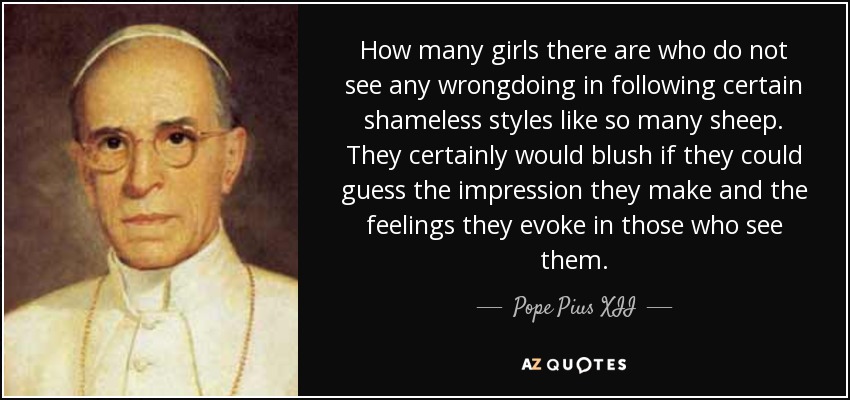
How many girls there are who do not see any wrongdoing in following certain shameless styles like so many sheep. They certainly would blush if they could guess the impression they make and the feelings they evoke in those who see them.
We are rather apt to consider an act wrong because it is unpleasant to us.
Most vices may be committed very genteelly: a man may debauch his friend's wife genteelly: he may cheat at cards genteelly
Many might go to heaven with half the labour they go to hell, if they would venture their industry the right way.
It is so often on the name of a misdeed that a life goes to pieces, not the nameless and personal action itself, which was perhaps a perfectly definite necessity of that life and would have been absorbed by it without effort.
Men whose wit has been mother of villainy once have learned from it to be evil in all things.
The popularity of disaster movies expresses a collective perception of a world threatened by irresistible and unforeseen forces which nevertheless are thwarted at the last moment. Their thinly veiled symbolic meaning might be translated thus: We are innocent of wrongdoing. We are attacked by unforeseeable forces come to harm us. We are, thus, innocent even of negligence. Though those forces are insuperable, chance will come to our aid and we shall emerge victorious.
No female iniquity was more severely condemned than the habit of plucking eyebrows and the hairline to heighten the forehead.
God holds each of us by a string. When we sin, we cut the string. But God ties it up again, making a knot. Each time our wrongdoing cuts the string, God ties another knot drawing us up closer to Him.
A wrongdoing doesn't give us the right to do wrong.
In the face of nature's overwhelming forces, humans needed a God who would protect them from harm. When they felt that they had broken the law or committed wrongdoing, people turned to a God who would judge them on the one hand and redeem their sins on the other. In this way, purely from slef-interest, the project of creating God in our own image proceeded--and continues to proceed.
Once we realise that utilitarianism comes with the idea of blameworthy rightdoing (such as when you push a big man onto the tracks in order to save five lives) and blameless wrongdoing (such as when you don't push a big man onto the tracks in order to save five lives), then utilitarianism all of a sudden appears to give the right answers.
Until we see something that is actually wrongdoing, we're probably not going to go on a fishing trip to go see look at.
The government would assert that individuals who are aware of serious wrongdoing in the intelligence community should bring their concerns to the people most responsible for that wrongdoing, and rely on those people to correct the problems that those people themselves authorized.
We reject President Donald Trump's view. It was a mistake to say that 'the Islamic world divided into "good" and "evil"', a major wrongdoing.
I respect very much the role of the media in our society; I think they can be very, very helpful. They serve as a very useful check, sort of a watchdog over the actions of the government, and I respect that. But there is a competing interest, and that is the ability of prosecutors to get information that may be absolutely essential to assist them in the investigation of illegal wrongdoing. And so you've got these two competing interests. I believe that the current policy at the Department of Justice reflects a careful balancing of those interests.
All of the evidence highlights the implicit bargain that is offered to citizens: pose no challenge and you have nothing to worry about. Mind your own business, and support or at least tolerate what we do, and you'll be fine. Put differently, you must refrain from provoking the authority that wields surveillance powers if you wish to be deemed free of wrongdoing. This is a deal that invites passivity, obedience, and conformity. The safest course, the way to ensure being “left alone,” is to remain quiet, unthreatening, and compliant.
Above all Christians are not allowed to correct by violence sinful wrongdoings.
Post-Watergate morality, by which anything left private is taken as presumptive evidence of wrongdoing.
I will use treatment to help the sick according to my ability and judgment, but never with a view to injury and wrongdoing. Neither will I administer a poison to anybody when asked to do so, nor will I suggest such a course. Similarly, I will not give to a woman a pessary to cause abortion. I will keep pure and holy both my life and my art.
Guilt agonizes over trifles, ignores habitual wrongdoing.
Society punishes not the vices of its members, but their detection.
Finding a way to extend forgiveness to ourselves is one of our most essential tasks. Just as others have been caught in suffering, so have we. If we look honestly at our life, we can see the sorrows and pain that have led to our own wrongdoing. In this we can finally extend forgiveness to ourselves; we can hold the pain we have caused in compassion. Without such mercy, we will live our own life in exile.
The moment we begin tolerating meanness, in ourselves and others, we are using our authorial power in the service of wrongdoing. We have both the capacity and the obligation to do better.
With our sympathy for the wrongdoer we need the old Puritan and Quaker hatred of wrongdoing; with our just tolerance of men and opinions a righteous abhorrence of sin.
Follow AzQuotes on Facebook, Twitter and Google+. Every day we present the best quotes! Improve yourself, find your inspiration, share with friends
or simply: