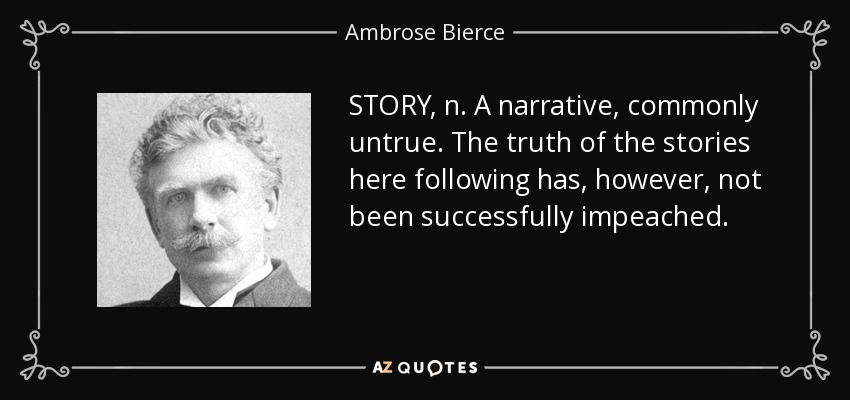


STORY, n. A narrative, commonly untrue. The truth of the stories here following has, however, not been successfully impeached.
INDIFFERENT, adj. Imperfectly sensible to distinctions among things.
PILGRIM, n. A traveler that is taken seriously. A Pilgrim Father was one who [was] not permitted to sing psalms through his nose [in Europe], followed it to Massachusetts, where he could personate God according to the dictates of his conscience.
OATH, n. In law, a solemn appeal to the Deity, made binding upon the conscience by a penalty for perjury.
EXHORT, v.t. In religious affairs, to put the conscience of another upon the spit and roast it to a nut-brown discomfort.
J, n. A consonant in English, but some nations use it as a vowel . . . from a Latin verb, "jacere", "to throw," because when a stone is thrown at a dog the dog's tail assumes that shape.
RITUALISM, n. A Dutch Garden of God where He may walk in rectilinear freedom, keeping off the grass.
TRUST, n. In American politics, a large corporation composed in greater part of thrifty working men, widows of small means, orphans in the care of guardians and the courts, with many similar malefactors and public enemies.
PIGMY, n. One of a tribe of very small men found by ancient travelers in many parts of the world, but by modern in Central Africa only. The Pigmies are so called to distinguish them from the bulkier Caucasians - who are Hogmies.
OYSTER, n. A slimy, gobby shellfish which civilization gives men the hardihood to eat without removing its entrails! The shells are sometimes given to the poor.
IMMORAL, adj. Inexpedient. Whatever in the long run and with regard to the greater number of instances men find to be generally inexpedient comes to be considered wrong, wicked, immoral.
CONGRESS, n. A body of men who meet to repeal laws.
INTENTION, n. The mind's sense of the prevalence of one set of influences over another set; an effect whose cause is the imminence, immediate or remote, of the performance of an involuntary act.
DEGRADATION, n. One of the stages of moral and social progress from private station to political preferment.
JOSS-STICKS- Small sticks burned by the Chinese in their pagan tomfoolery, in imitation of certain sacred rites of our holy religion.
MONSIGNOR- A high ecclesiastical title, of which the Founder of our religion overlooked the advantages.
PYRRHONISM- An ancient philosophy, named for its inventor. It consisted of an absolute disbelief in everything but Pyrrhonism. Its modern professors have added that.
PESSIMISM- philosophy forced upon the convictions of the observer by the disheartening prevalence of the optimist with his scarecrow hope and his unsightly smile.
If you would be accounted great by your contemporaries, be not too much greater than they.
WASHINGTONIAN, n. A Potomac tribesman who exchanged the privilege of governing himself for the advantage of good government. In justice to him it should be said that he did not want to.
OSTRICH, n. A large bird to which (for its sins, doubtless) nature has denied that hinder toe . . . . The absence of a good working pair of wings is no defect, for, as has been ingeniously pointed out, the ostrich does not fly.
MANICHEISM, n. The ancient Persian doctrine of an incessant warfare between Good and Evil. When Good gave up the fight the Persians joined the victorious Opposition.
PREHISTORIC, adj. Belonging to an early period and a museum. Antedating the art and practice of perpetuating falsehood.
PALM, n. A species of tree . . . of which the familiar "itching palm" ("Palma hominis") is most widely distributed . . . . This noble vegetable exudes a kind of invisible gum, which may be detected by applying to the bark a piece of gold or silver.
CAVILER, n. A critic of our own work.
Follow AzQuotes on Facebook, Twitter and Google+. Every day we present the best quotes! Improve yourself, find your inspiration, share with friends
or simply: