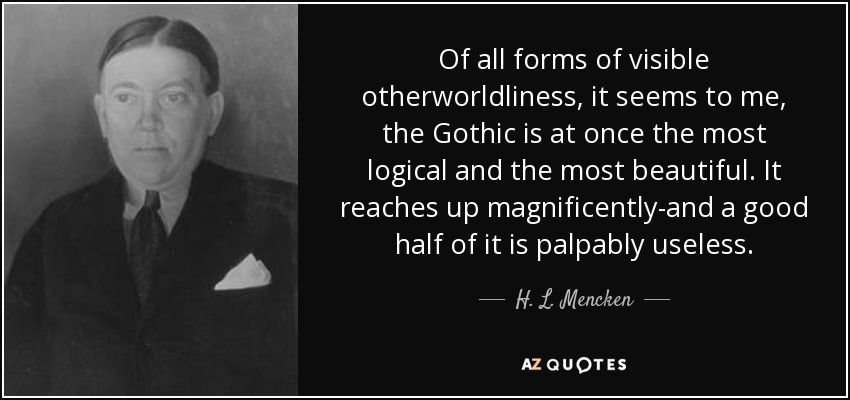

Of all forms of visible otherworldliness, it seems to me, the Gothic is at once the most logical and the most beautiful. It reaches up magnificently-and a good half of it is palpably useless.
The critic, to interpret his artist, even to understand his artist, must be able to get into the mind of his artist; he must feel and comprehend the vast pressure of the creative passion.
It is surely no mere coincidence that the land of the emancipated and enthroned woman is also the land of canned soup, of canned pork and beans, of whole meals in cans, and of everything else ready made.
At the end of one millennium and nine centuries of Christianity, it remains an unshakable assumption of the law in all Christian countries and of the moral judgement of Christians everywhere that if a man and a woman, entering a room together, close the door behind them, the man will come out sadder and the woman wiser.
Man is a beautiful machine that works very badly. He is like a watch of which the most that can be said is that its cosmetic effect is good.
He sailed through American history like a steel ship loaded with monoliths of granite.
What fetched me instantly (and thousands of other newcomers with me) was the subtle but unmistakable sense of escape from the United States.
The notion that artists flourish upon adversity and misunderstanding, that they are able to function to the utmost in an atmosphere of indifference or hostility - this notion is nine-tenths nonsense.
During many a single week, I daresay, more money is spent in New York upon useless and evil things than would suffice to run the kingdom of Denmark for a year.
Fame: an embalmer trembling with stage fright.
The way for newspapers to meet the competition of radio and television is simply to get out better papers.
No man ever quite believes in any other man.
It seems to me that a great university ought to have room in it for men subscribing to every sort of idea that is currently prevalent
The pedant and the priest have always been the most expert of logicians - and the most diligent disseminators of nonsense and worse.
What the meaning of human life may be I don't know: I incline to suspect that it has none.
The taboos that I have mentioned are extraordinarily harsh and numerous. They stand around nearly every subject that is genuinely important to man: they hedge in free opinion and experimentation on all sides. Consider, for example, the matter of religion. It is debated freely and furiously in almost every country in the world save the United States, but here the critic is silenced. The result is that all religions are equally safeguarded against criticism, and that all of them lose vitality. We protect the status quo, and so make steady war upon revision and improvement.
The Jews fastened their religion upon the Western world, not because it was more reasonable than the religions of their contemporaries - as a matter of fact, it was vastly less reasonable than many of them - but because it was far more poetical.
There comes a day of public ceremonial, and a chance to make a speech.... A million voters with IQs below 60 have their ears glued to the radio. It takes four days' hard work to concoct a speech without a sensible word in it. Next a dam must be opened somewhere. Four dry Senators get drunk and make a painful scene. The Presidential automobile runs over a dog. It rains.
Love begins like a triolet and ends like a college yell.
The seasick passenger on an ocean liner detests the good sailor who stalks past him 265 times a day grandly smoking a large, greasy cigar. In precisely the same way the democrat hates the man who is having a better time in the world. This is the origin of democracy. It is also the origin of Puritanism.
The Puritan, of course, is not entirely devoid of aesthetic feeling. He has a taste for good form; he responds to style; he is even capable of something approaching a purely aesthetic emotion. But he fears this aesthetic emotion as an insinuating distraction from his chief business in life: the sober consideration of the all-important problem of conduct. Art is a temptation, a seduction, a Lorelei, and the Good Man may safely have traffic with it when it is broken to moral uses--in other words, when its innocence is pumped out of it, and it is purged of gusto.
As if paralyzed by the national fear of ideas, the democratic distrust of whatever strikes beneath the prevailing platitudes, it evades all resolute and honest dealing with what, after all, must be every healthy literature's elementary materials.
One is conscious of no brave and noble earnestness in it, of no generalized passion for intellectual and spiritual adventure, of no organized determination to think things out. What is there is a highly self-conscious and insipid correctness, a bloodless respectability submergence of matter in manner--in brief, what is there is the feeble, uninspiring quality of German painting and English music.
What are the characters that I discern most clearly in the so-called Anglo-Saxon type of man? I may answer at once that two stickout above all others. One is his curious and apparently incurable incompetence--his congenital inability to do any difficult thing easily and well, whether it be isolating a bacillus or writing a sonata. The other is his astounding susceptibility to fears and alarms--in short, his hereditary cowardice.... There is no record in history of any Anglo-Saxon nation entering upon any great war without allies.
Happiness, like health, is probably also only a passing accident. For a moment or two the organism is irritated so little that it is not conscious of it; for the duration of that moment it is happy. Thus a hog is always happier than a man, and a bacillus is happier than a hog
Follow AzQuotes on Facebook, Twitter and Google+. Every day we present the best quotes! Improve yourself, find your inspiration, share with friends
or simply: