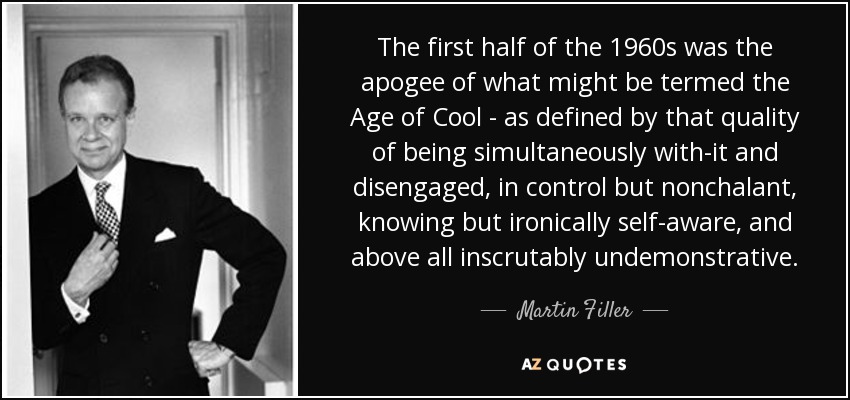
The first half of the 1960s was the apogee of what might be termed the Age of Cool - as defined by that quality of being simultaneously with-it and disengaged, in control but nonchalant, knowing but ironically self-aware, and above all inscrutably undemonstrative.
In the 1960s, The National Education Association changed its character. The NEA changed into a union. And from that point on you can see deterioration in the quality of schooling in the United States.
After World War II, a lot of people moved to the cities for work and abandoned the old vineyards. Then in the 1950s and 1960s, wineries were paid to produce volume at a cheap price. That's when the Lambruscos and bad Chianti were popular.
Nearly all the writing of our time is likely to disappear in a hundred years. Certainly most readers - and nearly all critics - feel that [Kurt] Vonnegut started to repeat himself, to grow increasingly self-indulgent and meandering, and to sometimes just blather in his later work. But his books up to "Slaughterhouse-Five" do possess a distinctiveness that will insure some kind of permanence, if only in the history of the 1960s and of science fiction.
Apart from the seemingly magical Internet, life in broad material terms isn't so different from what it was in 1953... The wonders portrayed in 'The Jetsons,' the space-age television cartoon from the 1960s, have not come to pass... Life is better and we have more stuff, but the pace of change has slowed down.
The most moving speech I have ever heard was Hugh Gaitskell saying he would 'fight, fight and fight again to save the party we love. That was the right message in 1960, and I believe it is still the right message today.
And that John F. Kennedy uttered the first variation of "ask not what your country can do for you" in Detroit on Labor Day in 1960. So Detroit was really central to Democratic politics United States. Every Democratic candidate would start their fall campaigns in Cadillac Square.
There was a way that I approached that with the art department and the background players, which was that I didn't want people to have stepped out of a catalogue. This is not a world of perfect beauty. I wanted it to be the real world of the 1960s. I know that some women walked out of the house without lipstick.
The job of the critic, as it might have been conceived in the 1950's or 1960's, was some kind of role of moral arbiter for people, not a huge number of people, but people who were, you know, fairly educated, well-placed people.
Usually when I drank too much, I could guess why I did so, the objective being to murder a state of consciousness that I didn't have the courage to sustain--a fear of heights, which sometimes during the carnival of the 1960s accompanied my attempts to transform the bourgeois journalist into an avant-garde novelist. The stepped-up ambition was a commonplace among the would-be William Faulkners of my generation; nearly always it resulted in commercial failure and literary embarrassment.
The venerable emeritus professors still at Yale when I entered graduate school [in the 1960s] may have been reserved, puritanical WASPs, but they were men of honor who had given their lives to scholarship. Today in the elite schools, honor and ethics are gone.
For inspiration I look to those great players who consistently found original ways to shock their opponents. None did this better than the eighth world champion, Mikhail Tal. The "Magician of Riga" rose to become champion in 1960 at age twenty-three and became famous for his aggressive, volatile play.
Until recently, the question was 'Why can't a woman be more like a man?' It should have been changed to 'Why can't both sexes be more like the best parts of each other?' Instead, the pendulum swung to the 1960s feminist lapel button Adam Was a First Draft. True enough. So are we all.
Tell me, why do former young designers who are now in their middle 40s have to redo the 1960s and 70s. Why they cannot invent fashion for today?
In the mid-1960s, as hard to believe as it may be now, choosing to go into academic philosophy was not an imprudent career choice. There were lots of academic jobs in philosophy then.
A citizen at his home in Rockford, Illinois, or Boulder, Colorado, could read a newspaper, listen to a radio, or watch the round-the-clock coverage on television, but he had no way of connecting with those who shared his views. Nor was there a quick, readily available tool for an ordinary citizen to gather information on his own. In 1960, communication was a one-way street, and information was fundamentally inaccessible. The whole idea of summoning up data or reaching thousands of individuals with the touch of a finger was a science-fiction fantasy.
In the 1950s and 1960s, the heroes were the long-term investors; today the heroes are the wise guys.
I died in 1960 from a prison sentence and poetry brought me back to life.
I feel that for the first time in a long time, educated Pakistanis are returning to their country to start up educational projects, to start up businesses, so instead of the brain-drain that happened in the 1950s and 1960s, the country is growing and improving economically.
The generation that migrated to the West in the 1970s or 1960s has now lived more in the West than India, and India has changed so much. My parents fall into that category.
When I arrived in America, I experienced serious culture shock. For someone with a religious upbringing, the 1960s were an extremely difficult time. Even though religion was a big part of the civil rights and peace movements, in my college religion was treated as irrelevant, hopelessly stodgy, and behind the times.
Back in 1960, the paper dollar and the silver dollar both were the same value. They circulated next to each other. Today? The paper dollar has lost 95% of its value, while the silver dollar is worth $34, and produced a 2-3 times rise in real value. Since we left the gold standard in 1971, both gold and silver have become superior inflation hedges.
When I first was exposed to Buddhism in the mid-1960s, I said it was so practical and utterly pragmatic. That's what attracted me to Buddhism.
In Britain, eponymous lifestyle branding as we know it started in the late 1960s, with two fascinating families - the Conrans and the Ashleys - who in increasingly brilliant settings and catalogues sold rather different visions of what the new ideal upper-middle-y life looked like.
The Olympics were produced absolutely the same way from 1960 through 1988. It was always the Western World against the Eastern Bloc. You didn't even have to spend one second developing the character of any of the Eastern Bloc athletes. It was just good guys and bad guys.
Follow AzQuotes on Facebook, Twitter and Google+. Every day we present the best quotes! Improve yourself, find your inspiration, share with friends
or simply: