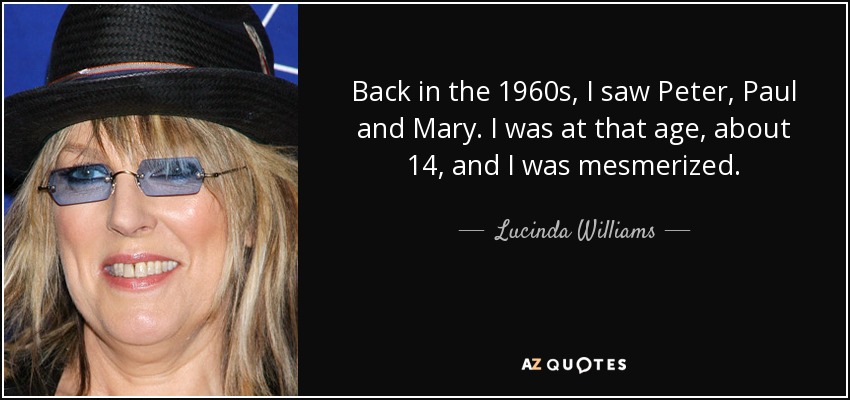
Back in the 1960s, I saw Peter, Paul and Mary. I was at that age, about 14, and I was mesmerized.
Since the 1960s, mainstream media has searched out and co-opted the most authentic things it could find in youth culture, whether that was psychedelic culture, anti-war culture, blue jeans culture. Eventually heavy metal culture, rap culture, electronica - they'll look for it and then market it back to kids at the mall.
I was born twice: first, as a baby girl, on a remarkably smogless Detroit day in January of 1960; and then again, as a teenage boy, in an emergency room near Petoskey, Michigan, in August of 1974.
I hated the 1960's feminists," she says. "They were dogmatists, you see. In comes ideology, and out goes common sense. This is my experience of life.
[Las Vegas in the early 1960] was thrilling, exciting... I would describe it as very Parisian.
Could it be? Samantha Kingston? Home? On a Friday?” I roll my eyes. “I don’t know. Did you do a lot of acid in the sixties? Could be a flashback.” “I was two years old in 1960. I came too late for the party.” He leans down and pecks me on the head. I pull away out of habit. “And I’m not even going to ask how you know about acid flashbacks.” “What’s an acid flashback?” Izzy crows. “Nothing,” my dad and I say at the same time, and he smiles at me.
Every generation faces a challenge. In the 1930s, it was the creation of Social Security. In the 1960s, it was putting a man on the moon. In the 1980s, it was ending the Cold War. Our generation's challenge will be addressing global climate change while sustaining a growing global economy
No one has a monopoly on knowledge the way that, say, IBM had in the 1960s in computing, or that Bell Labs had through the 1970s in communications. When useful knowledge exists in companies of all sizes and also in universities, non-profits and individual minds, it makes sense to orient your innovation efforts to accessing, building upon and integrating that external knowledge into useful products and services.
There does exist and has existed for a generation, an international Anglophile network which operates, to some extent, in the way the radical Right believes the Communists act. In fact, this network, which we may identify as the Round Table groups, has no aversion to cooperating with the Communists, or any other groups, and frequently does so. I know of the operations of this network because I have studied it for 20 years and was permitted for two years, in the early 1960s, to examine its papers and secret record.
Since 1960, there have been more plastic syringes available than anyone could need. And yet, for the decades since then, WHO has done NOTHING to stop the spread of vicious diseases that result from the mass re-use of dirty needles.
First, let's look at the importance of the young adult in the cigarette market. In 1960, this young adult market , the 14 to 24 age group, represented 21% of the population. As seen by this chart, they will represent 27% of the population in 1975, they represent tomorrow's cigarette business, as this 14 -24 age group matures, they will account for a key share of the total cigarette volume -- for at least the next 25 years .
Is it a coincidence that stories from the private life became more popular just as the grand hope for public redemption through revolution was beginning to sour? I witnessed a similar shift in taste in my own time. In the 1960s, while a hopeful vision of a just society arose again, countless poems and plays concerning politics and public life were written, read, and performed. But after the hope diminished and public life seemed less and less trustworthy, this subject was less in style.
The I-95 bridges were built in the early 1960s and are now more than 50 years old. The same vintage as the I-35 bridge that collapsed in Minnesota back in 2007, killing 13 people and injuring 145. The antiquated Skagit River Bridge in Washington state that collapsed last May after a truck hit one of the trusses was even older. And it's not just bridges. According to the American Society of Civil Engineers, 32 percent of the major roads in America are now in poor condition and in need of major repairs.
During the 1960s, and again in the 1970s, growth in manufacturing productivity in the United Kingdom was the lowest of all the seven major industrial countries in the world. During the 1980s, our annual rate of growth of output per head in manufacturing has been the highest of all the seven major industrial countries.
Despite the Internet 's origin in the late 1960s as a government sponsored means of communication between the Department of Defense, private industry, and academia, it has been at its best and generated the greatest economic, social, and technological benefits since it was 'liberated' by the hordes of 'geeks' who were originally hired to run it by employers who were not themselves conversant with computers, and couldn't tell when their employees were exchanging official traffic or trading dirty jokes and recipes for marijuana brownies.
When Tony Benn became a minister in the 1960s -- and I think this must be apocryphal -- he had a huge map of Britain hung upside down in his office, so the channel was at the top and Scotland was at the bottom and, apparently, he said, "This is how we need to look at this country, with the money and the power draining by force of gravity out of the south east." That was a great idea. I rather liked him for that. I don't know if it's actually true or not.
As South Korea shows, active participation in international trade does not require free trade. Indeed, had South Korea pursued free trade and not promoted infant industries, it would not have become a major trading nation. It would still be exporting raw materials (e.g., tungsten ore, fish, seaweed) or low-technology, low-price products (e.g., textiles, garments, wigs made with human hair) that used to be its main export items in the 1960s.
Back in the early 1960s, when I was eight or nine. Some neighborhood boys and I saw a disc-shaped, windowless object that hovered, silent, then simply vanished. My parents said, "That's very nice" and ignored it, but I knew what I'd seen, and it was life-changing.
It was a time period in the 1960, when a generation of souls looked at the established society, looked at the pettiness, the greed, the hate, and rejected it and tried to create something new. Their creation neither succeeded nor failed. It was another experience.
My travels to the Far East occurred primarily during the 1960's. Naturally, I have returned many times since. Of course, there was concern from my family that I was traveling to far distant lands to accomplish snowboarding activities that no one had tried yet.
In the early 21st century, it is easy to condemn the Bond books for being racist and imperialist, sexist and misogynist, elitist and sadistic. But this is merely another way of saying that we cannot understand the Bond books without reference to the personality, the outlook and the 'Tory imagination' of the man who wrote them, and to the time in which he wrote them; and that we cannot understand the 1950s and 1960s without some reference to them, and to him.
Television in the 1960s & 70s had just as much dross and the programmes were a lot more tediously patronising than they are now. Memory truncates occasional gems into a glittering skein of brilliance. More television, more channels means more good television and, of course, more bad. The same equation applies to publishing, film and, I expect, sumo wrestling.
After all, the internet originated around 1960 and wasn't privatized until 1995. That's thirty five years in the public domain during the hard, creative development period.
In effect, I grew up in a sort of timewarp, a place where times are scrambled up. There are elements of my childhood that look to me now, in memory more like the 1940s or the 1950s than the 1960s. Jack [Womack] says that that made us science fiction writers, because we grew up experiencing a kind of time travel.
The construction of social housing and the attempt to support families seeking to buy their own homes are all projects from the 1960s and '70s. It all sounds old-fashioned, but it is actually completely modern.
Follow AzQuotes on Facebook, Twitter and Google+. Every day we present the best quotes! Improve yourself, find your inspiration, share with friends
or simply: