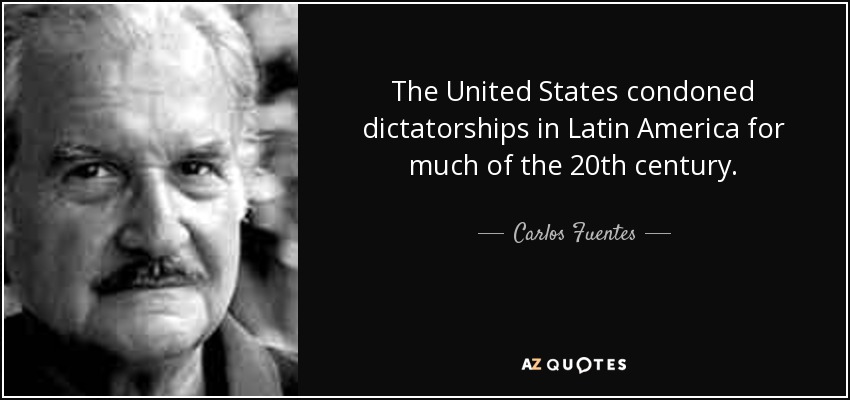
The United States condoned dictatorships in Latin America for much of the 20th century.
Mention the gothic, and many readers will probably picture gloomy castles and an assortment of sinister Victoriana. However, the truth is that the gothic genre has continued to flourish and evolve since the days of Bram Stoker, producing some of its most interesting and accomplished examples in the 20th century - in literature, film and beyond.
I like classical music of the late 19th and early 20th centuries, and I adore Bach above all.
The Hawk and the Dove is a wonderful idea for a book, wonderfully carried out. Nicholas Thompson has used illuminating new material to present each of his protagonists in a convincing, respectful, but unsparing way. Even more valuable, he has used the interactions and tensions between Paul Nitze and George Kennan to bring much of American 20th century foreign policy to life, with human richness ever present but with the big issues clear in all their complexity.
When I first started to do fashion shows I didn't have the budget to hire top models so I would cast women who inspired me, and ask them to walk how they walked. I was doing a mise en scène, which for me was normal. I love for people to see my clothes, but it was more about the attitude of the girls. The revues of the late 19th century/early 20th century were very much a reflection of what was happening in society and politics, and for me that is also the role of the fashion designer.
Well, the first thing I had to do was to read a lot. First of all, about education... and looking at education from the Middle Ages right through to the 20th Century. The second major area was country life in the 19th Century, which I don't know much about these days.
In the first half of the 20th Century, we lived through human disasters on a scale unimaginable. The Holocaust was once suggested would be the end of not only civilization, but art, too.
It was a different social structure. I'd go to [David] Bailey's for dinner at 10:30. There were always girls there and a house full of . . . I don't know, anybody. Cecil Beaton, Diana Cooper . . . And there I am sitting down with these creatures of the 20th century, and it was normal to us.
By far the most dangerous people in the world are optimists (those who believe that all can be made well here below). If you think all can be made well in this world, then you will go to any extreme to make it happen. There is the story of the 20th century. As Lenin said, "You can't make an omelet without breaking a few eggs".
A patient had a 50-50 chance of benefiting from visiting a physician as of 1910. Medicine was more like voodoo than science until the 20th Century.
It should come as no surprise that writers take an interest in punctuation. I have been told that the dying words of one famous 20th-century writer were, "I should have used fewer semicolons" - and although I have spent months fruitlessly trying to track down the chap responsible, I believe it none the less. If it turns out that no one actually did say this on their deathbed, I shall certainly save it up for my own.
The cell phone has transformed public places into giant phone-a-thons in which callers exist within narcissistic cocoons of private conversations. Like faxes, computer modems and other modern gadgets that have clogged out lives with phony urgency, cell phones represent the 20th Century's escalation of imaginary need. We didn't need cell phones until we had them. Clearly, cell phones cause not only a breakdown of courtesy, but the atrophy of basic skills.
Just because a lot of people know something nominal doesn't make it important. A lot of people know what a pencil sharpener is, but that doesn't make it the most important invention of the 20th century.
Images in the 20th century had a unique power where image became divorced from reality, and often more important than reality. Buildings were judged more by the way they looked in magazines than by the satisfaction people felt when using them.
For me, going back to itinerant landscape painting, it's not about returning to an older method, but about building on what happened in the 20th century in photography. And also highlighting what the differences are between a painting and a photograph in picturing space.
Much more than a 20th-century village storyteller, Cees Nooteboom stands as an impressive and inimitable voice among contemporary writers.
I was interested in Armstrong to begin with because he is the most important figure in Jazz in the 20th Century. There's simply no question about it. I mean, if you're going to compare him to somebody, it's Shakespeare in terms of centrality of the tradition, in being at the beginning of it.
We have a lot of long narrative poems written in the 20th century, but they're not very well known, and they're not read by very many people.
If something works for you, you continue to do it. I did a bunch of pictures for 20th Century Fox when Alan Ladd was over there, but I set the budgets so low that they'd approve and I'd deliver the film. They would have no say in it, which is the kind of arrangement I liked.
The 'realist' conception of continuing old-fashioned 'balance of power' politics may have been well founded in the past, but it is inconsistent with our increasing interdependent world. On moral grounds alone there can be no justification for the 20th century level of killing. To settle disputes without violence must become the primary goal of foreign policy for every nation.
When I was a kid, I looked at art as a way of blending everything. One of my favorite composers is Wagner - who coined the term "gesamtkunstwerk," or "total art work." That's what was going on in the 19th century, and the 20th century just kept it going.
I think if the United States gave anything to culture at large in the 20th century, the most important contribution made was the popular song.
The sexual revolution produced cultural convulsions that were unparalleled in the 20th century.
The sexual revolution produced cultural convulsions that were unparalleled in the 20th century. The female sex was historically sexualized and required to have orgasms for the first time. Sexual "deviants," particularly homosexuals, achieved partial emancipation.
When I write lyrics, I really do go into an automatic folk appropriation mode... I see the vernacular register of 20th century song as being a bunch of forms to adapt and reconfigure.
Follow AzQuotes on Facebook, Twitter and Google+. Every day we present the best quotes! Improve yourself, find your inspiration, share with friends
or simply: