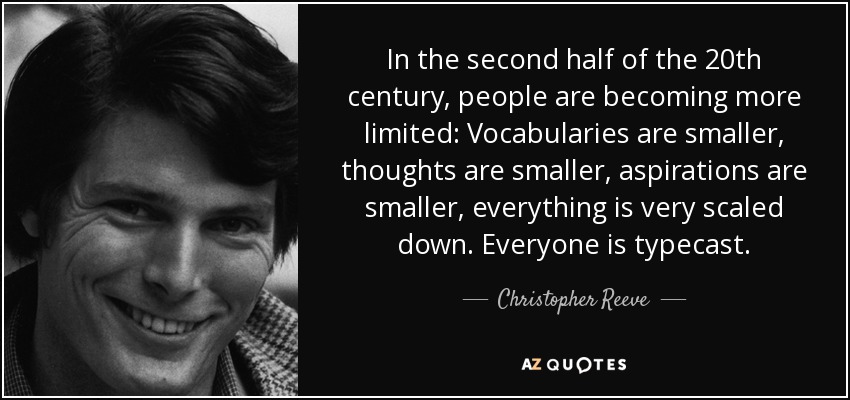
In the second half of the 20th century, people are becoming more limited: Vocabularies are smaller, thoughts are smaller, aspirations are smaller, everything is very scaled down. Everyone is typecast.
I think that Malcolm X was the most remarkable historical figure produced by Black America in the 20th century.
It is very easy for me to imagine in 200 years, people looking back at chemotherapy as proof that people of the 20th century were insane and just morons.
Prior to the early 20th century, for the totality of humankind's existence if they saw something moving, it meant it was there. If they saw a tiger walking, that meant they were near a live tiger. This was entrenched in our subconscious and our unconscious.Then that drastically changed with film and television.
The 20th century was a turning point; it freed and emancipated women, broke the back of segregation, and began the struggle to give justice to gay and lesbian people. But the Christian church, in both Catholic and Protestant forms, resisted every one of those humanizing developments. The church was on the wrong side of all three of those fights.
[Louis Brandeis] at the age of 57 decided to become the head of the American Zionist movement was more influential than anyone else in the 20th century in persuading Woodrow Wilson to recognize a Jewish homeland in Palestine.
I'd signed up not just for Christianity but the established Church of England. That has a particular history and I think we rather lost it in the 19th Century, we became so much part of empire and colonialism, the language of the Church Of England still reflects that Victorian time. As the 20th Century developed, not surprisingly people left the church and I can see the church's role in losing people.
Sacrifice. I'd never been in a position where I was number one on the call sheet, and everything was in my lap. I worked 16 hour days, and I was just not the lead of any film, it was a film about Jesse Owens, one of the greatest heroes of the 20th century. It was a whole new type of responsibility. It was a big weight, and I wanted to do him justice, especially in reviving him after 80 years.
It's really the story of a young woman, or two women, growing up in Naples in a poor neighborhood. The way that they get out of it - or don't get out of it - that's part of it. But it's also the story of the mid-20th century in Italy so it's really like a social, historical and personal novel. I think that even though I didn't live in Italy in those years, it did cover that same type of generational upbringing that someone like me might've had in America.
Perhaps unsurprisingly, there's a paradox here! Kierkegaard's own indirect communication proposes that we start with the experience of those who don't believe and meet them on their own ground. His success in doing this is evidenced by the fact that, at least for some periods of the 20th century, aspects of his work became a major focus for radical thinkers of various kinds, including the non-religious and, interestingly, a significant number of Jewish thinkers (Buber, Rosenzweig, Taubes, and others).
All of my grandparents came to the United States from Italy during the early years of the 20th century. I believe that my grandparents came here to take advantage of the opportunities furnished by a growing country with an open society.
Judge Samuel Alito was born and raised in the great state of New Jersey. Our state has a legacy of producing outstanding jurists, most notably the late William J. Brennan, who ushered in our nation's recommitment to civil rights in the latter half of the 20th century.
For me, the Dennis Wilson story is a quintessential You Must Remember This story because it's one of these stories that people never talk about, don't really think about, and it's forgotten within this major thing that is thought to be this cataclysmic event of the 20th century.
That was Robert Aldrich. And that [Emperor Of The North] was one of the only times I actually got a part in a movie in the conventional way: The role was there, I auditioned, I auditioned again, and then I actually did a full-fledged screen test, which they shot on a soundstage on the lot at 20th Century Fox. They put up a set, and Robert Aldrich actually directed me in this screen test.
You have the upper class Negroes who are the modern day Uncle Toms or the 20th century Uncle Toms. They don't wear a handkerchief anymore. They wear top hats. They're called Doctor, they're called - Reverend, but they're still - they play the same role today that Uncle Tom played on the plantation.
It's clear that there has to be some play between the vitality of invention in economic life and some regulation of it, and in some ways the great ideological wars of the 20th century that cost so many lives had to do with whether to have managed economies directed by government or economies directed by the free movement of capital, which is only partially subject to government regulation.
I think that poets can say, "What we want is for everybody on earth to wake up free from fear and with access to medicine and clean water and education." But I don't think poets have any special insight on how to get there. And the 20th century is a pretty good record of that because so many of the great poets were Stalinists: Vallejo, Neruda, Eluard, Aragon, etc. They wrote their odes to Lenin and Stalin. They glorified some of the most violent and grotesque dictatorships of the 20th century. And a lot of the ones who were not Stalinists were fascists or fascist sympathizers.
The nationalism and the protectionism that was built into the Mexican Revolution in 1910 and that characterized the Mexican attitude to the United States for much of the 20th century were difficult to overcome. But that actually has occurred. And the cooperation, trust and confidence that have been built is not something that should be abandoned without great consideration for the potentially grave consequences to the United States.
Lee Marvin was there at the same time, and I knew obviously it was his movie [Emperor Of The North], and Ernie Borgnine was playing the other part in the movie.I met Marvin there at wardrobe, and he said, "What are you doing for lunch?" I said, "Nothing." He said, "C'mon with me!" And he took me to the commissary. I walked into the commissary with Lee Marvin at 20th Century Fox, and he introduced me to people. He said, "This's Keith Carradine. We're doin' this movie together." He was so cool. I mean, my God.
A dining club which I was involved in at Oxford University invited Sir Isaiah Berlin to dinner, who I believe was probably the greatest liberal philosopher in the 20th century. I sat beside him and we spoke about liberal philosophy and the events of the 20th century all night over dinner - it was unforgettable!
Gone is any mention of American exceptionalism. I happen to believe that twice, three times in the 20th century, the United States saved Western democracy, both World War - both World Wars and the Cold War.
You know, on the spectrum of religious belief, there is atheism - these are people that don't believe. There's theism - these are the believers and agnostics say it's beyond comprehension that the whole issue of God us unknowable. You might be interested to know that perhaps the greatest mind of the 20th century Einstein, the one time that he actually used one of these appellations was in a letter about five years before he died and he referred to himself as an agnostic.
One of my inspirations, Harry Houdini, remains an icon of the art because he defied our primal fears. His demonstrations in the early 20th century, especially his escape from the Chinese water torture cell, represented triumph over suffocation, drowning, disorientation and helplessness.
Regarding social order, [Francis] Fukuyama writes, "The systematic study of how order, and thus social capital, can emerge in spontaneous and decentralized fashion is one of the most important intellectual developments of the late twentieth century." He correctly attributes the modern origins of this argument to F. A. Hayek, whose pioneering contributions to cognitive science, the study of cultural evolution, and the dynamics of social change put him in the forefront of the most creative scholars of the 20th century.
What we have lived through, the 20th century, has been like a great party. Adults now have had the best time humanity has ever had. Now the party is over and the Earth is reckoning up.
Follow AzQuotes on Facebook, Twitter and Google+. Every day we present the best quotes! Improve yourself, find your inspiration, share with friends
or simply: