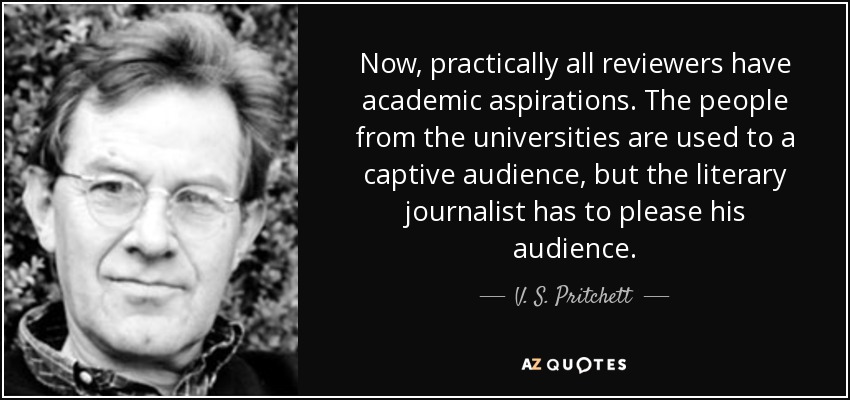
Now, practically all reviewers have academic aspirations. The people from the universities are used to a captive audience, but the literary journalist has to please his audience.
In a post 9/11 world, in which the uncritical essentializing of people from the "Third-World" has been legitimized; Iraq and Afghanistan have been dehumanized in an attempt to disseminate enlightenment in those "dark" regions; the discourse of "honor killings" is prevalent in the North West Frontier Province of Pakistan and has carved a niche in Western academic discourse as another instance of the incorrigible bestiality of the Orient.
Can a geology teacher blithely tell his students that the earth is flat, or a European history professor that the Holocaust didn't happen? That's not academic freedom, but dereliction of duty.
We found out that the young people who had a substantial number of lessons in the Resolving Conflict Creatively Curriculum ... not only did better in terms of people skills, that they managed their emotions, they were less violent and more caring, but they actually did better on their academic achievement tests.
...if use is not an appropriate criterion for decision making in the academic life, what is? Love. ...The virtues of love as a criterion for choosing a college major...it is not pretentious. "Use" is pretentious because it claims to know something about the future that it doesn't really know. Love is immediate... [love] guarantees that you will work to your highest potential...it is part of who you are, and not just something you think, often wrongly, that you can use.
In Britain the power of authority was weakened. There was much more individual freedom and there was great academic freedom.
In the mid-1960s, as hard to believe as it may be now, choosing to go into academic philosophy was not an imprudent career choice. There were lots of academic jobs in philosophy then.
I'd come into town from the bush - after 28 years of field work in natural systems - and become an academic. So I turned my attention to humans, much as I had to possums in the forests.
I put that part of myself into both Brendan and Evelyn [from The Thorn and the Blossom] - as well as some of my own anxieties about the academic life!
My uncommon sense told me to write this book [Turn and blossom], even though I was in the middle of making final revisions to my dissertation! Common sense would have said, finish the dissertation and get a good, solid academic position. But instead, I got to do something that no one else has done, because I don't think anyone has written a book quite like this one. And look at how beautiful it is!
I don't approach my writing or my work from an academic or analytical point of view. I do it for myself.
Bear in mind that we [ with Edward Herman] did not devise the terms "manufacture of consent" and "engineering of consent." We borrowed them from leading figures in the media, public relations industry, and academic scholarship.
It is familiar to mainstream academic scholarship. One very prominent political scientist, in his standard text American Politics 20 years ago, observes that "The architects of power in the United States must create a force that can be felt but not seen."
There is extensive critical scholarship that provides illustrations in many areas of scholarship. I've discussed many cases myself, while also citing and often relying on academic studies that disentangle these webs of mystification woven for the general public. It's impossible to provide illustrations that would even approach accuracy, let alone carry any conviction, without going well beyond the bounds of this discussion.
Intellectuals of the categories happen to enjoy unusual privilege, unique in history, I suppose. It's easy enough to find ugly illustrations of repression, malice, dishonesty, marginalization and exclusion in the academic world.
I like the way Microsoft participates in other-than-mainstream activities, such as academic research, charities, scholarships and connecting the disconnected by providing technology support to underserved people.
It may be primarily property taxes in the case of a public library, or state taxes and tuition in the case of an academic library at a public university, but the funding sources of most libraries continue to have a strong geographic component.
The music and the philosophy feed off of one another on a subconscious level, though I've never really integrated my academic teaching into songwriting. But what they have in common is that they're both ways to tap into the mysterious parts of our world.
The audience creates its own personality, I've noticed, in the first five minutes. They will either be generous, funny, silly, withholding, academic, analytical, grudging. And I'm fascinated with how that gets constructed, because it happens right away.
It's an academic book, and it's discussed under academic criteria. German historians cultivate so-called objectivity. They persuade themselves that they can switch off the subjective and therefore the unsettling.
A large part of academic community is unthinkingly self-involved, producing reams of sterile writing - often consuming unbelievable amounts of public funds - and serving as an instruction manual for how to chase away readers and ignore historical insights.
I decided to become a teacher because I thought it would be a great career where I could wear different hats. You're an academic one moment, and you're a psychologist the next moment, an athlete the next moment... when you are out on the playground or coaching...so it enables you to play different roles.
I think people are surprised when I string two sentences together. But I had a fiercely academic upbringing.
I had my own insecurities, which a lot of my comedy would come from, about not being able to live up to their academic expectations. Acting out those insecurities was a way of confronting them, like, “Let me just lean into being a guy who can’t read or write.”
Storytelling is how history is passed. It's what our ancestors did, it's what everybody's done. It has to come back into a story because otherwise, it's stuck in this book and it's boring and it's academic and I'm not against intelligence and I'm not against education, I don't want to be misunderstood, but we have tell the stories to our young people a little bit early and history gives us a lot of things.
Follow AzQuotes on Facebook, Twitter and Google+. Every day we present the best quotes! Improve yourself, find your inspiration, share with friends
or simply: