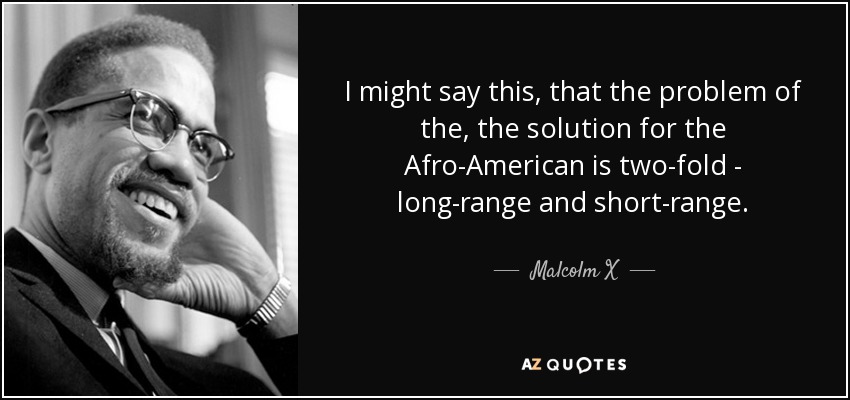
I might say this, that the problem of the, the solution for the Afro-American is two-fold - long-range and short-range.
The separating of a section of America for Afro- Americans is similar to expecting a heaven in the sky somewhere after you die.
The lesson this teaches and which every Afro-American should ponder well, is that a Winchester rifle should have a place of honor in every black home, and it should be used for that protection which the law refuses to give. When the white man who is always the aggressor knows he runs as great a risk of biting the dust every time his Afro-American victim does, he will have greater respect for Afro-American life. The more the Afro-American yields and cringes and begs, the more he has to do so, the more he is insulted, outraged and lynched.
I grew up in New York. We were all diversified, as far as music was concerned. I grew up liking just about everything. So I tried to incorporate that into my playing, although the original school where I came from was Afro-Cuban music. But I liked all kinds of music -- I tried to bring that into everything.
The final test of Afro-American studies will be the extent to which they rid the minds of whites and blacks alike of false learning, and the extent to which they promote for blacks and whites alike a completely rewarding participation in American life.
I keep telling everyone that I want to start a revolution but no one is taking me seriously. If I had black skin and an afro, would you take me seriously? If I was an Arab waving a hand grenade, would you take me seriously?
One of my dreams is to expand and make sure African music and Afro Beats music is really on the map. I would like to be a contribution to that success.
There came a point when I wanted to do television, and I didn't think the Afro was going to play, so I made a very difficult choice - to straighten my hair.
To say that the Afro American created jazz doesn't mean anything bad about Anglo Americans, and I always teach my younger jazz musicians that at this point the entirety of the American tradition is your heritage, and you need to know it.
When I did the Abyssinian mass, I went through the whole history of the church music and the gospel music, even with the Anglo American hymns, the Afro American hymns, the spirituals and how it developed, up to Thomas Dorsey and the Dixie Hummingbirds, going through the history of the music, jazz musicians.
When I was a little kid wanting to play music, it was because of people like Pete Johnson, Huey Smith, Allen Toussaint, Professor Longhair, James Booker, Art Neville ... there was so many piano players I loved in New Orleans. Then there was guys from out of town that would come cut there a lot. There was so many great bebop piano players, so many great jazz piano players, so many great Latin piano players, so many great blues piano players. Some of those Afro-Cuban bands had some killer piano players. There was so many different things going on musically, and it was all of interest to me.
When you go to South Africa, you get a different vibe and a different sound. The music is awesome the people are loving it. When you go to Botswana, it's a different ball game. The people out there love Afro Beat Hip Hop so much. When you go to Sierra Leone it's different, when you go to Nigeria it's different... It's all pretty exciting!
In January of 1969, after a meeting to discuss the leadership of UCLA's new Afro-American Program, [Alprentice "Bunchy" Carter and John Huggins, Jr.] were murdered on campus by a rival black nationalist group, the United Slaves Organization. This shook up all the students, black and white, and made us all realize that what we were doing wasn't just an academic exercise, but had repercussions in the real world.
I had a great fashion season in September so I told my agent that I would really like to walk the 2015 Victoria's Secret fashion show whilst rocking my short Afro hair.
A friend of mine who works for naval intelligence said an aerial satellite revealed that 1.9 million attended the event in 1995. But if they would have had a rumble at the march the newspapers would have said that 75 million Afro-Americans were there.
At 50, I thought proudly: Here we are, half century! Being 60 was fairly frightening. You want to know how I spent my 70th birthday? I put on a completely black face, a fuzzy black Afro wig, wore black clothes and hung a black wreath on my door.
When I say Afro-American aesthetic, I'm not just talking about the United States, I'm talking about the Americas. People in the Latin countries read my books because they share the same international aesthetic that I'm into and have been into for a long time. And it's multicultural.
Forget the methods or the differences in methods. As long as we agree that the thing that the Afro-American wants and needs is recognition and respect as a human being.
The problem [ of the twenty-two million Afro-Americans] is so broad that it's going to take the inner working of all organizations.
Samba rhythm is a great one to sing on, but it's also got some other suggestions in it, an undercurrent of being primitive - because it is a primitive African, South American, Afro-whatever-you-call-that rhythm. So to white people, it has a very sinister thing about it.
The hearts of Afro-American women are too warm and too large for race hatred. Long suffering has so chastened them that they are developing a special sense of sympathy for all who suffer and fail of justice.
There were tensions between these two organizations [Organization of Afro-American Unity and N.O.I.] , and Malcolm had to negotiate between them and since he was out of the country a great deal of the time, it was rather difficult for him to do so.
In the era of slavery, you could be a so-called Afro-Cuban one day and a so-called Black American the next day, or vice versa. I mean there was all this back and forth, and there was a lot of opposition in Black America to slavery in Cuba in particular, because slavery in Cuba lasted until the 1880s.
I've tried lots with my hair. Obviously I used to have it as a number one all over, super easy, but then I started to grow it out. I had an afro and then I got rid of the sides.
Biologically speaking the Afro-Asiatic block is in the ascendancy - always remember that both Negro and White are minority groups - the largest race is the Mongoloid group.
Follow AzQuotes on Facebook, Twitter and Google+. Every day we present the best quotes! Improve yourself, find your inspiration, share with friends
or simply: