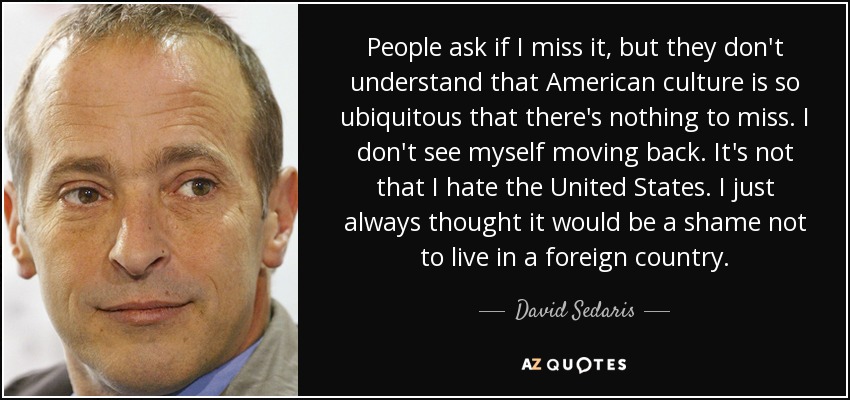
People ask if I miss it, but they don't understand that American culture is so ubiquitous that there's nothing to miss. I don't see myself moving back. It's not that I hate the United States. I just always thought it would be a shame not to live in a foreign country.
American culture never necessarily made sense to me, but they should warn you: leaving comes with a huge sense of alienation that never goes away.
It is not about promoting a distinct and great American culture because today's Democrat Party does not believe in one.
I think Latin American cultures are really rich and fascinating. I like the pomp and circumstance of some of their rituals and ceremonies.
Coming up in the African-American culture, we were taught that we belonged to the universe and society was wrong in the way it dealt with us. We had to learn to express and affirm values not from the winning position.
There's been this perception that Europeans still hold on to, that they discover the real talented ones in American culture and give them proper credit and that's not true anymore - it used to be. A lot of jazz musicians would get respect in Europe.
In American culture you leave home at 18. In the Asian culture, your parents don't really want you to leave home. So my parents just thought I was going to be one of those kids. I was like, "I'm never going to make a living at whatever I do." I just liked pretty things.
Yes, but the thing is my influences are so rooted in afro-American culture especially that it's quite sad to not enjoy the same success because the influences are so strong from there.
What city has given the world more in terms of American culture than New Orleans? There is none. Not New York. Not L.A. Not Chicago. Not anywhere, in the sense that African American music has gone around the world twenty times over, and it's continuing to evolve. It is our greatest cultural export.
Because in Australia we're so inundated with American culture, television, this that and the other, everyone in Australia can do an American accent. It's just second nature.
I often suggest in workshops that if you have 30 students in your American History course in 11th grade, or whatever grade level, that you maybe triple them up. You put, and have them choose, let's say 11 different Native American cultures. Maybe you give them a list of 15 and they choose 11 of those 15 so that they have some choice in the matter.
The gestures and the swagger and the attitude of black men is imitated everywhere in American culture, but people still find black men intolerable.
Even though we were influenced by American culture and music, we like the rest of Europe have been colonized with that in the post-war period. At the same time there's a sense of dirty earthiness and Europeanness and Britishness in it as well.
To make an absolutely gross generalization, I think a lot of people feel like if you're mixed, more often than not you're quote unquote white. So if you're mixed, you embrace the mainstream culture more than the African-American culture.
There's a distinct American culture that evolved from the United States founding, and that is what made America great, is what allowed the human being to become.
Lincoln is such an iconic figure in American history. He seems to reflect so many elements of American culture that we consider essential, whether it's the self-made man, the frontier hero, the politician who tries to act in a moral way as well as in a political way, Honest Abe. His career raises these questions that are still with us, the power of the federal government vis-à-vis the states, the question of race in American life, can we be a society of equals? There are so many issues central to Lincoln's career that are still part of our society one hundred and fifty years later.
Constant change is part of the American culture for most people.
The reinvention of American culture as purely the self catapulted Las Vegas to prominence. The city took sin and made it choice -- a sometimes ambiguous choice, but choice nonetheless. Combined with a visionary approach to experience that melded Hollywood and Americans' taste for comfort and self-deception, Las Vegas grew into the last American frontier city, as foreign at times as Prague but as quintessential as Peoria. In Las Vegas, you can choose your fantasy; in the rest of America, you don't always get to pick.
If we have an element of Americans here that reject western civilization, and that's a big element, that reject western civilization, then what have we? This is an effort on the left I think to break down the American civilization and the American culture and turn it into something entirely different.
The foreign audiences are somewhat surprised and happy to find an American film that asks questions about American culture. There's a certain kind of cultural imperialism that we practice. Our films penetrate every market in the world. I have seen and have had people reflect to me, maybe not in so many words or specifically, but I get the subtext of it - they're somewhat charmed and surprised and happy to see an American film reflect on our culture. Because they see other cultures reflect on our culture but they don't see US culture reflecting on itself in quite the same way.
We do not have an American culture. We have a white American culture and a black American culture. So when those two groups try to get together, [it's] very difficult because they each feel like they have the right to their culture.
In the end, there is no absence of irony: the integrity of what is sacred to Native Americans will be determined by the government that has been responsible for doing everything in its power to destroy Native American cultures.
The last publicized center of American writing was Manhattan. Its writers became known as the New York Intellectuals. With important connections to publishing, and universities, with access to the major book reviews, they were able to pose as the vanguard of American culture when they were so obsessed with the two Joes--McCarthy and Stalin--that they were to produce only two artists, Saul Bellow and Philip Roth, who left town.
The treatment of African and African American culture in our education was no different from their treatment in Tarzan movies.
As a student of American culture, I am willing to argue that the Twist is a valid manifestation of the Age of Anxiety.
Follow AzQuotes on Facebook, Twitter and Google+. Every day we present the best quotes! Improve yourself, find your inspiration, share with friends
or simply: