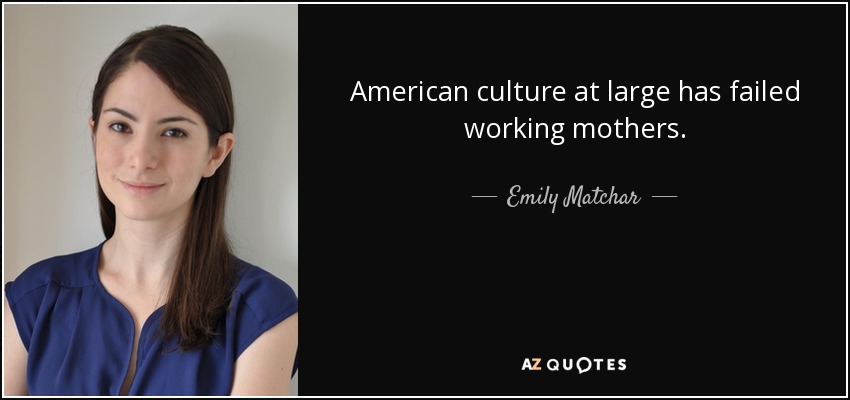
American culture at large has failed working mothers.
As a kid growing up in the 1950s I became acutely aware of the changes taking place in American culture and I must say I didn't much like it. I witnessed the debasement of architecture, and I could see a decline in the quality of things like comic books and toys, things made for kids. Old things seemed to have more life, more substance, more humanity in them.
The success [of the X-Men], I think, is for two reasons. The first is that, creatively, the book was close to perfect ... but the other reason is that it was a book about being different in a culture where, for the first time in the West, being different wasn't just accepted, but was also fashionable. I don't think it's a coincidence that gay rights, black rights, the empowerment of women and political correctness all happened over those twenty years and a book about outsiders trying to be accepted was almost the poster-boy for this era in American culture.
The dominant mood of contemporary American culture is the self-celebration of the peasantry.
We still have a lot of work to do in American culture. More open-mindedness is happening - in some cases rapidly, in some, slowly.
American culture has always known success, not suffering, so we've never known what to do with this part of the Bible. The more we succeed, the more we're seduced into thinking we can control everything. We dissect Revelation to get a sense of control over the future.
Historians differ on when the consumer culture came to dominate American culture. Some say it was in the twenties, when advertising became a major industry and the middle class bought radios to hear the ads and cars to get to the stores. ... But there is no question that the consumer culture had begun to crowd out all other cultural possibilities by the years following World War II.
Pro wrestling has always been ingrained into American culture. It was one of the first things that was ever on television, so everybody watched it.
We are being swallowed up by the popular culture of the United States, but then the Americans are being swallowed up by it too. It's just as much a threat to American culture as it is to ours.
Because revenge is a very known feeling in American culture, theres a certain element of an eye for an eye. Theres the saying, 'Be careful what you wish for, you might get it'. When you wish for revenge, and you think you've gotten it, what happens then? Revenge is just a really good drive for drama and good action.
The impact of black music and black art forms on American culture is really difficult to appreciate.
There's been a lot of talk about black men and the presence and absence of black men in positions of power in American culture.
Few places in American culture have made as effective a case for entrepreneurship than hip-hop. Hip-hop tells young people that our society is offering very limited options for youth. And that while society points to a radical decline in living wage jobs for youth and meaningful and affordable education, hip-hop is offering an alternative legitimate economy that is giving youth hope.
I push back against a deeply-entrenched tendency in American culture to label quickly and no longer even examine the labels that were initially stamped on a person. I don't have a problem with any of my "hyphenated" biography - I don't have any problem with that at all. The world would be a better place if our thread of hyphenation were truly embraced beyond mere naming and category.
We all exist in similar systems that mirror and reproduce the same American culture for the most part. What Oscar Wilde said about the lucky author who has a non-literary day job no longer holds, if it ever did. Artists seek validation as much as they seek money. The creation and invention of culture and canon is where most of the trouble lies.
Look, there's no denying that comics have moved dramatically into the mainstream in North American culture in the last 10 years, and for someone like me who's always tried to make a living at it, it's been great, I'm very grateful for it. But at the same time, it's not a subculture-y thing anymore; it's something that's in the New York Times and the New Yorker.
One of the defining characteristics or difference between today's illegal immigration and the immigration of old is the immigrants of the late 1800s through the early 1920s came here desiring to become Americans. They wanted to become part of what was a unique and distinct American culture. They were all coming from tyranny of one kind or another.
Today's Democrat Party believes that distinct American culture is corrupt, biased, racist, sexist, prejudicial, homophobic. There is nothing about it they want to preserve.
That is the beauty when I discovered the label 'Touched With Fire.' That book defined it for me, I could be that. And we just happen to be living in one age of society that put these various labels on the condition. In Aristotle's time, it was the 'inspired state.' In the Native American cultures, you were the shaman. Labels and language creates realities, even if they are false.
Miami, which has already aired, has this wonderful blend of Caribbean culture and Latin American culture and Southern American culture (talking about fried chicken). All those combine to make for a very very interesting array of ingredients, restaurants, and the chefs that come there. It also has great seafood, not to mention the glorious citrus that's there. And all those things inform what you do - and they should.
Religious faith is an important aspect of American culture and a fact of American political life.
Mrs. James, my fifth-grade teacher, introduced us to some of the great literature of African American culture. I won my first blue ribbon reciting the vernacular poems of Paul Lawrence Dunbar, in particular "Little Brown Baby."
What the left ends up missing is that politics have always been at the heart of American culture; it's been a white identity that's been rendered invisible and neutral because it's seen as objective and universal. As a result, we don't pay attention to how whiteness is one among many racial identities, and that identity politics have been here since the get-go.
[If] we can celebrate that in a way that celebrates our love for New England as well as our love for the Italian culture as well as the American culture, then we've done something that's really good and supporting these fishermen who are doing the right thing in sustainability . . . paying attention to make sure we don't overfish our world.
There's a huge piece of humanity that's missing - a huge piece - and our [American] culture is infant, comparatively speaking, to these folks who have been around for thousands of years.
Follow AzQuotes on Facebook, Twitter and Google+. Every day we present the best quotes! Improve yourself, find your inspiration, share with friends
or simply: