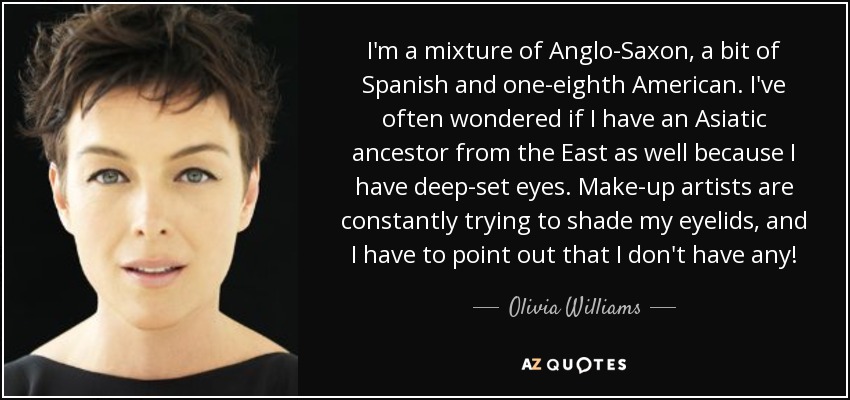
I'm a mixture of Anglo-Saxon, a bit of Spanish and one-eighth American. I've often wondered if I have an Asiatic ancestor from the East as well because I have deep-set eyes. Make-up artists are constantly trying to shade my eyelids, and I have to point out that I don't have any!
The embrace of present and past time, in which English antiquarianism becomes a form of alchemy, engenders a strange timelessness. It is as if the little bird which flew through the Anglo-Saxon banqueting hall, in Bede's Historia Ecclesiastica Gentis Anglorum, gained the outer air and became the lark ascending in Vaughan Williams's orchestral setting. The unbroken chain is that of English music itself.
A curious thing about the ontological problem is its simplicity. It can be put into three Anglo-Saxon monosyllables: 'What is there?' It can be answered, moreover, in a word--'Everything'--and everyone will accept this answer as true.
The Anglo-Saxon has established himself in climates totally diverse - Canada, South Africa, and India - and, through several generations, has preserved his essential race characteristics. He is not, of course, superior to climatic influences; but even in warm climates, he is likely to retain his aggressive vigor long enough to supplant races already enfeebled.
The eloquent voice of our century uttered, shortly before leaving the world, a warning cry against the "Anglo- Saxon contagion.
I have these guilts about never having read Chaucer but I was talked out of learning Early Anglo-Saxon / Middle English by a friend who had to take it for her Ph.D. They told her to write an essay in Early Anglo-Saxon on any-subject-of-her-own-choosing. “Which is all very well,” she said bitterly, “but the only essay subject you can find enough Early Anglo-Saxon words for is ‘How to Slaughter a Thousand Men in a Mead Hall’.
I contend that we are the finest race in the world and that the more of the world we inhabit the better it is for the human race. Just fancy those parts that are at present inhabited by the most despicable specimens of human beings what an alteration there would be if they were brought under Anglo-Saxon influence, look again at the extra employment a new country added to our dominions gives.
The faculty of attention has utterly vanished from the Anglo-Saxon mind, extinguished at its source by the big bayad?re of journalism, of the newspaper and the picture magazine which keeps screaming, "Look at me." Illustrations, loud simplifications... bill poster advertising ? only these stand a chance.
In recent years a new International System has been developing, oriented toward the establishment of norms and principles of universal jurisdiction, above national sovereignty, in the areas of what is called the New Agenda...we have to confront ..... what I dare to call the Anglo-Saxon prejudice against the establishment of supra-national organizations.
The image the Republicans have of themselves needs the image they have of the Democrats to bring it into sharp focus. The Democrats are plainly a disreputable crowd; the Republicans, by contrast, are men of standing and sobriety. Many a middle-class American in many a small town has had to explain painfully why he chose to be a Democrat. No middle-class American need feel uneasy as a Republican. Even when he is a minority--for example, among the heathen on a college campus--he can, like any white, Anglo-Saxon Protestant, warm himself before his little fire of self-esteem.
Jefferson never entertained the folly that he was of immigrant stock. He considered the English settlers of America courageous conquerors, much like his Saxon forebears, to whom he compared them. To Jefferson, early Americans were the contemporary carriers of the Anglo-Saxon project.
If I was writing about an academic or a more difficult person, I would use the Latinate vocabulary more, but I do think Anglo-saxon is the language of emotion.
There's a big difference between how the Anglo-Saxon world views India, or viewed India, and the way Europe views India.
Spanish and English have such different music, and in my own poetry I feel much less drawn to fluid sounds than I do toward the hard sounds and rhythms that come out of the Anglo-Saxon roots of English.
The Anglo-Saxon farmers had scarce conquered foothold, stronghold, freehold in the Western wilderness before they became sowers of hemp--with remembrance of Virginia, with remembrance of dear ancestral Britain.
Perhaps the one comforting thought I got out of this whole disgusting affair was that over the years when the government was tapping my telephone, it must certainly have heard some home truths from me about themselves, often couched in good Anglo-Saxon terms.
The Anglo-Saxon world saw India as an underdeveloped country. The land of snake charmers, the cows on the street, that "ex-colony-backward-nation" kind of viewpoint, very condescending. Europe on the other hand, saw India in a more romantic, mystical, spiritual way, as a place that's a fountain of wisdom.
In many places, above all in the Anglo-Saxon countries, logistics is today considered the only possible form of strict philosophy, because its result and procedures yield an assured profit for the construction of the technological universe. In America and elsewhere, logistics as the only proper philosophy of the future is thus beginning today to seize power over the intellectual world.
In Anglo-Saxon countries the prostitutes look as if they purveyed, along with sin, the attendant pains of hell.
The Anglo-Saxon hive have extirpated Paganism from the greater part of the North American continent; but with it they have likewise extirpated the greater portion of the Red race. Civilization is gradually sweeping from the earth the lingering vestiges of Paganism, and at the same time the shrinking forms of its unhappy worshippers.
The early 20th Century was probably the high tide of global white supremacy - I'm going to call it that because that's how people thought of it - and to be specific, Anglo-Saxon supremacy: The idea that white Anglo-Saxon Protestants were at the top of the world, representing the highest achievement possible for all of humanity, with Darwin's theories being used to prop up this belief.
We have a lot of black Anglo-Saxons. Their skin is black, but their brain is white. When I get real mad at them, I call them graham crackers.
There is no English equivalent for the French word flâneur. Cassell's dictionary defines flâneur as a stroller, saunterer, drifter but none of these terms seems quite accurate. There is no English equivalent for the term, just as there is no Anglo-Saxon counterpart of that essentially Gallic individual, the deliberately aimless pedestrian, unencumbered by any obligation or sense of urgency, who, being French and therefore frugal, wastes nothing, including his time which he spends with the leisurely discrimination of a gourmet, savoring the multiple flavors of his city.
Behaviour that's admired is the path to power among people everywhere.
This is what I like, sitting at a table and watching people go by. It does something to your outlook on life. The Anglo-Saxons make a great mistake not staring at people from a sidewalk table.
Follow AzQuotes on Facebook, Twitter and Google+. Every day we present the best quotes! Improve yourself, find your inspiration, share with friends
or simply: