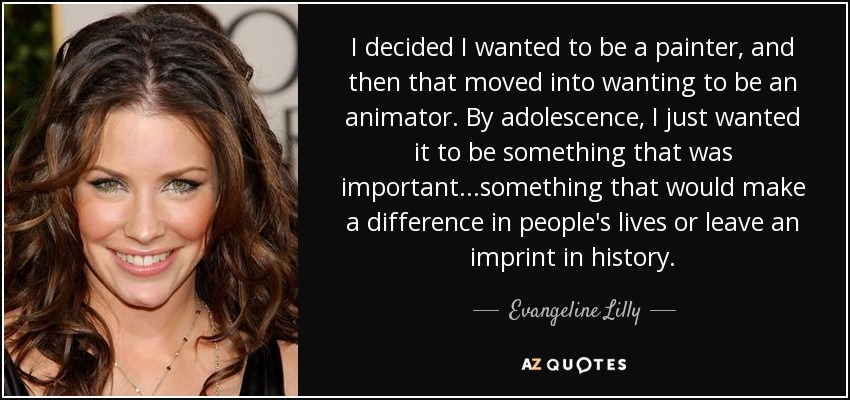
I decided I wanted to be a painter, and then that moved into wanting to be an animator. By adolescence, I just wanted it to be something that was important...something that would make a difference in people's lives or leave an imprint in history.
I've been very lucky to work with many amazing animators and directors who can interpret and extend the music I make. When it's done well, it can create extra meaning and new context for the song.
Toward the end of the film ['Life, Animated'] we see 'The Sidekicks Story,' and that is a story that Owen drew himself. We took that style, which is decidedly different from Disney animation, and used it as a basis. It's a 'two-dimensional' hand drawn animated form, so I went to this company in Paris called 'Mac Guff,' and they assembled an amazing group of young animators, and brought it to life.
There's this whole grey area seemingly every time it's talked about animators and who takes ultimate responsibility for the characters [of the Planet of the apes] but without question and I'll go down saying this year after year, these characters are authored by what we do on set. They are not authored by animators.
We exchanged a couple of ideas and stuff like that, but that's about it. I just think ... consulting on 'Tintin' was very interesting because you try to ... not educate, but inform the animators [about] what the lighting looks like, but [in the end] they do it themselves. I don't actually go and sit there with them. [We] just had a couple of conversations.
When you're acting in front of a camera, you can really give all of your emotions with your eyes so the camera can see it. When you're in voiceover, you can't do that at all. It's a lot tougher because you have to convey this emotion, and you have to have a lot of trust in the animators.
I'm not a public enough persona to be big and loud at the front of the ship. I'd rather more quietly interact with the artisan animators.
Since the waiting time required during the rendering process has been dramatically shorter in the last 10 years, I think that CGI animation has finally become practical. It is a fact that I processed the Steamboy work based on the assumption that the machine spec would be higher. In that context, young 3D animators have also gotten more skillful in recent years. But what I didn't expect is that the skills of traditional 2D animators have become worse, and notable young animators have not come out to the scene. This is a big issue for the industry.
The industry in Japan moving toward CGI is not as severe and extreme as in the U.S. The animation industry in the U.S. is firing 2D animators and closing those studios, but I think it's possibly because the national traits of the U.S. prefer super-realism. Since Japan is a country that prefers plane vision, I don't think we will leave 2D and substitute hand-drawing with CGI entirely.
I get a lot of credit for Tron. They called us scene choreographers back then because the animation unit wouldn't let us be called animators because we were working on computers. And we were some of the first people ever to make 3-D computer animation.
I love the culture of animation. What stop-motion has in common with live-action is that it has many of the same departments. There's hair, costume, makeup in the form of paint, gaffers, electricians. So there's the same sense of real stuff, real light. But it's not like everything happens at once, like it does in live-action. It's all subdivided into these small sets. It's where my strengths are. Live-action is just an utterly different world, and I'm not a public enough persona to be big and loud at the front of the ship. I'd rather more quietly interact with the artisan animators.
First of all, computer animation is certainly a tremendous and viable medium today. But the warmth and personality derived from 2-D animation, in my opinion, cannot be surpassed. Certain stories lend themselves well to 3-D animation and I won't labor this with naming them, but in my bones, I still respond more emotionally to the artists feel in 2-D. You feel the 'actor' in the animator more personally...it's hard to explain.
The quality and success of Disney was actually bad for us animators because everyone on the planet thought that animation was only for kids and only in a certain domain. The big film festivals never thought much about animated films.
In timing a film, we used to assume that sneaks move slowly. This was great for animators-thirty-six to forty-eight drawings for a single step-but it was sheer hell for the pace of the picture. So the rapid tiptoe was invented.
Follow AzQuotes on Facebook, Twitter and Google+. Every day we present the best quotes! Improve yourself, find your inspiration, share with friends
or simply: