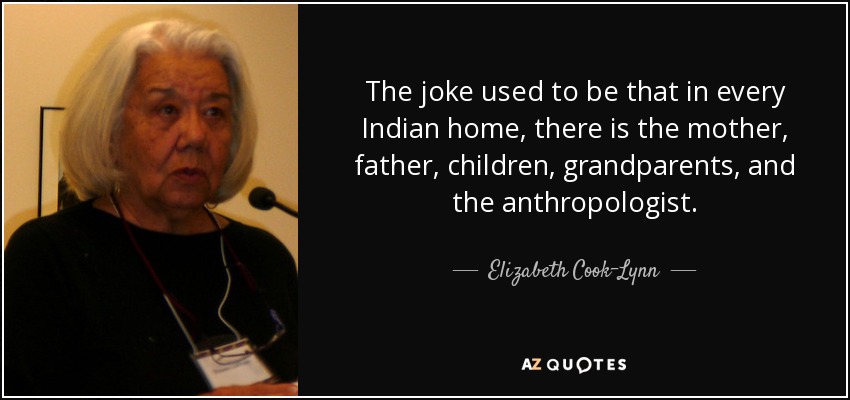
The joke used to be that in every Indian home, there is the mother, father, children, grandparents, and the anthropologist.
Concerned to reconstruct past ideas, historians must approach the generation that held them as the anthropologist approaches an alien culture. They must, that is, be prepared at the start to find that natives speak a different language and map experience into different categories from those they themselves bring from home. And they must take as their object the discovery of those categories and the assimilation of the corresponding language.
Certain anthropologists hold that man, having discovered tools, ceased to evolve biologically. Animals, never having discovered them, continue to fashion drills out of their beaks, oars out of their hind feet, wings out of their forefeet, suits of armor out of their hides, levers out of their horns, saws out of their teeth. Whether this be true or not, all authorities agree that man is the tool-using animal. It sets him off from the rest of the animal kingdom as drastically as does speech.
An anthropologist at Tulane has just come back from a field trip to New Guinea with reports of a tribe so primitive that they have Tide but not new Tide with lemon-fresh Borax.
I think of myself as a writer who happens to be doing his writing as an anthropologist
As soon as you take out a pencil and paper with the Indians, you're one thing to them - an anthropologist - and what they tell to anthropologists is always distorted.
The historical development of the work of anthropologists seems to single out clearly a domain of knowledge that heretofore has not been treated by any other science
Younger anthropologists have the notion that anthropology is too diverse. The number of things done under the name of anthropology is just infinite; you can do anything and call it anthropology
Anthropologists say that in every culture in history, children have played the game hide and seek.
Every city, every town, every region in USA has these weird things - the way they pronounce words, or what they call soda, or how people drive. It's a huge country, and there's all these strange pockets of behavioral patterns that social anthropologists could spend lifetimes researching and reporting on.
The anthropologist respects history, but he does not accord it a special value. He conceives it as a study complementary to his own: one of them unfurls the range of human societies in time, the other in space.
The world of rumor and gossip is like a privileged world with which a social scientist or an anthropologist can take the temperature of popular aspirations.
Anarchism and anthropology go well together because anthropologists know that a society without a state is possible because so many exist.
Rituals, anthropologists will tell us, are about transformation. The rituals we use for marriage, baptism or inaugurating a president are as elaborate as they are because we associate the ritual with a major life passage, the crossing of a critical threshold, or in other words, with transformation.
I'm a complete human being. I'm very emotional and loving. I feel, I hurt, I give, I take, and also I think. I analyze. I'm a sociologist, anthropologist.
I certainly don't object to [writers] trying to imagine the lives of other societies, but you have to do it with a certain amount of humility and respect. If it were not for the ethnographic material that had been collected by missionaries and anthropologists and so forth, much of past Native American society would no longer be accessible. What I object to is making kitsch of things that are very serious.
The philosophical anthropologist ... can know the wholeness of the person and through it the wholeness of man only when he does not leave his subjectivity out and does not remain an untouched observer.
The loss of body hair is interesting to anthropologists, because it is a feature that distinguishes us from our nearest living relatives, chimpanzees. They have body hair, we don't.
Because he did not have time to read every new book in his field, the great Polish anthropologist Bronislaw Malinowski used a simple and efficient method of deciding which ones were worth his attention: Upon receiving a new book, he immediately checked the index to see if his name was cited, and how often. The more "Malinowski" the more compelling the book. No "Malinowski", and he doubted the subject of the book was anthropology at all.
In truth, philosophy is the mode of thought shaped by the most radical form of prejudice: the passion of being-in-the-world. With the sole exception of specialists in the field, virtually everyone senses that anything which offers less than this passion play remains philosophically trivial. Cultural anthropologists suggest the appealing term 'deep play' for the comprehensively absorbing preoccupations of human beings. From the perspective of a theory of the practising life we would add: the deep plays are those which are moved by the heights.
The selection process has been powerful enough to produce one indisputable outcome: the family is a universal human institution. . . . In virtually every society into which historians or anthropologists have inquired, one finds people living together on the basis of kinship ties and having responsibility for raising children. . . . Even in societies where men and women have relatively unrestricted sexual access to one another beginning at an early age, marriage is still the basis for family formation. It is desired by the partners and expected by society.
You know, a lot of girls go out with me just to further their careers...damn anthropologists.
You can lose a reader in a blink of an eye. If a person is an engineer or chemist or an anthropologist or whatever, you spoil the whole book for that person if there's obviously ignorance here. What's wrong with so much science fiction is that the science is so lousy that it isn't worth paying attention to.
John Colman Wood's The Names of Things is a thoughtful, patient, and ultimately rewarding book. It's about, among many other things, the connections human beings make, that in spite of everything, we will always make. To quote from the book, 'What he saw in the people was what the old anthropologists called communitas. It wasn't that the people sang and moved. It was their singing and moving together' Singing and moving together, Wood has found a way to express this profound and beautiful idea through fiction.
I have looked warily at anthropologists ever since the day when I went to hear a great Greek scholar lecture on the Iliad, and listened for an hour to talk about bull-roarers and leopard-societies.
Follow AzQuotes on Facebook, Twitter and Google+. Every day we present the best quotes! Improve yourself, find your inspiration, share with friends
or simply: