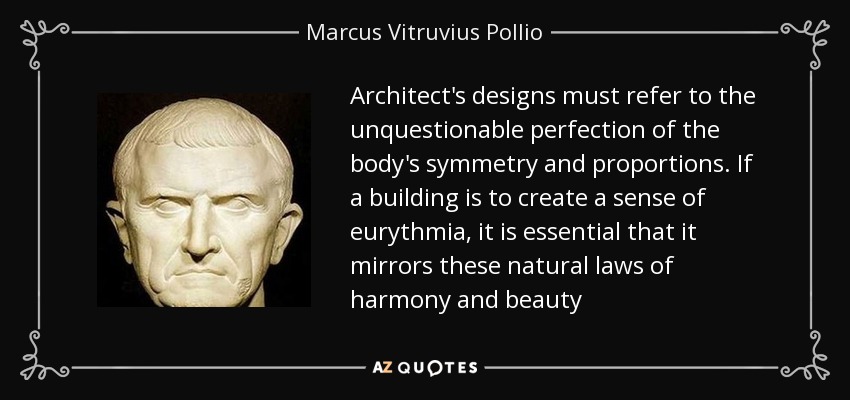
Architect's designs must refer to the unquestionable perfection of the body's symmetry and proportions. If a building is to create a sense of eurythmia, it is essential that it mirrors these natural laws of harmony and beauty
Architects should be educated, skillful with the pencil, instructed in geometry, know much history, have followed the philosophers with attention, understand music, have some knowledge of medicine, know the opinions of the jurists, and be acquainted with astronomy and the theory of the heavens
A musician, an artist, an architect: the man or woman who is not one of these is not a Christian.
Before World War II, Modernist architects sometimes had to resort to custom fabrication or outright fakery to achieve the machine imagery advocated by the Bauhaus after its initial, Expressionist, phase. Stucco masqueraded as reinforced concrete; rivets were used for decoration.
Cost overruns are not uncommon in architecture, particularly for designs that depart from structural or technological norms, or demand a finer quality of execution than commercial schemes - conditions typical of buildings for cultural institutions. Budgets are exceeded for many reasons, not all of them within an architect's control.
Despite the persistent image of the architect as a heroic loner erecting monumental edifices through sheer force of will, the building art has always been a highly cooperative enterprise.
During the modern period, the vanguard architect has usually relied on small residential jobs both to supply a steady income and to serve as 'sketches' for ideas that are often later translated to the larger scale of public commissions.
You are the architect of the memories that others will have about you.
This great Mughal Emperor [Akbar] was illiterate; he could neither read nor write. However, that had not stopped Akbar from cultivating the acquaintance of the most learned and cultured poets, authors, musicians, and architects of the time - relying solely on his remarkable memory during conversations with them.
I would like my architecture to inspire people to use their own resources, to move into the future.
To create, one must first question everything.
Each new situation requires a new architecture.
The architecture we remember is that which never consoles or comforts us.
There are 360 degrees, so why stick to one?
Today's enterprise IT architecture is about integrating systems to meet business needs. Consequently, IT architects can't - and don't - live in a vacuum. To address that reality, Catalyst Conference 2006 will delve into strategic infrastructure technologies with the depth to which our clients have grown accustomed. With the larger number of Cross-Cutting Concerns sessions, we'll also clearly illustrate how these technologies relate to each other, and how roles, geographies, and business processes intersect within an enterprise.
The great liability of the engineer compared to men of other professions is that his works are out in the open where all can see them. His acts, step by step, are in hard substance. He cannot bury his mistakes in the grave like the doctors. He cannot argue them into thin air or blame the judge like the lawyers. He cannot, like the architects, cover his failures with trees and vines. He cannot, like the politicians, screen his shortcomings by blaming his opponents and hope the people will forget. The engineer simply cannot deny he did it. If his works do not work, he is damned.
When I am asked what I believe in, I say that I believe in architecture. Architecture is the mother of the arts. I like to believe that architecture connects the present with the past and the tangible with the intangible.
I love paper. A nice thick pile of it and a pencil, and I'm content.
Inconsistency itself breeds vitality.
Who is the architect? I am the architect.
Working with Monk brought me close to a musical architect of the highest order. I felt I learned from him in every way--through the senses, theoretically, technically. I would talk to Monk about musical problems, and he would sit at the piano and show me the answers just by playing them. I could watch him play and find out the things I wanted to know. Also, I could see a lot of things that I didn't know about at all.
As an architect, I learned to think and express myself on flat forms, on paper, and to imagine the contour of the lines of a design.
Whatever may be the judgement pronounced on the competency of the architects of the Constitution, or whatever may be the destiny of the edifice prepared by them, I feel it a duty to express my profound and solemn conviction . . . that there never was an assembly of men, charged with a great and arduous trust, who were more pure in their motives, or more exclusively or anxiously devoted to the object committed to them.
I did a cake for the 60th birthday of Elton John, for Britney Spears' 27th birthday and for the 'Circus' album she put out - the cake had circus themes. I prepared a cake for a surprise 82nd birthday event for the architect Frank Gehry; the cake was comprised of mini-replicas of his buildings.
When I was a carpenter, I once worked with this Russian lady architect. I would tell her, ‘Look, I’m terribly sorry, but I want to change that a half inch,’ and she would say, ‘No limit for better.’ I think that is a worthy credo. You keep on going until you get it as close to being right as the time and patience of others will allow.
Follow AzQuotes on Facebook, Twitter and Google+. Every day we present the best quotes! Improve yourself, find your inspiration, share with friends
or simply: