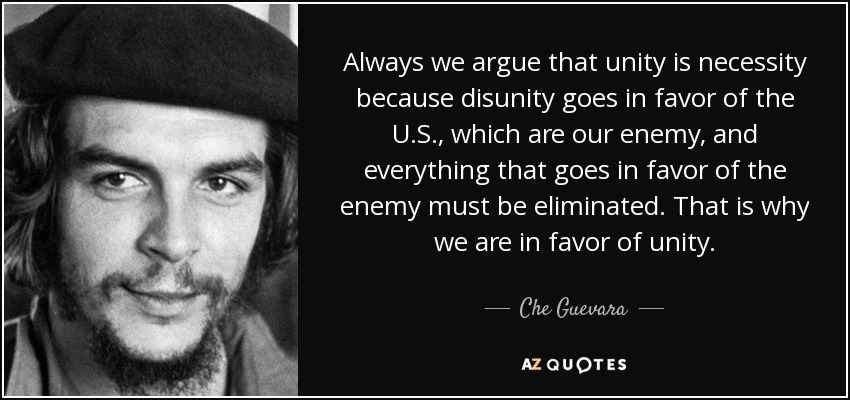
Always we argue that unity is necessity because disunity goes in favor of the U.S. , which are our enemy, and everything that goes in favor of the enemy must be eliminated. That is why we are in favor of unity.
I do not believe we will get to Ray Kurzweil's proposed "singularity" in which human minds meld with machines to produce, in effect, synthetic human evolution. Our basic problems with maintaining the electric grid argue against that fantasy.
We have this wild life experience that is full of fantastic minutiae and banal, huge events at the same time. Yet, all of it shrinks in the shadow of death. It's hard to argue with death as a game-changer.
We are all so immersed in our own technology bubbles that we're ignoring so many important things. We're all online arguing over nuance and nonsense, and everybody's so incensed and upset about things that ultimately mean nothing while we are destroying our environment. While we're racing towards Armageddon, we're all online arguing about what Beyonce said at some award.
In my own personal experience in my life, people that I argue with or have confrontations with are the people I love and care about the most. I wouldn't think to argue with somebody I couldn't give two s**ts about. There's no point in arguing if you don't care.
Artists used to argue about art for art's sake versus social realism etc, and now it's like the most dominate argument is related to "art for the market's sake." It's a necessity, somewhat, for some people.
No self-respecting feminist could argue with the claim that the novel is more likely to accept existing power structures than not. But there's a vast difference, surely, between Dickens saying Indians should be exterminated and a Dave Eggers writing eloquently about the NSA, but not being as outspoken on American military power abroad.
I wrote my own first book about the defense of television as an art form in 1992. It was harder to make the argument then. Now it seems absolutely a given. You can argue about when the Platinum Age Of Television begins, but I don't think that anybody can argue that it's not here.
I like intersections. They're the nature of New York, and there's always the possibility that when you're at one you can meet someone new. Have I ever met anyone new at an intersection? No, but I like the idea of it. I like cities because if you're stopping on the corner to wait for a light to change, there's the possibility that you and somebody else can talk. And if you and that somebody else start to talk, then you can start to argue, and if you start to argue, you might start a revolution.
There are pros and cons about the policy decision whether to follow the Geneva Conventions in a war where they do not legally apply. Among the pros might be benefits for America's image, its ability to argue in future conflicts that the Conventions should be followed, and training soldiers to follow only the Geneva standards. Among the cons might be greater security and safety for our troops who capture and detain al Qaeda operatives and the ability to gather more actionable intelligence swiftly.
Coming from the era of vinyl you could argue that everything went wrong in the music business the moment we went digital. The day the first CD came out, it all went downhill in the music industry. Digital destroyed everything.
You can argue about globalization and the many benefits it has had, but also you have to appeal to the mass with everything. The Chinese, the Americans, the Russians... Everything becomes this very bland product, and that's all we're producing at the moment. It's driven by money.
I'm lucky to be in food at the moment, because we're living in a time where so many people are obsessed with it. People will go to food festivals now, and argue over the merits of a taco for hours. It's about the people who deeply care, and want that exchange of ideas.
Fasting is required, staying away from fighting and arguing and bombing of masjids is still going on. Hatred is still manifested between Sunni and Shi'a, I don't know whether there is deepening of commitment to Ramadan in that part of the world.
There certainly is a pattern of administrations that have good transitions, George W. Bush to Barack Obama, and administrations that have really bad transitions, I would say Dwight Eisenhower to John F. Kennedy. I would say this is beginning to look like a bad transition, from Barack Obama to Donald Trump as they begin to argue even at the presidential level, which is more or less unprecedented.
I think that all moralities adequately serving the function of fostering social cooperation must contain a norm of reciprocity - a norm of returning good for good received. Such a norm is a necessity, I argue, because it helps relieve the strains on motivation of contributing to social cooperation when it comes into conflict with self-interest.
I argue for a relational conception of the person as a basis for an environmental ethic that can encourage us to preserve the environment not solely on the basis of satisfying human interests and not solely because we might attribute intrinsic value to the environment, but because the environment is something with which we can potentially enter into constructive relationship, as part of what makes us who we are or transform who we are and open us up to new interests.
One thing to argue against Hillary Clinton being harmed by my saying on aging is that when you take Hollywood and television and look at the primary demographic there. Hollywood movies. Most of them are made for guys that still have acne, just reached puberty, you know, under 24. And they don't vote, the lowest common denominator in terms of age demographics.
We need to be honest with the American people about the problems and the challenges ahead and the solutions that are needed to fix them. And I would argue it's the president who has been missing in action on this front. He knows we have a debt crisis coming. All independent experts show us this. And so he hasn't even given us a budget yet. I mean, the law required that he was supposed to submit a budget the first Monday in February.
When you look at the people that Donald Trump is actually put around him on his Cabinet, this is a pretty - I would argue a very conservative Cabinet. And whether it's on issues of immigration, his pick for the attorney general, very conservative on that issue.
You're like, "I don't want to argue with Dr. Drew on national radio." You're like the invited guest. But at the same time, as a thinking person, it's very difficult just to stand by and go, "Yeah, man, it's cool."
Maybe one day, I would write a story about arguing in public, and those would come in handy in some way.
In the world of comedy, there's this: "If it's going badly, get off. If it's going well, get off". You can't argue with that either.
I think Donald Trump does want a result. He clearly, in the meeting that we had was trying to sort of push the process along, realizing that the Senate has a role to play and that there are differences of opinion. I think he wants it to be a health care plan, proposal that we can go out there and defend and that he can defend and argue for to the American people.
If you're not arguing, your coalition isn't wide enough.
Follow AzQuotes on Facebook, Twitter and Google+. Every day we present the best quotes! Improve yourself, find your inspiration, share with friends
or simply: