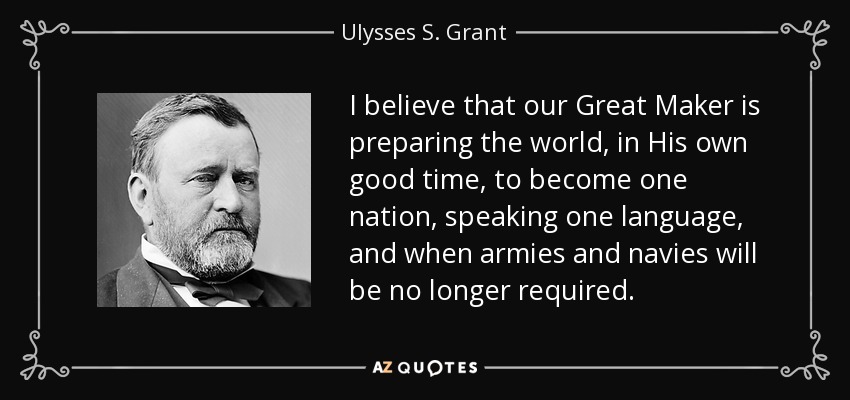
I believe that our Great Maker is preparing the world, in His own good time, to become one nation, speaking one language, and when armies and navies will be no longer required.
The problem [of specialization] is essentially that of communications to an army in action. After a rapid advance communications become disorganized, and there is a temporary halting until they are again in working order.
Flying is one of the safest jobs in the Army as long as you don't drop out. If you do drop out, you are a dead man, and dropping out means, usually, that you have made a mistake or let go of your grip.
Place your army in deadly peril, and it will survive; plunge it into desperate straits, and it will come off in safety.
The main form of struggle is war; the main form of organization is the army... . Without armed struggle there would be no place for the proletariat, there will be no place for the people, there will be no place for the Communist Party, and there will be no victory in revolution.
I spent two years in the Army. And my older brother, who was also a great positive influence on me, encouraged me to think about law school, and I said - well, I didn't have any money.
Obviously we don't have 300 million people. We haven't got a big army. We don't have Hollywood. We're a medium small-sized country. We have to do what medium small-sized countries do, which-even though we're not smarter than other people-is to make ourselves seem to be smarter. We have to work harder and know more than other people.
A standing army, however necessary it may be at some times, is always dangerous to the liberties of the people. Such power should be watched with a jealous eye.
The AEC had at its command an army of highly skilled scientists.
It turns out one of my ancestors fought in the Continental Army, so I was inducted into the Sons of the American Revolution.
My parents were both in the army for 20 years and then worked in government departments; but they had gone through the Great Depression and known lean times. They always remained extremely frugal and lived far below their means.
It was only after five years in the army, when I was having to do a very boring job in a very boring place, that I thought: 'Why not try writing a novel?' partly out of youthful arrogance and partly because there had been a long line of writers in my mother's family.
Napoleon had been fighting this army of slaves and free people in Haiti and it depleted his forces. And after the Revolution, when the French were driven out, they stopped and sold this big chunk of North America to the Americans for very little money.
When I was in the Army, the unit I served in, you could never stop. It was a volunteer unit, and there was a fairly high rate of attrition. The people who stayed through are the people who were either great at it or the people who just didn't know how to stop. And I fell into that second category.
My dad and grandpa were in the army and as a country singer you're constantly playing at military bases all across the country and meeting soldiers and their families and hearing their stories.
We are the folk song army, every one of us cares. We all hate poverty, war, and injustice unlike the rest of you squares.
There are routes not to be followed, armies not to be attacked, citadels not to be besieged, territory not to be fought over.
I'd breed a little liberal army in the wood, just like these redneck lunatics I see at the local bar with their tribe of mutant inbred piglets.
I can preach until your deaf and dumb, I'm in that soul saving army beating on that big bass drum.
My mom is in the navy and my dad works for the army, but I never called them 'sir' or 'ma'am' or anything like that, and we never really moved around a lot because both my parents were stationed in D.C.
I was first introduced to Kafka's writing during my compulsory army-service basic training. During that period, Kafka's fiction felt hyperrealistic.
In the army you feel violated - there's no private space. Writing was a life-saver, a way of recovering private territory.
What you experience in the army, aged 18 to 21, is what you take through all your life. You cross invisible lines: you shoot someone, get shot, break into people's houses. It's naive to think you won't carry anything into your life.
The Army's always had a special place in my heart.
I was going to get drafted, but I didn't really want to go into the Army.
Follow AzQuotes on Facebook, Twitter and Google+. Every day we present the best quotes! Improve yourself, find your inspiration, share with friends
or simply: