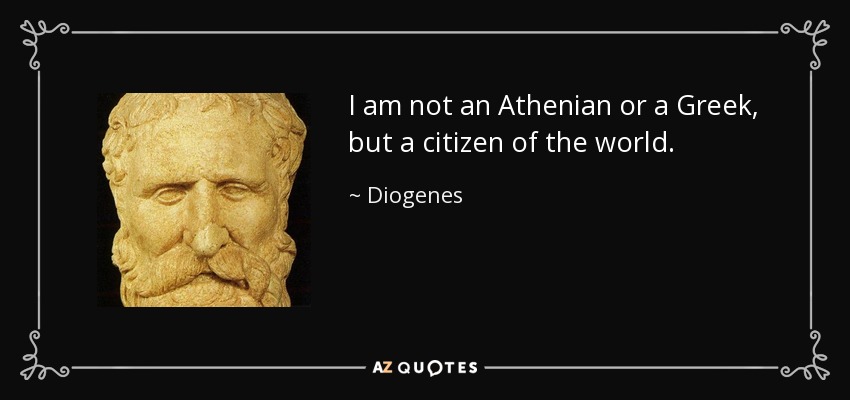
I am not an Athenian or a Greek, but a citizen of the world.
When the freedom they wished for most was freedom from responsibility, then Athens ceased to be free and was never free again.
Athens, the eye of Greece, mother of arts And eloquence.
The growth of the power of Athens, and the alarm which this inspired in Sparta, made war inevitable.
At Athens, wise men propose, and fools dispose.
An Aristotle was but the rubbish of an Adam, and Athens but the rudiments of Paradise.
How great are the dangers I face to win a good name in Athens.
An Athenian citizen does not neglect his state because he takes care of his own household; even those of us who are engaged in business have a very fair idea of politics. We do not regard a man who takes no interest in public affairs as harmless. We do not say that such a man 'minds his own business'. Rather we say he has no business here at all.
Athenian men, I respect and love you, but I shall obey the god rather than you.
The Athenians govern the Greeks; I govern the Athenians; you, my wife, govern me; your son governs you.
We Athenians hold that it is not poverty that is disgraceful but the failure to struggle against it.
Eloquence, when at its highest pitch, leaves little room for reason or reflection; but addressing itself entirely to the fancy or the affections, captivates the willing hearers, and subdues their understanding. Happily, this pitch it seldom attains. But what a Tully or a Demosthenes could scarcely effect over a Roman or Athenian audience, every Capuchin, every itinerant or stationary teacher can perform over the generality of mankind, and in a higher degree, by touching such gross and vulgar passions.
This was the Athenians' war against the King of Macedon, a war of words. Words are the only weapons the Athenians have left.
If the modern spirit, whatever that may be, is disinclined towards taking the Lord's word at its face value (as I hear is the case), we may observe that Isaiah's testimony to the character of the masses has strong collateral support from respectable Gentile authority. Plato lived into the administration of Eubulus, when Athens was at the peak of its jazz-and-paper era, and he speaks of the Athenian masses with all Isaiah's fervency, even comparing them to a herd of ravenous wild beasts.
Being summoned by the Athenians out of Sicily to plead for his life, Alcibiades absconded, saying that that criminal was a fool who studied a defence when he might fly for it.
Alcibiades had a very handsome dog, that cost him seven thousand drachmas; and he cut off his tail, "that," said he, "the Athenians may have this story to tell of me, and may concern themselves no further with me.
Demosthenes told Phocion, "The Athenians will kill you some day when they once are in a rage." "And you," said he, "if they are once in their senses."
It is not I who have lost the Athenians, but the Athenians who have lost me.
What is the foundation of that interest all men feel in Greek history, letters, art, and poetry, in all its periods, from the Heroic or Homeric age down to the domestic life of the Athenians and Spartans, four or five centuries later? What but this, that every man passes personally through a Grecian period.
Mars, when guilty of homicide, and set free from the charge of murder by the Athenians through favour, lest he should appear to be too fierce and savage, committed adultery with Venus.
Eutrapelia . "A happy and gracious flexibility," Pericles calls this quality of the Athenians...lucidity of thought, clearness and propriety of language, freedom from prejudice and freedom from stiffness, openness of mind, amiability of manners.
The wide difference between the two characters, the slowness and want of energy of the Spartans as contrasted with the dash and enterprise of their opponents, proved of the greatest service, especially to a maritime empire like Athens. Indeed this was shown by the Syracusans, who were most like the Athenians in character, and also most successful in combating them.
So that we may not be like the Athenians, who never consulted except after the event done. [Fr., Afin que ne semblons es Athenians, qui ne consultoient jamais sinon apres le cas faict.]
O Athenians, what toil do I undergo to please you!
The Athenians regularly maintained a number of degraded and useless beings at the public expense; and when any calamity, such as plague, drought, or famine, befell the city, they sacrificed two of these outcast scapegoats.
Follow AzQuotes on Facebook, Twitter and Google+. Every day we present the best quotes! Improve yourself, find your inspiration, share with friends
or simply: