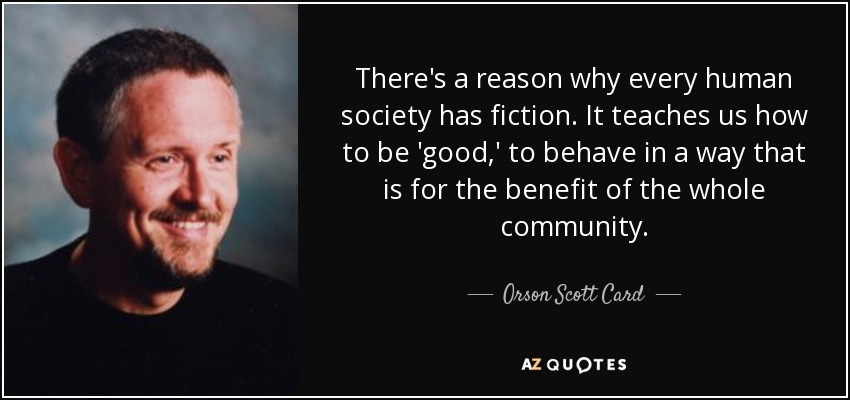
There's a reason why every human society has fiction. It teaches us how to be 'good,' to behave in a way that is for the benefit of the whole community.
One can think of a secretary actively operating a filing system, of a librarian actively cataloguing books, of a computer actively sorting out information. The mind however does not actively sort out information. The information sorts itself out and organises itself into patterns. The mind is passive. The mind only provides an opportunity for the information to behave in this way. The mind provides a special environment in which information can become self-organising. This special environment is a memory surface with special characteristics.
Considering how bad men are, it is wonderful how well they behave.
Things that happen, however painful they are at the time, do not matter very much for long. Only how we behave to them matters.
The way we behave toward people indicates what we really believe about God.
When we recognize that nothing has to go right for us to be happy, that people do not have to behave for us to love them, our walk home can be surprisingly simple. We have enormous power not to manipulate the world, but to be happy and to know peace.
One night in Tokyo we watched two Japanese businessmen saying good-night to each other after what had clearly been a long night of drinking, a major participant sport in Japan. These men were totally snockered, having reached the stage of inebriation wherein every air molecule that struck caused them to wobble slightly, but they still managed to behave more formally than Americans do at funerals.
The most startling result of Faraday's Law is perhaps this. If we accept the hypothesis that the elementary substances are composed of atoms, we cannot avoid concluding that electricity also, positive as well as negative, is divided into definite elementary portions, which behave like atoms of electricity.
Where the electron behaves and misbehaves as it will, where the forces tie themselves up into knots of atoms and come united.
As a rule, there is no surer way to the dislike of men than to behave well where they have behaved badly.
The most powerful way to change the world is to secretly commit little acts of compassion. You must behave as if your every act, even the smallest, impacted a thousand people for a hundred generations. Because it does.
We are the greatest power in the world. If we behave like it.
Until the world in some way changes, then my responsibility is to share what I know and more importantly to behave like I know about the extraordinary work and effort and blood shed for me to be able to sit here.
There's definitely evidence that capitalism at its most ruthless rewards psychopathic behavior. When you look at the worst corners of the American health insurance industry or the sub-prime banking market, it really feels like the more psychopathically someone behaves, the more it's rewarded.
I think behind closed doors people behave differently no matter what period we're looking at, because people have to stand up straight in public but can slouch behind closed doors - can you imagine wearing those corsets?
Generally speaking, rural drivers are a much better behaved species than city drivers. I'm not sure whether they're intrinsically this way, or there are just fewer opportunities for them to do behave badly. You can't go around running red lights if there aren't any red lights to run.
It may take practice to think more positively and more compassionately, but just as you must train a puppy to behave the way you want it to, you must train your mind to behave itself. Otherwise, like the puppy, your mind will just make a lot of messes.
If you're acting, then there's a prescribed way to behave; whereas in life there's no prescribed way. So acting feels like a comfortable way to get through the day.
If you're interested in how people behave, if you're interested in the way they talk about themselves, the way the conceive of themselves, it's very hard to ignore drugs nowadays, because that is so much part of the conversation.
The difficulty really is psychological and exists in the perpetual torment that results from your saying to yourself, "But how can it be like that?" which is a reflection of uncontrolled but utterly vain desire to see it in terms of something familiar. ... If you will simply admit that maybe Nature does behave like this, you will find her a delightful, entrancing thing. Do not keep saying to yourself, if you can possible avoid it, "But how can it be like that?" because you will get 'down the drain', into a blind alley from which nobody has escaped. Nobody knows how it can be like that.
Because he says he can't stand you and you act like you can't stand him, and whenever a man and a woman behave like that toward each other, it usually means something's going on.
I had this spooky psychological thing about 'The Piano' before it began, which was how everybody was going to go nuts on the set. Because a film tends to set up the way people are going to behave.
I revise constantly, as I go along and then again after I've finished a first draft. Few of my novels contain a single sentence that closely resembles the sentence I first set down. I just find that I have to keep zapping and zapping the English language until it starts to behave in some way that vaguely matches my intentions.
To read a character I'm not sympathizing with is generally quite a good, attractive proposition because I've got somewhere to go, I've got work to do, to try to understand why they behave like they behave, to relate entirely and understand them and to be completely emotionally connected. That is much more fun 99 percent of the time.
I'm not certain that I draw from any one culture more than others. Many myths and legends of many different cultures are really the same story when you get to the heart of it. They are often cultural cautionary tales about how we should behave and how we should live.
Follow AzQuotes on Facebook, Twitter and Google+. Every day we present the best quotes! Improve yourself, find your inspiration, share with friends
or simply: