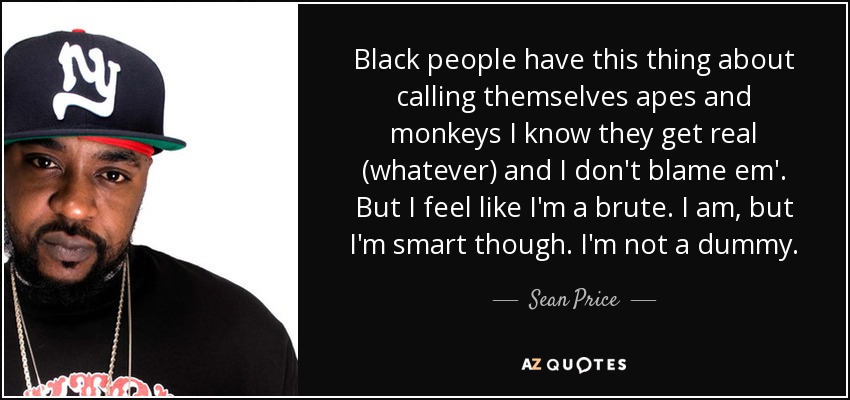
Black people have this thing about calling themselves apes and monkeys I know they get real (whatever) and I don't blame em'. But I feel like I'm a brute. I am, but I'm smart though. I'm not a dummy.
I think at the time, my radicalization was not through growing up Chinese, but through the role that the black people were playing at the beginning of World War II, when they had started the "Double V for Victory" movement - for democracy at home as well as abroad.
Socially, hip-hop has done more for racial camaraderie in this country than any one thing. 'Cause guys like me, my kids - everyone under 45 either grew up loving hip-hop or hating hip-hop, but everyone under 45 grew up very aware of hip-hop. So when you're a white kid and you're listening to this music and you're being exposed to it every day on MTV, black people become less frightening. This is just a reality. What hip-hop has done bringing people together is enormous.
Black people still call me Prince. Sometimes I ask them, "Why do you call me Prince?" And people say, "Because you are a prince to us." Usually when they say that, you know my heart goes out and I have to say, "I don't mind your calling me that."
I come out of the environment of the Deep South, where I had seen the millstone of racial discrimination weighting down my people, both the black people and the white people; and I had seen the enormous progress that we were able to make after we removed the legal restraints of a two-class society, with the whites superior and blacks inferior. So I was very convinced before I became President that basic human rights, equality of opportunity, the end of abuse by governments of their people, was a basic principle on which the United States should be an acknowledged champion.
There's no reason in the world why black [people] should not be regarded as an attribute that is not degrading but is positive. There's no reason in the world why any person should think that white is degrading.
I love seeing black people do normal things, being judged as normal people.
I'm not romanticizing black people, because we've got gangsters like everybody else.
At least black people knew when they were slaves; you remain clueless.
To change history is very slow. The first two times I came to the States - black people didn't have the right to vote.
You know how Mexican restaurants always have "border" in the name: Border Grill, Border Cafe. You wouldn't do that to black people: Kunta's Kitchen or Shackles. They don't do it to white people. You don't see the Honkey Grill, the Cracker Barrel... oh, nevermind.
Intellectual traditions emerging from populations that have always been the constitutive other in the development of the properly free citizen - indigenous people, populations labeled physically or mentally unfit, black people, migrants, women, prisoners - have always produced robust critiques of the what Dylan Rodriguez calls "white bourgeois freedom."
Actually we've had a black bourgeoisie or the makings of a black bourgeoisie for many more decades.In a sense the quest for the emancipation of black people in the US has always been a quest for economic liberation which means to a certain extent that the rise of black middle class would be inevitable. What I think is different today is the lack of political connection between the black middle class and the increasing numbers of black people who are more impoverished than ever before.
We have to look at for example the increasing globalization of capital, the whole system of transitional capitalism now which has had an impact on black populations - that has for example eradicated large numbers of jobs that black people traditionally have been able to count upon and created communities where the tax base is lost now as a result of corporations moving to the third world in order to discover cheap labor.
I would suggest is that in the latter 1990s it is extremely important to look at the predicament of black people within the context of the globalization of capital.
Often young black people are looking towards the alternative economies. They are looking towards the drug economy.... the economies that are going to that apparently will produce some kind of material gain for them.
The de industrialization of the US. economy based on the migration of corporations into third world areas where labor is very cheap and thus more profitable for these companies creates on the one hand conditions in those countries that encourage people to emigrate to the US. in search of a better life. On the other hand, it creates conditions here that send more black people into the alternative economies, the drug economies, women into economies in sexual services, and sends them into the prison industrial complex.
The internal sexism within womanhood is very predominant in Hollywood, because we all want to be successful. There's a plug to it: You all have to be skinny! You all have to be pretty! You all have to be likable, because that's the formula that works. On an executive level. On a power level. And it's not always the same working with black people, because of the internalized racism. The colorism.
Black people have slavery. And white people have our own thing-stuff we went though that hurt us that we have to cope with. Like when they took our slaves away. That was really hard for us. So it's pretty even.
People always say 'You do racial comedy.' And I don't, exactly. I do cultural comedy. Because race and culture are two different things. There's black people from America and then there's black people from Africa. Racially, they're the same; culturally, they're extremely different.
What I want to know is how the white man, with the blood of black people dripping off his fingers, can have the audacity to be asking black people [why] they hate him?
If you're black, you can't just be ordinary. All successful black people are extraordinary.
Just reading that - just reading that a person can be black and still perform in blackface, making fun of black people for a living, and at the same time be a genius and be an incredible entertainer and at the same time be extremely conflicted and feel like - just feel terrible for doing that, essentially, which is what Bert Williams felt, from what I gather, from what I read - all of that just made - was so incredible to me.
Usually we look at it like, "Oh, black people couldn't vote in Mississippi because they had to take a literacy test." But one of the things you learn in the film is that there were major consequences for even trying to vote. You could be killed for trying to vote. You could definitely be fired from your job and many were, which is why so few black Mississippians even attempted to register early on. They put your name in the newspaper if you tried to register to vote.
I want to be able to tell black people something they don't know, something about our own lives.
Follow AzQuotes on Facebook, Twitter and Google+. Every day we present the best quotes! Improve yourself, find your inspiration, share with friends
or simply: