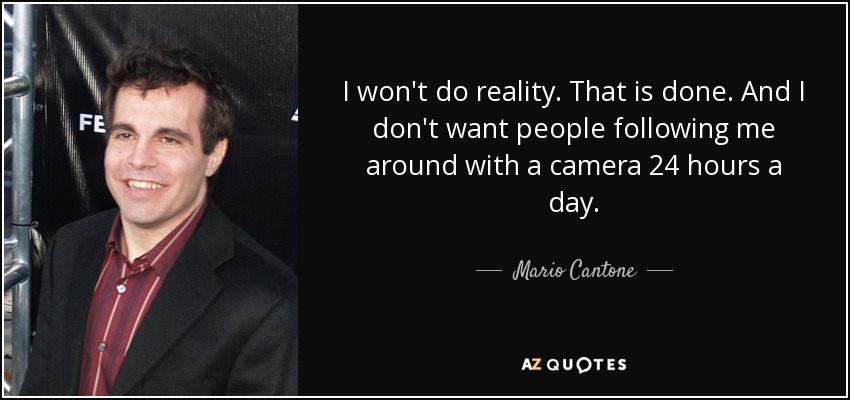
I won't do reality. That is done. And I don't want people following me around with a camera 24 hours a day.
I only shoot on film. I like the quality, the grain and the imperfections. It offers me something much more rewarding than any digital camera can give me. I believe the extra expense is worth it.
I've tried plenty of telephones. I tried to get into the Samsung Galaxy and the Blackberry, but the iPhone is just too easy to use. The camera takes clear pictures and the phone itself looks great. Like all Apple products, it kind of just makes sense.
There is a very particular feeling I get when I have the camera in my hand, looking at an actor talk, knowing that what I’m shooting will end up on the screen.
Yes, I got my first Bolex camera a few weeks after being dropped in New York by the United Nations Refugee Organization. That was on October 29th, 1949. With my brother Adolfas, we wanted to make a film about displaced persons, how one feels being uprooted from one's home.
People have been reading photography as a true document, at the same time they are now getting suspicious. I am basically an honest person, so I let the camera capture whatever it captures whether you believe it or not is up to you; it’s not my responsibility, blame my camera, not me.
One night I had an idea while I was at the movies: to photograph the film itself. I tried to imagine photographing an entire feature film with my camera. I could already picture the projection screen making itself visible as a white rectangle. In my imagination, this would appear as a glowing, white rectangle; it would come forward from the projection surface and illuminate the entire theater. This idea struck me as being very interesting, mysterious, and even religious.
I was 19 when I first auditioned for 'American Idol.' I'd never been on an airplane; I'd never been outside of my hometown, except to go to Myrtle Beach. I'm 22 now. I'm learning a lot about life, and it's all in front of the cameras.
It was a hobby I got into a long time ago, hacking cameras. I was able to make my own using different lenses.
In an ideal world, I'd be able to do my shows in my pajamas. Luckily I've got one of the best stylists in the business, Rebecca Allen - she knows what looks good on camera and gives it a sexy kick.
If you continue to act now and be a member of the WWE Universe, you will see the same footage from... another... camera angle.
I don't really have a favorite camera. I use a Leica and Canon a lot. It depends, especially professionally, on the requirements. But my carry-around camera is a Leica.
In my hand luggage I always have my camera, iPod, make-up bag, tooth brush, cleansing products, clean underwear, socks and a change of clothes in case anything goes missing at the other end - and of course my passport.
Practicing going over scenes and in front of the camera just to see how that feels, and then ultimately just finding a way to expose yourself to people. That’s what I did.
I think the camera was always my obsession, the camera movements. Because for me it's the most important thing in the move, the camera, because without the camera, film is just a stage or television - nothing.
Aging on camera is just very hard. I love my age. I feel good about myself but high definition television is not kind. You don't even look like yourself in high-def. It just makes every little line on your face more exaggerated so it ends up aging you. It's like you're watching yourself seven years older.
Every time you see someone sticking up a 7-Eleven, the kid's wearing a hoodie. Every time you see a mugging on a surveillance camera or they get the old lady in the alcove, it's a kid wearing a hoodie. You have to recognize that this whole stylizing yourself as a gangsta - you're going to be a gangsta wannabe? Well, people are going to perceive you as a menace.
The general killed the Viet Cong; I killed the general with my camera.
My relationship with the journalists who covered the campaign was complicated. I often hid from the critical eye of their cameras and their omnipresent digital recorders, wary of the critique implicit in every captured moment. But I also grew to respect and understand their passion for their work, their love for the journey we were sharing.
Here’s a current example of the challenge we face. At the height of its power, the photography company Kodak employed more than 140,000 people and was worth $28 billion. They even invented the first digital camera. But today Kodak is bankrupt, and the new face of digital photography has become Instagram. When Instagram was sold to Facebook for a billion dollars in 2012, it employed only thirteen people. Where did all those jobs disappear to? And what happened to the wealth that all those middle-class jobs created?
A model needs to know how to project herself into the camera.
It is inescapable that Ringo was the catalyst for the others. He certainly completed the jigsaw and The Beatles, with Ringo, became a magnet for the great camera artists of the world, a target for the jaded, lately hostile eyes of people who had hardly known that popular music existed.
When I see someone filming me, I don't usually think, 'No, man, don't put this up online!' I'd think, 'Hey man, you don't get to go to shows very often, put down the camera and enjoy it!' I love going to theatre and to shows so much.
It is said that the camera cannot lie, but rarely do we allow it to do anything else, since the camera sees what you point it at: the camera sees what you want it to see.
Editing can alter the original meaning and context, and computers can alter the image itself. The camera can also be manipulated. At the very least, it must be turned in one direction - only one direction at a time ... Who chooses what direction to point the camera, and why?
Follow AzQuotes on Facebook, Twitter and Google+. Every day we present the best quotes! Improve yourself, find your inspiration, share with friends
or simply: