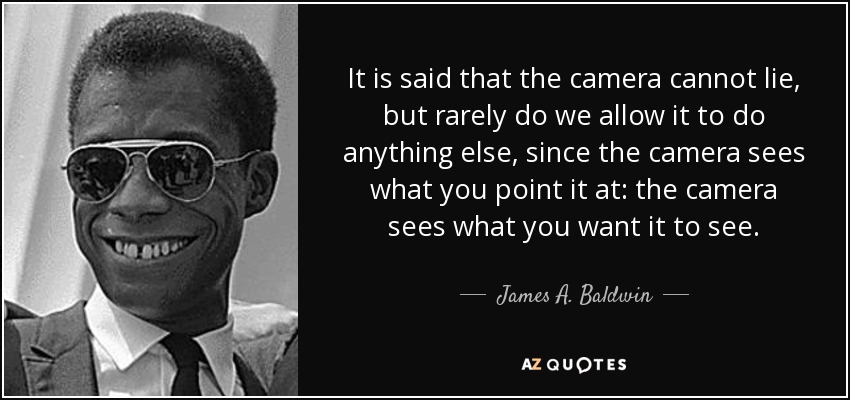
It is said that the camera cannot lie, but rarely do we allow it to do anything else, since the camera sees what you point it at: the camera sees what you want it to see.
Editing can alter the original meaning and context, and computers can alter the image itself. The camera can also be manipulated. At the very least, it must be turned in one direction - only one direction at a time ... Who chooses what direction to point the camera, and why?
I fell in love with the place! You know, the people, the bourbon, the music... it's in the air. It's something you can't describe on camera.
I find that when one has worked long enough, technical know-how becomes almost irrelevant. In photography, it's not difficult to reach a technical level where you don't need to think about the technique any more. I think there is far too much literature and far too much emphasis upon the techniques of photography. The make of camera and type of film we happen to use has little bearing on the results.
It's possible to think of photography as an act of editing, a matter of where you put your rectangle pull it out or take it away. Sometimes people ask me about films, cameras and development times in order to find out how to do landscape photography. The first thing I do in landscape photography is go out there and talk to the land - form a relationship, ask permission, it's not about going out there like some paparazzi with a Leica and snapping a few pictures, before running off to print them.
Every photograph that is made whether by one who considers himself a professional, or by the tourist who points his snapshot camera and pushes a button, is a response to the exterior world, to something perceived outside himself by the person who operates the camera.
Over the years I have photographed thousands of people. I have never stopped being curious and trying to discover new worlds. I have used my camera as a mirror for my subjects as well. I remember photographing a woman in her 80s for my book, Wise Women, who told me it had been a long time since anyone had really been interested in "seeing" or photographing her. When she saw the picture, she burst into tears. She saw something in the photograph, an inner beauty and soul, she felt had long ago vanished.
Laugh, love, dream, strive, smile, feel, joy, look, try, fail, read, walk, search, share, help, work, fun, learn, retry, sweat, cry, rest, wait, fear, hope, trust, pride... when we have lived all of these, our photography might stop being a record of what our camera sees and become an expression of what we as photographers feel.
A camera exposes more than just an image. It also exposes the photographer.
I just happened to have my camera and be photographing my friends. It was totally innocent; there was no purpose to the photographs. There was a purity to them that wasn’t planned; it was realism.
Where past generations had film cameras, scrapbooks, notebooks, and that part of the brain which stores memories, we now have a smartphone app for every conceivable recording need. The thing is, all that time you spend logging and then curating the quotidian aspects of your daily life is time taken away from actually doing things.
I am not as intelligent as Aamir Khan . I am barely managing to be in front of the camera. There are many people who know marketing well and surely Aamir knows much more than I do.
For half a century photography has been the "art form" of the untalented. Obviously some pictures are more satisfactory than others, but where is credit due? To the designer of the camera? to the finger on the button? to the law of averages?
When I walk with a camera, I walk from shot to shot, reading the light on a calibrated meter. When I walk without a camera, my own shutter opens, and the moment's light prints on my own silver gut. When I see this second way I am above all an unscrupulous observer.
With dancing, you have to know spatial movement with somebody. It is steps. It's literally steps and knowing how close to be or how far away. You have to have the beat in the right place with the camera.
The camera has its own kind of consciousness; in the lens the Garden of Eden itself would become ever so slightly too perfect.
I like having the digital camera on my smart phone, but I also like having a dedicated camera for when I want to take real pictures.
Bleak factory buildings and billboard-cluttered avenues look as beautiful, through the camera's eye, as churches and pastoral landscapes.
The possession of a camera can inspire something akin to lust. And like all credible forms of lust, it cannot be satisfied.
Reality has come to seem more and more like what we are shown by cameras.
I began making pictures because I wanted to record what supports hope: the untranslatable mystery and beauty of the world. Along the way, however, the camera also caught evidence against hope, and I eventually concluded that this, too, belonged in pictures if they were to be truthful and thus useful.
To be a gentleman is to be oneself, all of a seam, on camera and off.
Television is a prisoner of dialogue and steady-cam. People walk down a hall, and the camera follows them around a corner.
I was so besotted with '8½' that, when it was on TV, I used to take pictures with my 35-mm. camera of the frames of the film. That was the first time I'd ever really seen Italians on screen.
The world I feel, within the realm of art, is more genuine than the wrorld of matter. Artistic feeling is not tape measures, spectrographs, or flash camera lens.
Follow AzQuotes on Facebook, Twitter and Google+. Every day we present the best quotes! Improve yourself, find your inspiration, share with friends
or simply: