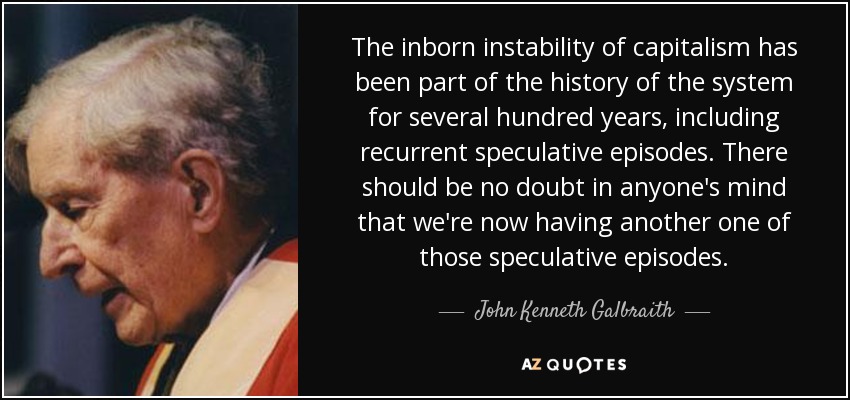
The inborn instability of capitalism has been part of the history of the system for several hundred years, including recurrent speculative episodes. There should be no doubt in anyone's mind that we're now having another one of those speculative episodes.
I begin with the renaming of the system. It used to be capitalism. But that evokes [Karl] Marx and [John] Rockefeller. So now we speak of the market system. That is a nice bland expression, which forgets those off-color references.
Speaking as a New Yorker, I found it a shocking and terrifying event [9/11], particularly the scale of it. At bottom, it was an implacable desire to do harm to innocent people. It was aimed at symbols: the World Trade Center, the heart of American capitalism, and the Pentagon, the headquarters of the American military establishment.
I've lived long enough to see the triumph of zealots and absolutists, to watch money swallow politics, to witness the rise of the corporate state. See the party of working and poor people become a sycophant of crony capitalism. Watch the union of church and state become fashionable again. Witness the coupling of news and entertainment. See everyday people cast overboard as the pirates and predators of Wall Street seized the ship of state. I didn't drift; I moved left just by standing still.
I'm by no means convinced that capitalism and the development of technology has made anarchism easier.
Here's what I do believe very strongly: that once capitalism comes into existence, once it creates this mythology of a stingy nature, then that myth has to be exorcised. In other words, we have to get out of people's heads the idea that without a market economy, without egotism, competition, rivalry and self-interest, without all the technological advances that [Karl] Marx imputed to capitalism, we have to eliminate the feeling that we would sink into some kind of barbarism.
After reading The Great Transformation by Karl Polanyi, I realized that capitalism did not naturally grow as [Karl] Marx would imply by his theory of historical materialism. People were dragged into capitalism screaming, shouting, and fighting all along the way, trying to resist this industrial and commercial world.
I'm convinced more than ever that capitalism, with its technological development, has not been an advance toward freedom but has been an enormous setback of freedom.
Capitalism in its imperialistic stage is a system which regards war as a legitimate method for solution of international disputes - a method which is legitimate in fact if not legally so.
Are there no American citizens sympathizing with whiteguard emigres who conduct propaganda in favor of capitalism, against the Soviets? Then what does the point involve? The point is not to assist these persons, not to finance their activities. The point is that officials of both countries should not interfere in the internal affairs of the other country.
Neither Italian fascism nor German national "socialism" have anything in common with such a [Soviet socialistic] society, primarily because private ownership of factories, plants, lands, banks, means of transportation, etc., remain untouched there, and, therefore, capitalism in Germany and Italy remains in full force.
The situation is that in Germany capitalism has remained, classes and class struggle have remained which all the same will break into the open, which includes also the field of struggle of parties representing opposing classes just as it broke through in, let us say, Spain.
We wasted a lot of creative energy in that immediate post colonial era, when there was a struggle between, you know, the Cold War between the capitalism and communism. Many writers just wasted their energy and their talent because they want to be ideologically correct and of course all they produced was propaganda.
From the time I first understood economic principles, I was always concerned also that any system be operated on an efficient basis, which meant decentralization because knowledge is not concentrated anywhere. It's based on motivation, and so these are the advantages of, say, the cautious case for capitalism, that the market system is efficient.
I think on the efficiency level, not only the distribution level, capitalism is a flawed system. It probably has the same virtues as Churchill attributed to democracy: It's the worst system except for any other. And I think that's right, but it cannot be thought that some unmitigated belief in free markets is a cure even from the efficiency point of view.
Democrats can have a different version of the line, or they can just say, no, we are the party of international peace and activism, and we're the party that's going to have a civilized capitalism.
I do think, over the last years, a lot of Republicans have decided it's not working, what the party believed in, free trade, global capitalism, open borders.
Basically, global capitalism, basically to support it, or is it to be opposed? Is international order to be supported, or is it to be opposed? Republicans have taken a very clear line.
Basically, global capitalism, basically to support it, or is it to be opposed? Is international order to be supported, or is it to be opposed? Republicans have taken a very clear line. Democrats can have a different version of the line, or they can just say, no, we are the party of international peace and activism, and we're the party that's going to have a civilized capitalism.
Frankly, the conservatives need to be better conservatives. Real conservatives actually respect our Constitution and would stand up to an authoritarian. Real conservatives believe in clean, limited government and would stand up to anybody who is basically setting up a kleptocracy, nepotism, and crony capitalism. And real conservatives are actually strong for America and not weak for Russia.
I gather that a lot of the "pots" in the great museum in Baghdad, which we allowed to be looted and then gutted, are now for sale to the highest bidder on the art and archeology black market. This is good capitalism, I guess, while a museum, being a public trust and accessible to all, is anticapitalist, pretty damn near socialist in fact.
I don't like the idea of capitalism anyway. Because it's not capital we are talking about; it's knowledge and creating well-being. Because I mean, that gets people on the wrong track when it's capital and how we allocate capital - no. How do we create the Republic of Science in America? How do we have a system of mutual benefits where people succeed by helping others improve their lives? So I don't like that at all.
Capitalism gives all of us a great opportunity if we seize it with both hands and hang on to it.
You just overwhelm the system with so many dependents and so many middle class benefits having to be paid that the money isn't there. It causes a system-wide collapse, capitalism implodes upon itself, and somebody comes into the breach and restructures the government as a socialist utopian paradise - and the guy's dead serious about it.
If you believe [Steven Lerner] is being honest about what he believes - and I do - it's a fascinating look into the mind-set of the kook, extremist left in this country who are treated sympathetically by the media. Their causes are all just, and so is the notion that capitalism is unfair and that their money has been stolen from them and that the country is unjust - and they need to, you know, economically hobble it.
Follow AzQuotes on Facebook, Twitter and Google+. Every day we present the best quotes! Improve yourself, find your inspiration, share with friends
or simply: