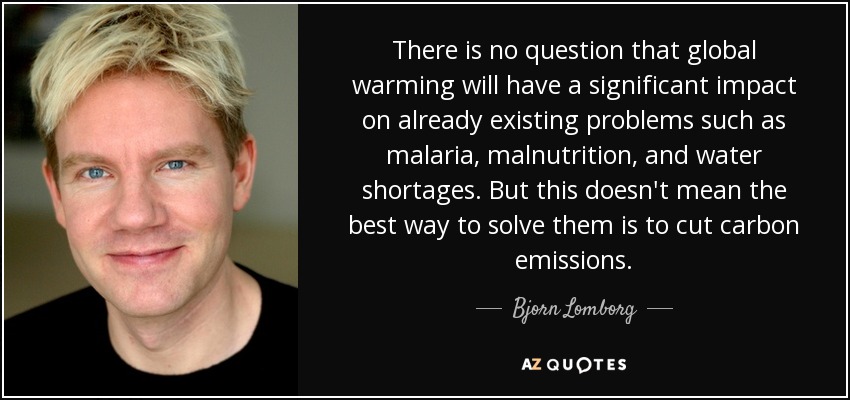
There is no question that global warming will have a significant impact on already existing problems such as malaria, malnutrition, and water shortages. But this doesn't mean the best way to solve them is to cut carbon emissions.
Science is warning us that if we do not quickly reduce the global warming pollution that is trapping so much of the heat our planet normally radiates back out of the atmosphere, we are in danger of creating a permanent 'carbon summer'.
Carbon is the currency of how you measure climate change, but water will be the teeth.
'Goals' and 'caps' on carbon emissions are practically worthless, if coal emissions continue, because of the exceedingly long lifetime of carbon dioxide in the air.
Trees and soils can absorb carbon dioxide released by fossil fuel burning. It would be great to subsidize responsible farmers and forest managers.
Decades of scientific research has proven that carbon pollution is harmful to human health and causes global warming.
The record-breaking extreme weather events causing chaos across the globe should be a wake-up call. The transition to a low-carbon economy will be much more painful if we wait until there is a climate crisis before recognising that more than half of the world's fossil fuel reserves will have to remain in the ground.
Once the renewable infrastructure is built, the fuel is free forever. Unlike carbon-based fuels, the wind and the sun and the earth itself provide fuel that is free, in amounts that are effectively limitless.
Grief is an element. It has its own cycle like the carbon cycle, the nitrogen. It never diminishes not ever. It passes in and out of everything.
When I was a boy in the 1930s, the carbon dioxide level was still below 300 parts per million. This year, it reached 382, the highest figure for hundreds of thousands of years.
We must stop climate change. And we can, if we use the tactics that worked in South Africa against the worst carbon emitters.
Taking significant amounts of carbon out of our economy without harming its vibrancy is exactly the sort of challenge at which California excels.
If we don't embrace a low carbon economy this decade, it won't just harm the planet, but also the U.S. economy.
Meatspace still has some advantages for a carbon-based girl.
This generation has altered the composition of the atmosphere on a global scale through radioactive materials and a steady increase in carbon dioxide from the burning of fossil fuels. Entire regional airsheds, crop plant environments, and river basins are heavy with noxious materials. Motor vehicles and home heating plants, municipal dumps and factories continually hurl pollutants into the air we breathe. Each day almost 50,000 tons of unpleasant, and sometimes poisonous, sulfur dioxide are added to the atmosphere, and our automobiles produce almost 300,000 tons of other pollutants.
Organic compounds exist in which a hydrogen atom, joined to the carbon, acquires acid properties as a result of the proximity of certain functional groupings.
Here's the problem - carbon dioxide doesn't contribute to smog and isn't a health threat. All of this is being done because some people believe carbon dioxide is causing global warming, and that preventing carbon dioxide from entering the air is the only answer. Never mind that there is still an ongoing scientific debate about global warming itself, and that some respected climate scientists believe that methane is a better target, California legislators have locked their sites on carbon dioxide.
Knowledge is like fire 'cause it breaks down things so you can see what they truly are. It's like how a fire breaks your body down to carbon.
We can come up with a working definition of life, which is what we did for the Viking mission to Mars. We said we could think in terms of a large molecule made up of carbon compounds that can replicate, or make copies of itself, and metabolize food and energy. So that's the thought: macrocolecule, metabolism, replication.
Carbon is, as may easily be shown and as I shall explain in greater detail later, tetrabasic or tetratomic, that is 1 atom of carbon = C = 12 is equivalent to 4 At.H.
There's no huge mystery. If you dig up huge amounts of carbon, huge amounts of ancient biology, hundreds of millions of year's worth of ancient biology, and flush it into the atmosphere in a matter of decades, then it stands to reason that we're going to have enormous effects, and now we can see those effects all around us.
Society's emissions of carbon dioxide may or may not turn out to have something significant to do with global warming-the jury is still out.
A couple degrees warmer would be good for humanity and planet, especially with more plant-fertilizing carbon dioxide in the air. [...] But a couple degrees colder would bring serious adverse consequences for habitats, wildlife, agriculture and humanity."
Carbon tax has the advantage of basically being able to subsidize one set of activities that you want with another set of activities that you don't want. It's like a cigarette tax.
We're clearly not going to stop global warming at this point. We've already raised the temperature of the planet one degree. We've got another degree in the pipeline from carbon we've already emitted. What we're talking about now is whether we're going to have a difficult, difficult century, or an impossible one.
Follow AzQuotes on Facebook, Twitter and Google+. Every day we present the best quotes! Improve yourself, find your inspiration, share with friends
or simply: