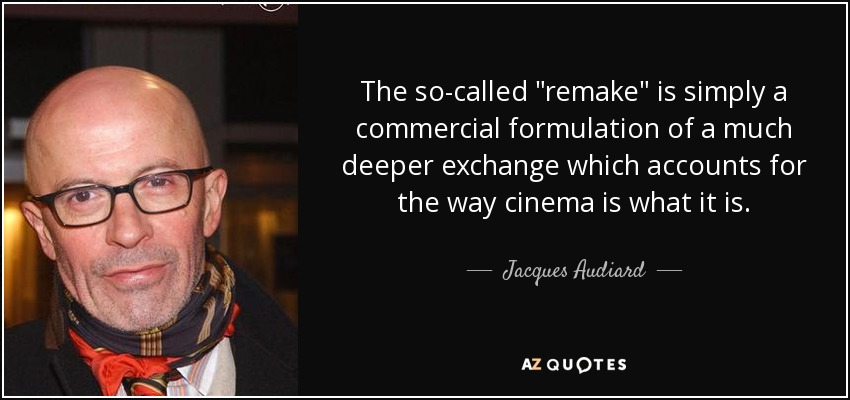
The so-called "remake" is simply a commercial formulation of a much deeper exchange which accounts for the way cinema is what it is.
Every medium has its own kind of freedom. I don't want to just cross from one to the next. I want to enjoy the freedom each one has. Sometimes, you can do something for TV that you can't do in the cinema.
In terms of making TV drama, not everything has to make sense. In cinema, you usually strive for reality and a natural environment, but in TV, it's more acceptable to do something crazy and break with naturalism.
What the rest of the world knows about Mexico is what they see on films and the bad news they see on TV. We need to make films that are worthy of who we really are as Mexicans. We also need to make cinema that reflects the diversity in the region, so that Americans and Europeans know who Mexicans are, who Salvadorians are, who Cubans are, etc. We need to do it, and all we really need is support because we have the talent.
In this particular business [cinema], you don't choose your own experiences. They start to happen and then they start to peel off and make other ones happen, and then you can start choosing. But it happens to you.
Imagine, there is almost no possibility for a foreign language film to be distributed in America right now. That doesn't just make the industry poorer, it makes the landscape of cinema poorer, in America. The impossibility to get a good release on a really good European, Latin American, Asian movie is a tragedy.
I would like to compare football and cinema. I think it's very similar. It's two games... different games. You have to work very hard and find the confidence to enjoy it on the pitch or in the film.
When I say that it's taken us [with Luca Guadagnino ] 11 years to make this film, what I mean is that it was 11 years ago that we started to talk about a kind of cinema that we wanted to make together.
I think that's true of all cinema, that's why cinema is the great humanistic art form. Whatever the film is, it doesn't matter what the film is about, or even whether it's a narrative or figurative film at all, it's an invitation to step into somebody else's shoes. Even if it's the filmmaker's shoes filming a landscape, you go into somebody else's shoes and you look out of their lens, you look out of their eyes and their imagination. That's what going to the pictures is all about.
This...Godless society operates in an extremely efficient manner at least in its higher levels of leadership...It follows a perfectly mapped out strategy. It holds almost complete sway in international organizations, in financial circles, in the field of mass communications; press, cinema, radio and television.
On the professional side, I've helped move cinema from a chemical-based medium to a digital-based medium. That'll be one of the landmarks. And I've left these stories, these little tales that have been imprinted on the media, which will or will not be of interest to people in the future. I've done the best I can.
There's a lot of great writing, and characters, and stories being told in television nowadays. And much more than there used to be. The opportunities to tell stories, because of the opportunities to show content. And so it's drawing actors from cinema, movie actors, actors to where there's a lot of opportunities to where you can tell stories.
I'm one of the few reading and thinking people who loves Las Vegas for the vulgarity and omnipresence of the dream. The collective dream. There's something enormous about it. Let me say one thing: Las Vegas and cinema have similar roots. The country fair. The magician at the country fair. The vulgarity of the country fair.
I think that it's not a bad thing to not be too versed in the vocabulary of cinema, because you start to think that certain things are allowed and not allowed.
A "name" no longer carries a film. People used to go to the cinema to see a "John Wayne film." And you don't have that thing happening now except in the rock world, which has taken the event out of movies.
A lot of the young people make beautiful films or big films or are able to finance them, but they can't get anyone to distribute them, they can't get anyone to see them, so they go to these thousands of film festivals. So I still believe that even though a young kid might be able to make a masterpiece or something that changes the direction of cinema, the issue of how to get it to people is still not solved.
Film has become a marketed commodity, and the opportunities and audiences for art cinema have grown smaller. There is a general downturn in cultural literacy, perhaps because of television.
I don't try to make a place in history at all! People put me in the history of cinema because my first film, La pointe-courte, was so ahead of some other filmmakers. Many filmmakers have made resurgent work, and I was just a little ahead of the time.
When I started my first film, there were three women directors in France. Their films were OK, but I was different. It's like when you start to jump and you put the pole very high - you have to jump very high. I thought, I have to use cinema as a language.
When I saw what painting had done in the last thirty years, what literature had done - people like Joyce and Virginia Woolf, Faulkner and Hemingway - in France we have Nathalie Sarraute - and paintings became so strongly contemporary while cinema was just following the path of theater. I have to do something which relates with my time, and in my time, we make things differently.
At that time, when I started, in the '50s, cinema was very classical in its aims.
That sort of detailed filmmaking is one, hard to do and not have it be pretentious, and two, have it tell the story, which is what you're taught, that cinema is the language of images and you really should be able to make a film with no dialogue and tell a story.
I don't know what to say to people. It's become so big. It's become part of the cultural environment. For the first and second Twiglight, I knew exactly what to say to people. If you don't know what the story is by now, then you've probably never been to the cinema before. How about, "Why not go to the cinema for once?" I don't know.
Civilization is drugs, alcohol, engines of war, prostitution, machines and machine slaves, low wages, bad food, bad taste, prisons, reformatories, lunatic asylums, divorce, perversion, brutal sports, suicides, infanticide, cinema, quackery, demagogy, strikes, lockouts, revolutions, putsches, colonization, electric chairs, guillotines, sabotage, floods, famine, disease, gangsters, money barons, horse racing, fashion shows, poodle dogs, chow dogs, Siamese cats, condoms, peccaries, syphilis, gonorrhea, insanity, neuroses, etc., etc.
The fact is that Hollywood, from as early as the sixties to the present time, has ghettoized cinema into the big industry, a marketing industry. In doing this, the audiences have lost touch with the aspects of film which were to be informative and educational and even spiritual.
Follow AzQuotes on Facebook, Twitter and Google+. Every day we present the best quotes! Improve yourself, find your inspiration, share with friends
or simply: