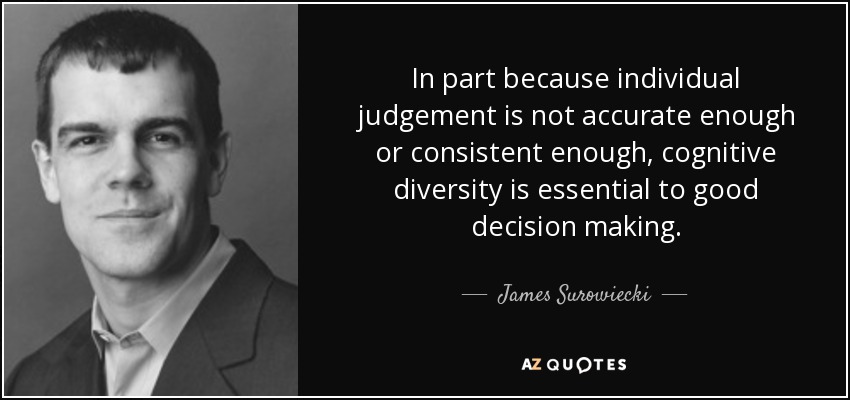
In part because individual judgement is not accurate enough or consistent enough, cognitive diversity is essential to good decision making.
Suicide rates have not slumped under the onslaught of antidepressants, mood-stabilizers, anxiolytic and anti-psychotic drugs; the jump in suicide rates suggests that the opposite is true. In some cases, suicide risk skyrockets once treatment begins (the patient may feel not only penalized for a justifiable reaction, but permanently stigmatized as malfunctioning). Studies show that self-loathing sharply decreases only in the course of cognitive-behavioral treatment.
It is not quite right to describe One Taste as a "consciousness" or an "awareness," because that's a little too heady, too cognitive. It's more like the simple Feeling of Being. You already feel this simple Feeling of Being: it is the simple, present feeling of existence.
With every passing year we discover more evidence to support Darwin's revolutionary hypothesis that the cognitive and emotional lives of animals differ only by degree, from the fishes to the birds to the monkeys to humans.
There are a variety of techniques to help people change the kind of thinking that leads them to become depressed. These techniques are called cognitive behavioral therapy.
In the end, leadership is not intellectual or cognitive. Leadership is emotional.
The difficulty in judging what type of behavior works well arises not only because a given course of action does not always produce the outcomes. Similar outcomes can occur for reasons other than the person's actions, which further complicates inferential judgment. Effects that arise independently of one's actions distort the influence of similar effects produced by the actions, but only on some occasions. Given a strong cognitive set to perceive regularities, even chance joint occurrences of events can be easily misjudged as genuine relationships of low contingent probability
In social cognitive theory, perceived self-efficacy results from diverse sources of information conveyed vicariously and through social evaluation, as well as through direct experience
Regression analyses show that self-efficacy contributes to achievement behavior beyond the effects of cognitive skills
From the social cognitive perspective, it is mainly perceived inefficacy to cope with potentially aversive events that makes them fearsome. To the extent that people believe they can prevent, terminate, or lessen the severity of aversive events, they have little reason to be perturbed by them. But if they believe they are unable to manage threats safely, they have much cause for apprehension.
I see psychoanalysis, art and biology ultimately coming together, just like cognitive psychology and neuroscience have merged.
A distinguished cognitive neuroscientist confessed to me that, because of his religious upbringing, he could not get rid of psychoneural dualism. The idea that one ceases to be after death was too painful to him.
I really haven't been cognitive of gas prices. It wasn't until I filled up my husband's Toyota Prius Hybrid that I had a moment of understanding of how people who drive gas cars feel.
After a while, if you're committed, you start to believe in the things in which you're praying. It's just cognitive dissonance. You can't live a completely religious life and not start to have it sink in.
Follow AzQuotes on Facebook, Twitter and Google+. Every day we present the best quotes! Improve yourself, find your inspiration, share with friends
or simply: