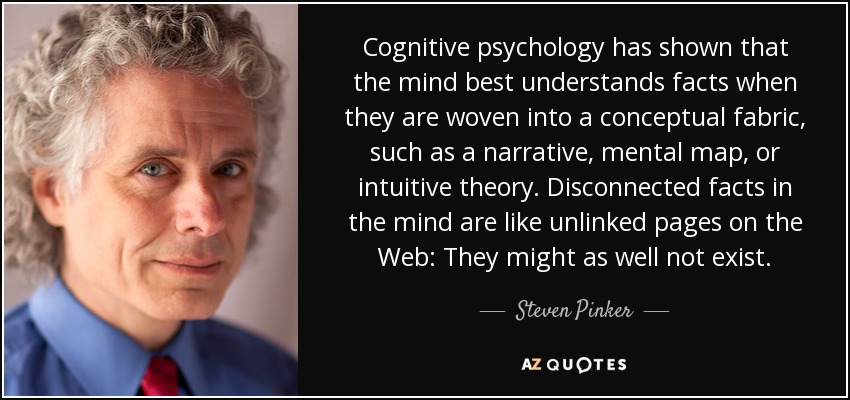
Cognitive psychology has shown that the mind best understands facts when they are woven into a conceptual fabric, such as a narrative, mental map, or intuitive theory. Disconnected facts in the mind are like unlinked pages on the Web: They might as well not exist.
I spent 20 years doing research on regular and irregular verbs, not because I'm an obsessive language lover but because it seemed to me that they tapped into a fundamental distinction in language processing, indeed in cognitive processing, between memory lookup and rule-driven computation.
At a conference of sociologists in America in 1977, love was defined as "the cognitive-affective state characterized by intrusive and obsessive fantasizing concerning reciprocity of amorant feelings by the object of the amorance." That is jargon - the practice of never calling a spade a spade when you might instead call it a manual earth-restructuring implement - and it is one of the great curses of modern English.
It is possible to be a fan of reality TV, talent shows and bubblegum pop and still have a brain. You will also see that a great many people know perfectly well how silly and camp and trivial their fandom is. They do not check in their minds when they enter a fan site. Judgement is not necessarily fled to brutish beasts, and men have not quite lost their reason. Which is all a way of questioning whether pop-culture hero worship is really so psychically damaging, so erosive of cognitive faculties, so corrupting of the soul of mankind as we are so often told.
To summarize, using money to motivate people can be a double-edged sword. For tasks that require cognitive ability, low to moderate performance-based incentives can help. But when the incentive level is very high, it can command too much attention and thereby distract the person’s mind with thoughts about the reward. This can create stress and ultimately reduce the level of performance.
A general “law of least effort” applies to cognitive as well as physical exertion. The law asserts that if there are several ways of achieving the same goal, people will eventually gravitate to the least demanding course of action. In the economy of action, effort is a cost, and the acquisition of skill is driven by the balance of benefits and costs. Laziness is built deep into our nature.
To every object there correspond an ideally closed system of truths that are true of it and, on the other hand, an ideal system of possible cognitive processes by virtue of which the object and the truths about it would be given to any cognitive subject.
The great cognitive shift is an expansion of consciousness from the perspectival form contained in the lives of particular creatures to an objective, world-encompassing form that exists both individually and intersubjectively. It was originally a biological evolutionary process, and in our species it has become a collective cultural process as well. Each of our lives is a part of the lengthy process of the universe gradually waking up and becoming aware of itself.
Nonetheless, it still remains true that as a set of cognitive beliefs, religious doctrines constitute a speculative hypothesis of an extremely low order of probability.
I find that here in the States, audiences are generally less knowledgeable, from the cognitive point of view, though they are emotionally more receptive.
Actually, I think my view is compatible with much of the work going on now in neuroscience and psychology, where people are studying the relationship of consciousness to neural and cognitive processes without really trying to reduce it to those processes.
As applied to substance abuse, the cognitive approach helps individuals to come to grips with the problems leading to emotional distress and to gain a broader perspective on their reliance on drugs for pleasure and/or relief from discomfort.
I think that cognitive scientists would support the view that our visual system does not directly represent what is out there in the world and that our brain constructs a lot of the imagery that we believe we are seeing.
When it comes to the mental world, when we design things like health care and retirement and stock markets, we somehow forget the idea that we are limited. I think that if we understood our cognitive limitations in the same way that we understand our physical limitations … we could design a better world.
Ultimately, of course, you must decide for yourself whether the subjective psychological effects created by your evolved cognitive biases reflect an objective reality, perhaps as evidence that God designed your mind to be so receptive to Him. Or, just maybe, you will come to acknowledge that, like the rest of us, you are a hopeless pawn in one of natural selection's most successful hoaxes ever-and smile at the sheer ingenuity involved in pulling it off, at the very thought of such mindless cleverness. One can still enjoy the illusion of God, after all, without believing Him to be real.
I've had a lot of cognitive behavioural therapy, and am having a family now.
Coming to understand a painting or a symphony in an unfamiliar style, to recognize the work of an artist or school, to see or hear in new ways, is as cognitive an achievement as learning to read or write or add.
Because of my bipolar disorder, I tend to these mixed states, which are depressed but loud and agitated. So I can be terribly irritable. I go to cognitive behavioral therapy in order not to yell at my children.
Emotion only lasts in our bodies for about 90 seconds. After that, the physical reaction dissipates, UNLESS our cognitive brain kicks in and starts connecting our anger with past events.
The fact that cognitive diversity matters does not mean that if you assemble a group of diverse but thoroughly uninformed people, their collective wisdom will be smarter than an expert's. But if you can assemble a diverse group of people who possess varying degrees of knowledge and insight, you're better off entrusting it with major decisions rather than leaving them in the hands of one or two people, no matter how smart those people are.
I think that in order to achieve progress in the study of language and human cognitive faculties in general it is necessary first to establish 'psychic distance' from the 'mental facts' to which Köhler referred, and then to explore the possibilities for developing explanatory theories... We must recognize that even the most familiar phenomena require explanation and that we have no privileged access to the underlying mechanisms, no more so than in physiology or physics.
Although elephants are far more distantly related to us than the great apes, they seem to have evolved similar social and cognitive capacities.
There are cognitive processes and limbic reactions associated with basic emotions. And you can change brain chemistry, but you're still not going to change memories and experiences in a human being.
What do we mean by "knowledge" or "understanding"? And how do billions of neurons achieve them? These are complete mysteries. Admittedly, cognitive neuroscientists are still very vague about the exact meaning of words like "understand," "think," and indeed the word "meaning" itself.
Novels institutionalize the ruse of eros. It becomes a narrative texture of sustained incongruence, emotional and cognitive. It permits the reader to stand in triangular relation to the characters in the story and reach into the text after the objects of their desire, sharing their longing but also detached from it, seeing their view of reality but also its mistakenness. It is almost like being in love.
Follow AzQuotes on Facebook, Twitter and Google+. Every day we present the best quotes! Improve yourself, find your inspiration, share with friends
or simply: