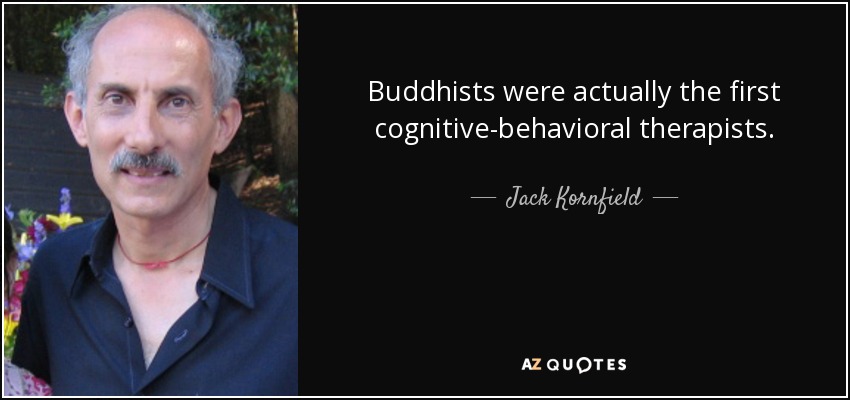
Buddhists were actually the first cognitive-behavioral therapists.
The guy [Donald Trump] has a lot of problems - physical, mental, emotional, cognitive. You know, he comes with a whole lot of baggage, and I think it's pretty obvious.
All psychedelic explorers should be aware of the concept of what is called a cognitive hallucination. The is a much more insidious phenomenon. This is, quite simply, an out-and-out delusion.
Part of the fascination that photography holds is its ability to unlock secrets kept even from ourselves. Like dreams, the photograph can uncork a heady bouquet of recognition which can escape into the cognitive world.
One way of submitting your moral intuitions in relation to some issue to cognitive therapy is to learn more about how people in other cultures think about it.
Cognitive liberty begins at home, behind your eyes and between your ears. The first act of liberation is to step forward, and be counted as one of us.
America has long raised political and cultural cognitive dissonance to an art form. We are capable of living with enormous inequality and injustice while convincing ourselves that we are in fact moving toward what Churchill called the "broad, sun-lit uplands."
I wondered if there was a way to teach people how to use their imaginations in prayer and worship. So I began reading books on cognitive therapy and neuroscience and started studying the devotional traditions of the church.
Since the idea that modification of synaptic function can provide a basis for memory arose shortly after the first anatomical description of the synapse a number of models (Hebb 1949 . . Hayek 1952 . . Kendel 1981) have been proposed in which various cognitive activities are represented by combinations of the firing patterns of individual neurons.
Friedrich Hayek .. seems to have been the first to postulate what is the core of this paper, namely, the idea of memory and perception represented in widely distributed networks of interconnected cortical cells. Subsequently this idea has received theoretical support, however tangential, from the fields of cognitive psychology, connectionism and artificial intelligence. Empirically, it is well supported by the physiological study and neuroimaging of working memory.
Regarding social order, [Francis] Fukuyama writes, "The systematic study of how order, and thus social capital, can emerge in spontaneous and decentralized fashion is one of the most important intellectual developments of the late twentieth century." He correctly attributes the modern origins of this argument to F. A. Hayek, whose pioneering contributions to cognitive science, the study of cultural evolution, and the dynamics of social change put him in the forefront of the most creative scholars of the 20th century.
One of the things cognitive science teaches us is that when people define their very identity by a worldview, or a narrative, or a mode of thought, they are unlikely to change-for the simple reason that it is physically part of their brain, and so many other aspects of their brain structure would also have to change; that change is highly unlikely.
It's a shame cars don't run on cognitive dissonance.
So when you're talking about lyrics in the context of music, it's not just about what the words mean, and what you were thinking about when you wrote it. It's not cognitive in that same way. It's almost like music turns words into touch, which is hard to describe, like the feeling of your shirt on your back. It's a pretty delicate thing to try to put into words. You just feel it.
I think it started to feel like home when I stopped maintaining any pretense that I was ever going to be in the movie business. I went there like many writers - I had a screenplay deal and I would go to these meetings and it was the typical thing. And I hated it. I was not interested in writing screenplays, actually. But I kept feeling like that was what I was supposed to do. It was just this horrible cognitive dissonance.
Faith is an unclassified cognitive illness disguised as a moral virtue.
Our contention is not that medication alone is the answer. We really need to have it in conjunction with cognitive behavioral therapy and with peer support. And that needs to be reimbursed [by health insurers], because it shows huge reductions in overall spending.
Epistemology now flourishes with various complementary approaches. This includes formal epistemology, experimental philosophy, cognitive science and psychology, including relevant brain science, and other philosophical subfields, such as metaphysics, action theory, language, and mind. It is not as though all questions of armchair, traditional epistemology are already settled conclusively, with unanimity or even consensus. We still need to reason our way together to a better view of those issues.
You should not take the content of your intuitive response as evidence until you have submitted your psychological reaction to what I call cognitive psychotherapy. You should do what you can to learn as much as possible about the origin of your reaction.
You are only allowed to treat the content of your intuition as evidence if the intuition stays after you have exposed it to cognitive psychotherapy; in some cases you have to reject it even if it does indeed stay.
I believe in goal-setting. I don't care what it is. If you want to drop 10 pounds, increase your bench press, jump higher, or win a Super Bowl, you have to set that goal for yourself before you go out and achieve it. I think you have to regulate it, and see how you're building toward it every single day. Am I getting closer to that ultimate goal? Am I doing everything I possibly can today to be successful? I'm always very cognitive of my goals.
What's popularly known as the evolution of consciousness, in other words that the expansion of cognitive repertoire that occurs in human beings, which has always been a great puzzle to evolutionary theory, I believe, occurred in the presence of a kind of catalyst for the human imagination.
One of the series I like is D.M. Cornish's 'Monster Blood Tattoo,' in which he creates a whole language. Kids who are reading that are building a language in their heads. There's no real cognitive difference. I think kids are excited by language, and they're not always given credit for that.
The abbreviations (e.g. NATO, UN, USSR - E.W.) denote that and only that which is institutionalized in such a way that the transcending connotation is cut off. The meaning is fixed, doctored, loaded. Once it has become an official vocable, constantly repeated in general usage, "sanctioned" by the intellectuals, it has lost all cognitive value and serves merely for recognition of an unquestionable fact.
There is the experience of enlightenment, to be very aware of what lies beyond the boundaries of cognitive perception, reflection and self-awareness as seen by the personality.
Follow AzQuotes on Facebook, Twitter and Google+. Every day we present the best quotes! Improve yourself, find your inspiration, share with friends
or simply: