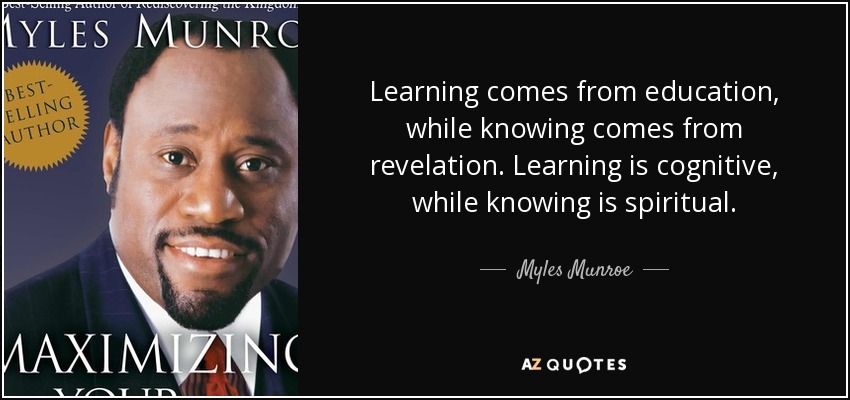
Learning comes from education, while knowing comes from revelation. Learning is cognitive, while knowing is spiritual.
Words can enhance experience, but they can also take so much away. We see an insect and at once we abstract certain characteristics and classify it - a fly. And in that very cognitive exercise, part of the wonder is gone. Once we have labeled the things around us we do not bother to look at them so carefully. Words are part of our rational selves, and to abandon them for a while is to give freer reign to our intuitive selves.
What Warcollier demonstrated is compatible with what modern cognitive neuroscience has learned about how visual images are constructed by the brain. It implies that telepathic perceptions bubble up into awareness from the unconscious and are probably processed in the brain in the same way that we generate images in dreams. And thus telepathic “images” are far less certain than sensory-driven images and subject to distortion.
Many cognitive psychologists see the brain as a computer. But every single brain is absolutely individual, both in its development and in the way it encounters the world.
Empty heads, cognitive science has taught us, learn nothing. The powerful cultural and personal flexibility of our species is owed at least in part to our starting off so well-informed; we are good learners because we know what to pay attention to and what questions are the right ones to ask.
Lions mane may be our first smart mushroom. It is a safe, edible fungus that appears to confer cognitive benefits on our aging population.
Cognitive therapy is based on the idea that when you change the way you think, you can change the way you feel and behave. In other words, if we can learn to think about other people in a more positive and realistic way, it will be far easier to resolve conflicts and develop rewarding personal and professional relationships.
Lakoff's idea is that most of our thought is guided by underlying conceptual mappings between two domains that share some content, that overlap in the sets of their attributes. ... Contrary to the assertions of Lakoff and some of the cognitive metaphor theorists, people can read through to an underlying mapping, but only when the surface metaphor is new to them.
Walking is the only way proven to stave off cognitive decline - it works.
I'm not sure if a mental relation with a woman doesn't make it impossible to love her. To know the mind of a woman is to end in hating her. Love means the pre-cognitive flow...it is the honest state before the apple.
Ideas are so much flat psychological surface unless some mirrored matter gives them cognitive lustre. This is why as a pragmatistI have so carefully posited 'reality' ab initio, and why throughout my whole discussion, I remain an epistemologist realist.
I believe that I have created a lot of cognitive dissonance in the minds of people who are comfortable with stereotypes.
Good design is a Renaissance attitude that combines tech, cognitive science, human need and beauty to produce something.
Cognitive therapy seeks to alleviate psychological stresses by correcting faulty conceptions and self-signals. By correcting erroneous beliefs we can lower excessive reactions.
Unlike art which contains a message, wine conveys nothing, it has no intellectual or cognitive content
[There will be movement toward] behavioral economics... [which] involves study of those aspects of men's images, or cognitive and affective structures that are more relevant to economic decisions.
Decision-making is difficult because, by its nature, it involves uncertainty. If there was no uncertainty, decisions would be easy! The uncertainty exists because we don't know the future, we don't know if the decision we make will lead to the best possible outcome. Cognitive science has taught us that relying on our gut or intuition often leads to bad decisions, particularly in cases where statistical information is available. Our guts and our brains didn't evolve to deal with probabilistic thinking.
You'd think people would realize they're bad at multitasking and would quit. But a cognitive illusion sets in, fueled in part by a dopamine-adrenaline feedback loop, in which multitaskers think they are doing great.
Just as man's physical existence was liberated when he grasped that 'nature, to be commanded, must be obeyed', so his consciousness will be liberated when grasps that nature, to be apprehended, must be obeyed - that the rules of cognition must be derived from the nature of existence and the nature, the identity, of his cognitive faculty.
Social cognitive theory rejects the dichotomous conception of self as agent and self as object. Acting on the environment and acting on oneself entail shifting the perspective of the same agent rather than reifying different selves regulating each other or transforming the self from agent to object
Regression analyses show that self-efficacy contributes to achievement behavior beyond the effects of cognitive skills
From the social cognitive perspective, it is mainly perceived inefficacy to cope with potentially aversive events that makes them fearsome. To the extent that people believe they can prevent, terminate, or lessen the severity of aversive events, they have little reason to be perturbed by them. But if they believe they are unable to manage threats safely, they have much cause for apprehension.
I see psychoanalysis, art and biology ultimately coming together, just like cognitive psychology and neuroscience have merged.
A distinguished cognitive neuroscientist confessed to me that, because of his religious upbringing, he could not get rid of psychoneural dualism. The idea that one ceases to be after death was too painful to him.
I really haven't been cognitive of gas prices. It wasn't until I filled up my husband's Toyota Prius Hybrid that I had a moment of understanding of how people who drive gas cars feel.
Follow AzQuotes on Facebook, Twitter and Google+. Every day we present the best quotes! Improve yourself, find your inspiration, share with friends
or simply: