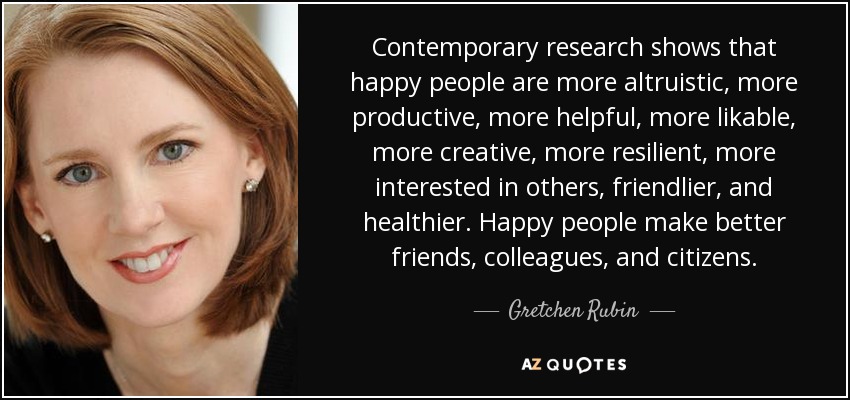
Contemporary research shows that happy people are more altruistic, more productive, more helpful, more likable, more creative, more resilient, more interested in others, friendlier, and healthier. Happy people make better friends, colleagues, and citizens.
But I would like to think for a moment about a man who in the morning teaches his students that a false attribution of a Watteau drawing or an inaccurate transcription of a fourteenth-century epigraph is a sin against the spirit and in the afternoon or evening transmits to the agents of Soviet intelligence classified, perhaps vital information given to him in sworn trust by his countrymen and intimate colleagues. What are the sources of such scission? How does the spirit mask itself?
At the moment, it actually says nothing about a possible cosmic-ray effect on clouds and climate, but it's a very important first step.” This may be because he was ordered to speak circumspectly. According to science writer Nigel Calder, Rolf-Dieter Heuer, the director of the CERN lab, told a German newspaper that “I have asked the colleagues to present the results clearly, but not to interpret them. That would go immediately into the highly political arena of the climate change debate. One has to make clear that cosmic radiation is only one of many parameters.
It could be argued that all leadership is appreciative leadership. It’s the capacity to see the best in the world around us, in our colleagues, and in the groups we are trying to lead. It’s the capacity to see the most creative and improbable opportunities in the marketplace. It’s the capacity to see with an appreciative eye the true and the good, the better and the possible.
[E]volutionists sometimes take as haughty an attitude toward the next level up the conventional ladder of disciplines: the human sciences. They decry the supposed atheoretical particularism of their anthropological colleagues and argue that all would be well if only the students of humanity regarded their subject as yet another animal and therefore yielded explanatory control to evolutionary biologists.
Synonyms know each other like old colleagues, like a set of friends who've seen the world together. They swap stories, reminisce about their origins and forget that though they are similar, they are entirely different, and though they share a certain set of attributes, one can never be the other. Because a quiet night is not the same as a silent one, a firm man is not the same as a steady one, and a bright light is not the same as a brilliant one because the way they wedge themselves into a sentence changes everything.
Great artists are products of their own time: they do not spring forth fully equipped from the head of Jove, but are formed by the circumstances acting upon them since birth. These circumstances include the ambiance created by the other, lesser artists of their own time, who have all done their part in creating the pressure that forces up an exceptional talent. Unjustly, but unavoidably, the very closeness of a great artist to his colleagues and contemporaries leads to their eclipse.
Although [in 1937] we might still hope to prevent the divisions of Europe into Fascist and anti-Fascist camps, our real affinities and interests, strategic as well as political, lay with France, a fact which some of my colleagues were most reluctant to realise.
Yes. I'm a doctor, an epidemiologist, and lots of my professional colleagues flip back and forth between industry and medical roles. I know them; they are not bad people. But it is possible for good people in bad systems to do things that inflict enormous harm.
I try to make myself happy ... because I know that if I'm not happy, my colleagues are not happy, and my shareholders are not happy, and my customers are not happy.
Dissents speak to a future age. It's not simply to say, 'My colleagues are wrong and I would do it this way.' But the greatest dissents do become court opinions and gradually over time their views become the dominant view. So that's the dissenter's hope: that they are writing not for today but for tomorrow.
At one campus where I was lecturing, I asked a friend, "How many of my colleagues know I'm gay?" He answered, "All of them." I wasn't surprised. But, just the same, it was kind of spooky, because not one of them had ever given me the faintest sign that he or she knew. If I had spoken about it myself, most of them would have felt it was in bad taste.
A colleague who met me strolling rather aimlessly in the beautiful streets of Copenhagen said to me in a friendly manner, "You look very unhappy"; whereupon I answered fiercely, "How can one look happy when he is thinking about the anomalous Zeeman effect?".
In science men have learned consciously to subordinate themselves to a common purpose without losing the individuality of their achievements. Each one knows that his work depends on that of his predecessors and colleagues, and that it can only reach its fruition through the work of his successors. In science men collaborate not because they are forced to by superior authority or because they blindly follow some chosen leader, but because they realize that only in this willing collaboration can each man find his goal.
The realization that American power could and should be used for the defense of pluralism and as a punishment for fascism came to me in Sarajevo a year or two later... That was an early quarrel between me and many of my Nation colleagues, and it was also the first time I found myself in the same trench as people like Paul Wolfowitz and Jeane Kirkpatrick: a shock I had to learn to get over. The only real radicalism in our time will come as it always has from people who insist on thinking for themselves and who reject party-mindedness.
It may sound surprising when I say, on the basis of my own clinical practice as well as that of my psychological and psychiatric colleagues, that the chief problem of people in the middle decade of the twentieth century is emptiness.
In 1969, nationwide, female professors who had never been married and never published earned 145% of their counterpart male colleagues.
The real and most pressing question raised by any social problem is: "How do I appear concerned and compassionate to all my friends, colleagues, and peers?
Knowing something for oneself or for communication to an expert colleague is not the same as knowing it for explanation to a student.
My male colleagues sometimes wonder if I understand as much about defense as I ought to. Of course if I agree with them, they think that I do.
My first job was scooping ice cream at Friendly's in Albany, New York. I hated the work, most of my colleagues, and the uniform, and I more or less lost my taste for ice cream permanently.
I strongly support SNAP and will continue to urge my colleagues in Congress to provide adequate funding to this important program.
I've always found women more loyal, more disciplined, less neurotic, more hardworking. I just think they're perfect colleagues. Whereas, God knows, I've dealt with plenty of neurotic men.
Educators committed to engaging in the long-term, often difficult work of strengthening their relationships with colleagues, students and parents and expanding their opportunities for personal growth will find Nonviolent Communication to be an invaluable tool.
I am no longer a divine biped. I am no longer the freest German after Goethe, as Ruge named me in healthier days. I am no longer the great hero No. 2, who was compared with the grape-crowned Dionysius, whilst my colleague No. 1 enjoyed the title of a Grand Ducal Weimarian Jupiter. I am no longer a joyous, somewhat corpulent Hellenist, laughing cheerfully down upon the melancholy Nazarenes. I am now a poor fatally-ill Jew, an emaciated picture of woe, an unhappy man.
Follow AzQuotes on Facebook, Twitter and Google+. Every day we present the best quotes! Improve yourself, find your inspiration, share with friends
or simply: