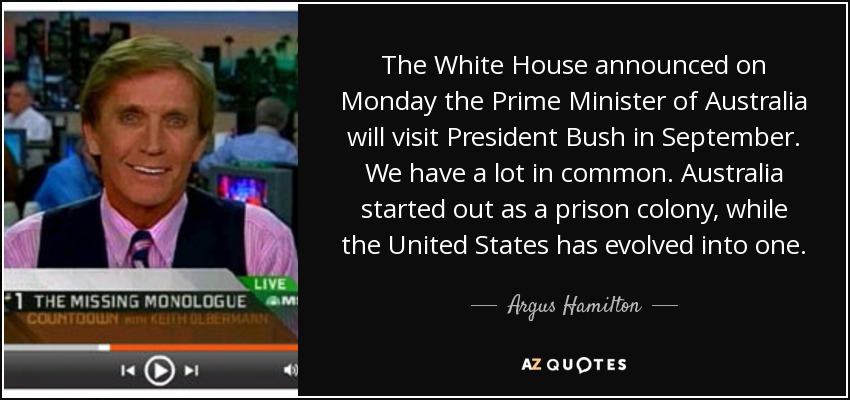
The White House announced on Monday the Prime Minister of Australia will visit President Bush in September. We have a lot in common. Australia started out as a prison colony, while the United States has evolved into one.
A colony, yet a nation - words never before in the history of the world associated together.
The residence of the Plymouth settlers in the Netherlands, and the later conquest of the Dutch colonies, had brought the Americans into contact with the singularly wise and free institutions of the Dutch.
I've been gratified to see over the twenty or so years of my writing life the West become less of a colony of the East; maybe new technologies and too much travel undermine the idea of provinciality.
I'm always looking for context in which people tell stories. In "Fight Club" it's these support groups for dying people, and then in "Choke" it's 12-step recovery groups. In one novel it's artists' colonies, in another novel it's a diary form that submariners' wives typically keep so that when their husband comes back from serving on a submarine they have an accounting of their spouse's time. So I'm always looking for, number one, a non-fiction context - because you can tell a more outrageous story if you use a non-fiction form.
If what makes you happy is going out and living it up and spending all your money on wine, women, and song, the world doesn't need that. But on the other hand, if you give your life to good works - you go and work in a leper colony and it doesn't make you happy - the chances are you're not doing it very well.
Cuba was neo-colony of the United States and still suffers a blockade. So, therefore, the consumer goods and so forth, we don't have here, especially when you leave the city areas it's a spartan life. But what is impressive about it is what is coming about. It's the future that all these socialists look forward to.
I'd been influenced by reading books on art and colonies that existed in Paris and places like that and so when I came to Europe I came to France and I had very little money, and I had to live low and stayed in a bohemian section of Paris with a lot of other students, who were from medical school, science school and art school. We all lived in a kind of communal way and I was challenged politically, because I didn't have a clue and they would ask me questions about the Algerian War, which was very big in France in the late '50s.
We were German-Americans in a British colony, so we were outsiders.
Australia is this former British colony at the foot of Asia. We've been involved - we've been in lockstep with America in every battle you have fought for a century. We were there in Vietnam. We were there in Korea. We were there in Iraq. We were there in Afghanistan. We are slightly apprehensive about the rise of China.
When this country here was first being founded, there were 13 colonies. The whites were colonized. They were fed up with this taxation without representation. So some of them stood up and said, liberty or death.
[Albert] Camus' was born in Algeria of French nationality, and was assimilated into the French colony, although the French colonists rejected him absolutely because of his poverty.
I spent a lot of time studying our Founders and people like Samuel Adams and the original Tea Party. What Adams and the Sons of Liberty did in Boston was spread the word about the abuses of the British. They had Committees of Correspondence that got the word out to the colonies. We need Committees of Correspondence now, and we are getting them.
That is what is happening with the Tea Parties. I wrote a column called "The Second American Revolution" about the fact that people are acting for themselves as it happened with the Sons of Liberty which spread throughout the colonies. That was a very important awakening in this country.
The Anglo-Saxon world saw India as an underdeveloped country. The land of snake charmers, the cows on the street, that "ex-colony-backward-nation" kind of viewpoint, very condescending. Europe on the other hand, saw India in a more romantic, mystical, spiritual way, as a place that's a fountain of wisdom.
Haiti was a French colony, but in 1804, the slaves rose up and defeated the French and formed the Republic. For the last 200 years, Haiti has had a very unfortunate history.
As far as actually setting up colonies of people who would live their whole lives in space, I think we're a long ways from doing that yet, and I think we have many, many decades before we could be able to even consider something like that.
You know, by 1936, Hitler was already talking very loudly about his desire to expand to the east. Mussolini, in 1935, went and then in the next year, conquered Ethiopia, acquiring himself a colony. So people at the time really saw fascism not just as an evil but as an aggressive evil that seemed to be spreading.
You must not deprive the colonies of their right to make laws for themselves. Parliament should only make laws necessary for the empire as a whole.
The epithets of parent and child have been long applied to Great Britain and her colonies, [but] we rarely see anything from your side of the water except the authoritative style of a master to a school-boy.
We want to build colonies on the Moon, Mars, the Moons of other planets, and even nearby asteroids. We want to make space tourism and commerce routine.
If the new Universal History were also read, it would give a connected idea of human affairs, so far as it goes, which should be followed by the best modern histories, particularly of our mother country; then of these colonies; which should be accompanied with observations on their rise, increase, use to Great Britain, encouragements and discouragements, the means to make them flourish, and secure their liberties.
If we could get out of this jam by giving up Malta and Gibraltar and some African colonies I would jump at it. But the only safe way is to convince Hitler that he cannot beat us.
In the field of snobbery, Australia is an underdeveloped country; even a few British ex-colonies, regarded as under developed in all other respects, could export a great deal of snobbery to Australia and still have enough to spare for their own, internal needs.
It is in the nature of imperialism that citizens of the imperial power are always among the last to know-or care-about circumstances in the colonies.
Follow AzQuotes on Facebook, Twitter and Google+. Every day we present the best quotes! Improve yourself, find your inspiration, share with friends
or simply: