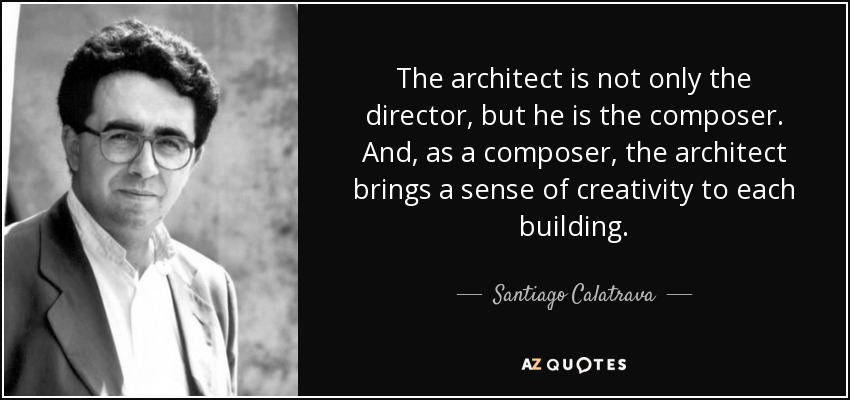
The architect is not only the director, but he is the composer. And, as a composer, the architect brings a sense of creativity to each building.
A film just doesn't involve actors, a director and a producer, there is also the cameraman, the sound engineer, the music composer, the lyric writer. So many people come together to make a film. When we all feel satisfied with the film that we have created it's a win for all of us.
I had a really nice association with Richie DeRosa, a great musician, a great drummer and composer and arranger. And I had a number of classes with him.
[Phil wood] put on some [Igor] Stravinsky and say to follow the score, tell me to play me the opening to the Rite of Spring. Or, "I'm going to play you some 20th century obscure classical composer you don't know". Or, "Let's listen to some Charles Ives, let's sight read some Bartok violin duets", etc.
Alan [Ferber] is a great trombonist and composer. I'm thankful that I got some associations like that through peers and former students. That's kind of what it is.
[We need] someone like Don Sickler, who is an amazing trumpet player and who is also a publisher and amazing producer and composer and arranger. There's a lot of ways you can make a contribution.
No composer has yet caught this rhythm of America - it is too mighty for the ears of most.
I was composing before I realised I was a composer. It came more or less naturally. There were a couple of old ladies lived next door to me, and I frequented their house more than I did my own, because it had all those marvellous things in that that old ladies do have. And they had a piano, and I used to play around with that; they showed me how to read music and I used to play to them.
I was composing before I realised I was a composer. I mean it came more or less naturally.
Notes are part of life for any composer for hire. There's no way around it. I think anyone who has done even a small number of films as a professional composer gets used to that idea pretty quickly.
Sometimes the personality or just the particular process of a director can really affect your quality of life as a composer in terms of how much time you spend away from your family or the amount of time you spend doing the type of work that you maybe don't consider as fun to do as other type of work.
You know creators, composers, need a palette for life, a color for life.
Every time I see a film or TV show, I think about how that composer made those choices and how that director envisioned music and how that could work onstage or in a film and how you could support that even further by putting lyrics to it.
I think, when you're a young composer, you're told constantly that what you're supposed to do is figure out what your voice is. "What is your thing supposed to sound like?" You know: "What's the thing you do," that everyone can recognizably tell from a long distance is you and then you're supposed to be in search of that marker and you're supposed to find it and you're supposed to live there for the rest of your life. And it seemed to me, from a young age, that was what I was encouraged to do. You find a sound and that's your sound! That's what you do.
One important thing, just being a film composer in general, is to have a great respect for the art that you're working on - a great respect for the film and a great respect for the filmmakers.
The reality is each new day and each project is another opportunity to learn, experiment and try something I haven't done before. I've found that's what keeps me motivated and moving forward - learning new things and challenging myself on a daily basis to improve as a composer, recording engineer, percussionist, guitarist, producer...the list goes on and on!
I'd love to do a musical actually. My background is in music. I have a bachelors in music. I thought that I was going to be a composer, long ago when I first started. So it was amazingly fun to do those two routines in the film.
I've always been fascinated by music and sounds. I was lucky to receive proper classical training as an orchestra player and I'm always learning as a composer, looking to create new flavors and colors.
I'm a geek and I'm a nerd, and I can listen into any piece of music. I think, I can usually tell you what orchestra it was, I can usually tell you what hall it was in. I can tell you, obviously who the conductor was, and who the composer was.
The main thing the composer needs to do is it needs to remember that the director is there to cheer you on. The director wants you to succeed because if you succeed, you'll be helping the film. And they are truly your conscience. And they're truly your guide.
Be persistent. Establishing yourself in this field could easily take years. Rarely will any composer get that one "big break." More often, success is built on hundreds - or thousands - of very small breaks. When I decided that I was definitely going to pursue a career as a film composer, I decided I was going to beat my head against that particular wall until something broke.
Before writing a single note of music, and even before the spotting session, I find it best to sit down with the director and just listen to him or her talk about the film - what they're trying to say, what they want the audience to understand or believe, and a thousand other similar questions. The director has most likely been living with the film for years before a composer is attached, and so the director's inclinations, desires, and understanding of the film are paramount.
I've been a full-time composer for many years, and I'm still learning all the time. There is always more than one musical "solution" to each movie scene, but my goal is to compose music that works perfectly for the director, and me!
For me, listening to Beethoven and Tchaikovsky in particular, there's an emotional aspect - very different kinds of emotional aspects from those two composers, nonetheless, very strong emotional aspects from both of those composers.
I don't like to do things the same way every time. You always want to be evolving as a composer, and if your creative process is exactly the same each time, then how do you expect today's work to be any different from yesterday's?
Follow AzQuotes on Facebook, Twitter and Google+. Every day we present the best quotes! Improve yourself, find your inspiration, share with friends
or simply: