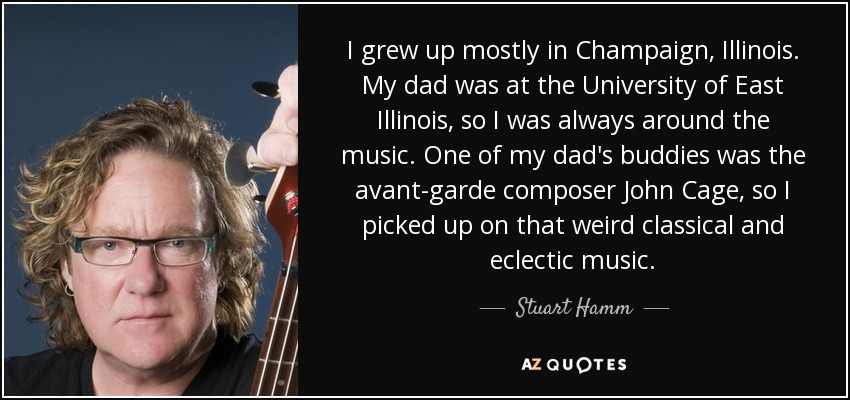
I grew up mostly in Champaign, Illinois. My dad was at the University of East Illinois, so I was always around the music. One of my dad's buddies was the avant-garde composer John Cage, so I picked up on that weird classical and eclectic music.
The use of electronics is a natural extension of the instrument - it is an electric guitar. So we guitarists have been plugging into something since 1931, and we are not about to stop now. Current advances in technology means we can have a huge array of sounds at our fingertips, and this offers amazing possibilities to the contemporary composer. It is always a guitar (I don't play synthesizer) but it becomes something else all together - more like sculpting sound in real time using metal wires, 5 fingers and a pick.
Elizabeth Lutyens was the first professional composer that I ever knew. I sent someextremely infantile pieces that I I'd written and got marvellous encouragement andinterest from her... she's certainly the English composer who's influenced me themost.
I am proud to be able to claim that, from the age of nineteen, I've managed to earna living entirely as a composer.
I knew I could never be accepted as a straight-ahead jazz musician, nor would Iaccept myself as that. I would never be accepted as a minimalist. I wouldn't be adowntown composer. Because I find all orthodoxies, all doctrines to be ultimatelybanal.
It is hard to think of another composer who so perfectly marries form and passion.
I believe that interpretation should be like a transparent glass, a window for the composer's music.
As a composer I could never find use for over 4 or 5 notes in any musical number, and as a playwright most of my plays have two acts because i couldn't think of an idea for the third act.
You think about, like, [20th-century classical composers] Alban Berg, Schoenberg, and Webern sitting around in some living room in Vienna and being like, "We are the end of music. We are the end of this tradition. Music is done."
If I weren't a director, I would want to be a film composer.
A good composer is slowly discovered and a bad composer is slowly found out.
Composers and musicians have always starved and, as this is a sentimental country, we think the tradition should be continued.
I don't think they understand it's as important as math and science. It rounds you out as a person. I think it gives you a love of certain things. You don't have to become the next great composer. It's just nice to have heard certain things or to have seen certain things. It's part of being a human being.
I think that if I were required to spend the rest of my life on a desert island, and to listen to or play the music of any one composer during all that time, that composer would almost certainly be Bach. I really can’t think of any other music which is so all-encompassing, which moves me so deeply and so consistently, and which, to use a rather imprecise word, is valuable beyond all of its skill and brilliance for something more meaningful than that — its humanity.
When we play music we describe the echo the tableau of natural forms, their shapes and arrangements, as uncovered by the composer's imagination, which yet must be filtered through our own. There is no other way. And in acknowledging this tableau, this revelation, we must "hesitate", we must doubt, as the composer doubted, for no valid creation can issue unscarred by doubt, by that vast flux of wonder which precedes the construction of being.
What's great about [Guettel] is his very distinct voice as a composer. And that distinct voice is something worth cherishing and expressing so we just didn't want to screw that up.
I don't understand why we have to experiment with film. I think everything should be done on paper. A musician has to do it, a composer. He puts a lot of dots down and beautiful music comes out. And I think that students should be taught to visualize. That's the one thing missing in all this. The one thing that the student has got to do is to learn that there is a rectangle up there - a white rectangle in a theater - and it has to be filled.
It's nice that all the composers have said that nobody interprets a lyric like Fred Astaire. But when it comes to selling records I was never worth anything particularly except as a collector's item.
My entire education in music was in reading interviews with bands like Stereolab and finding out about Brazilian music or a Romanian composer. You expose yourself to what people you look up to admire.
Working with composers often is a really frustrating experience because you speak a different language and, oftentimes, they take two or three jobs, at the same time. They're difficult and pretentious and they're tormented artists.
I went to Hollywood. I put the action in Hollywood. I watched a lot of movies, maybe 100 or something close to that. I have tons of DVDs now at home. I don't know what to do with them because they're not useful anymore. My kids never watched them. I read a lot of autobiographies, listened to a lot of music by classical era composers like Franz Waxman, Max Steiner, Bernard Herrmann, Alfred Newman and Leonard Bernstein. I listened to only that kind of music the entire time I was writing, even at home.
...in my lieder concerts, I always strove, when possible, to sing only the works of a single composer, so that the audience could be gradually drawn into a particular creative genius' way of thinking, and could follow him.
My closest friends are Roger Moore, who is an actor, Sean Connery, who is an actor, Terry O'Neill, who is a photographer, Johnny Gold, who was the boss of Tramp, and Leslie Bricusse, who is a composer.
I don't meet stockbrokers or carpenters or coal miners; I spend all day with actors, composers and photographers.
Originally, I wanted to be a composer. I always tell people, 'I think of myself as a composer.
Follow AzQuotes on Facebook, Twitter and Google+. Every day we present the best quotes! Improve yourself, find your inspiration, share with friends
or simply: